|
| Clear picture: Students use their gap year to introspect on their future |
While her friends are spending sleepless nights mulling over future career plans, 20-year-old Ishanee Sarkar is taking a year off to do things that interest her. Unlike her classmates who are busy working or studying, Ishanee plans on enjoying a year off before studying further.
This literature graduate from St Stephen’s College, Delhi, is busy writing, editing and clicking photographs. “This is the only year I can afford to do things my way. I feel the time spent doing and exploring things I like to do will give me an opportunity to decide what I want to do eventually,” Sarkar says. Later this year, she also plans to go for a vacation to offbeat locations with her friends.
Though the concept of a year off after school or college is quite popular in the West, it has never caught on in India. But the times are changing. Like Ishanee, a small section of Indian students is taking a break after school or college to reflect on their future goals. The time is spent volunteering for non-governmental organisations or just backpacking.
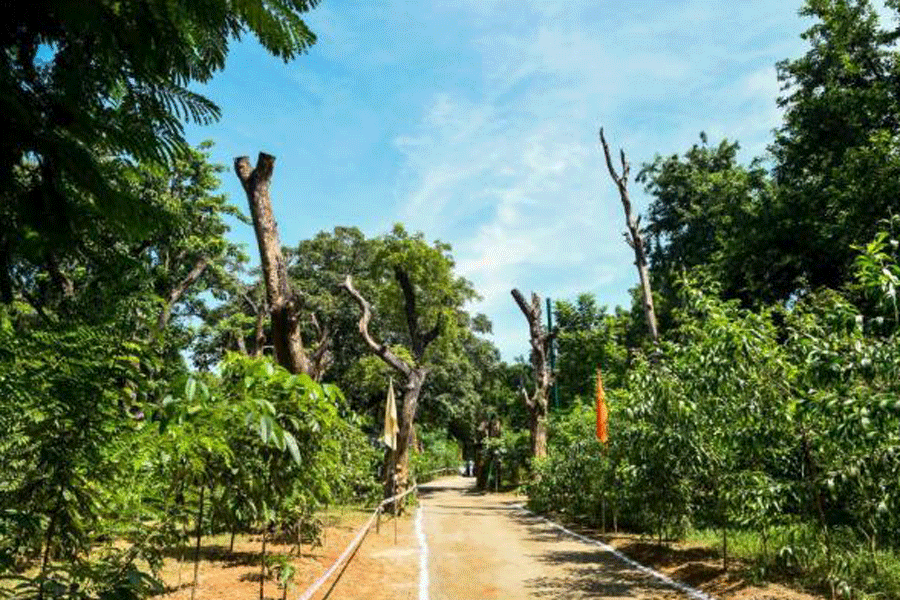
Though there are no documented figures on the number of students taking time off from studies, their numbers have been increasing steadily over the last couple of years. For proof, look no further than India’s first gap year college (GYC) in Mussourie, Uttaranchal. The nine-month programme takes young individuals of 18 years or above on a process of learning and exploration. Located in the picturesque hills of Kempty in Mussourie, the college commenced classes in July 2007 with a batch of 10 students. As part of the gap year college, which is conducted by the Society for the Integrated Development of the Himalayas (SIDH), students will learn creative design, architecture, wood art, sketching, theatre, publishing, environment and ecology, water harvesting, forest restoration and yoga.
“Even 10 years back, a gap year college would have been unthinkable. It would have been considered a waste of time. But now students and parents are willing to explore other avenues,” says Vinish Gupta, a resident faculty member, GYC. Agrees Namrata Majumdar, who is currently on a break after graduating from Lady Shri Ram College, Delhi, in 2006, “It is no longer a sin to take time off. My parents have been very supportive of my decision.”
An aspiring film-maker, Majumdar spent the last year working as an assistant director and also shot a few independent short films and documentaries. She also got time to indulge in one of her pet passions — travelling. She explored Goa all alone and also trekked to remote places like Kheerganga and Malana in Himachal Pradesh.
Unfortunately, most students in India mindlessly get into jobs and courses without thinking about their interests and aptitude. So, students who have defied convention to take time out are a positive sign of our times. “My gap year has been a great experience. I was able to look at life objectively, be in touch with myself and introspect on what I wanted to do in life. In fact, the last year has been very productive. It has taught me to be patient, has honed my communication skills and helped me to grow creatively,” Majumdar adds.
A year off is also the time to unwind. Most students use this time to travel, spend time with family and friends and catch up on movies. “Two years of MBA had bogged me down. So after my course, I wanted to just chill out,” says Divya Khanijo, who graduated in fashion retail management from the Pearl Academy of Fashion (PAF), Delhi, in 2006. For a few months, Divya just lazed at home, saw all the latest blockbusters in town, met friends and also went to California for a month. Some students, of course, use this time to gain work experience in the sector that they are interested in.
So taking a detour from the conventional track for a year could be your ticket to a better career. |