|
|
Nirendranath Chakrabarty and Aparna Choudhuri at the launch of her book in a city bookstore. Picture by Bishwarup DuttaActors Jisshu Sengupta and Nilanjanaa at their wedding. A Telegraph picture |
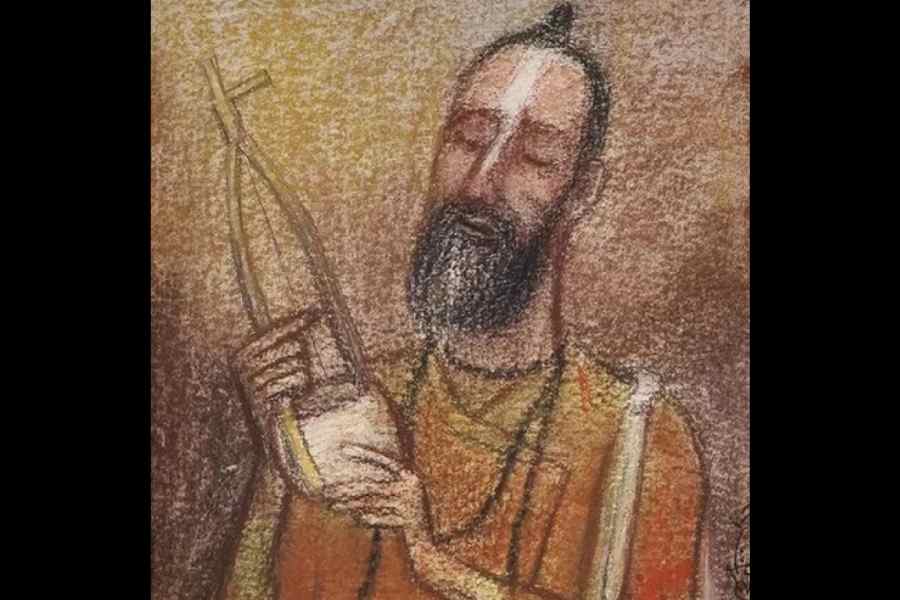
Tagore wrote Shey (He) for his granddaughter Pupe. It is a world of delightful and bizarre adventures where the poet and the protagonist, shey, weave a web of stories for the nine-year-old Pupe.
Enter a 10-year-old translator, who wants to participate in this story-telling. The result after six years is He, a translation published by Penguin in its Modern Classics series.
Translator Aparna Choudhuri, all of 16 today, is the daughter of Sukanta and Supriya Choudhuri, well-known translators of Tagore and leading academics.
It is only natural that Aparna has to defend her work from any interference, correction or revision from her parents. “My parents definitely read my translation, but they never criticised it objectively for they didn’t want to spoil my pleasure in doing the translation,” says Aparna, who began translating Shey during one of those long lazy summer afternoons during a holiday.
She plans to continue to translate Bengali texts, but admits that she has begun with a “rather difficult text”. “It is precisely because it is difficult, because it is such a riddle, that I wanted to translate it. The things that attracted me to Shey as a reader also prompted me to translate it,” says Aparna.
Her work has a longish introduction by Sankha Ghosh, who contextualises the book and the translation, preparing the reader for the text. The translation has won accolades. At the launch of the book at Oxford Bookstore on Monday, poet Nirendranath Chakrabarty said: “The translation is as good as the original. It has kept the style of Tagore’s writing absolutely intact.”
Commending the translator for having achieved this at such a tender age, he, however, cautioned her: “Don’t be a Max Beerbohm, who published his complete works when he was only 24.”
Beerbohm, English wit, parodist and illustrator, had published The Works of Max Beerbohm in 1896.
Wedding music
|
|
Actors Jisshu Sengupta and Nilanjanaa at their wedding. A Telegraph picture |
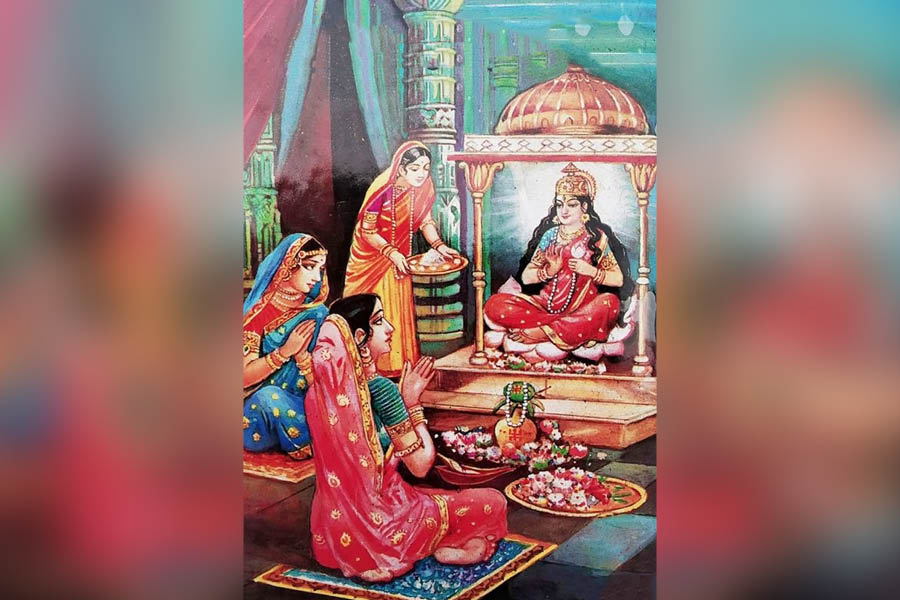
The occasional sangeet and the lehenga choli were the first indications. Now the Bangali biye is poised to become fully filmi. You can play songs at every step of the rather long ceremony.
The music company Gathani is marketing cassettes and CDs of an album called Bangalir Shubhobibaher Gaan (Songs for a Bengali Wedding). Sung by an Amitava Ghosh, the list of songs starts at patra pachhanda (selection of the groom) goes via kone shajano to phool shojya, but covers everything in between: patipatra or paka dekha (the day the marriage is finalised), pranayakankha (desire, but when was it acknowledged as a part of a Bengali wedding?), aibudabhat (the last meal of a bride or groom as a singleton), dadhimangal, nandimukh, gaye halud (when the bride is smeared with turmeric before the wedding), snan parba (the bathing ceremony), bor boron (welcoming the groom), bibaha achaar, basar raat, koner ukti, basi biye, kanya biday, bou boron, phool shojya, madhuchandrima (honeymoon). Well, it should be a most imaginative task fitting fitting words to all these rituals.
But does a Bengali wedding observe these many rituals now? Maybe the album — and Bollywood — will help revive Bengali tradition!
Rubbish
A question to the manufacturers: Why is a brand of packaged snacks, a la Haldiram, called Habijabi? Do they really believe that consumers like rubbish?
(Contributed by Anasuya Basu and Malini Banerjee) |