|
A couple of months ago, one could
not open a newspaper or magazine without coming across some
reference to the raging inflation. The Central government
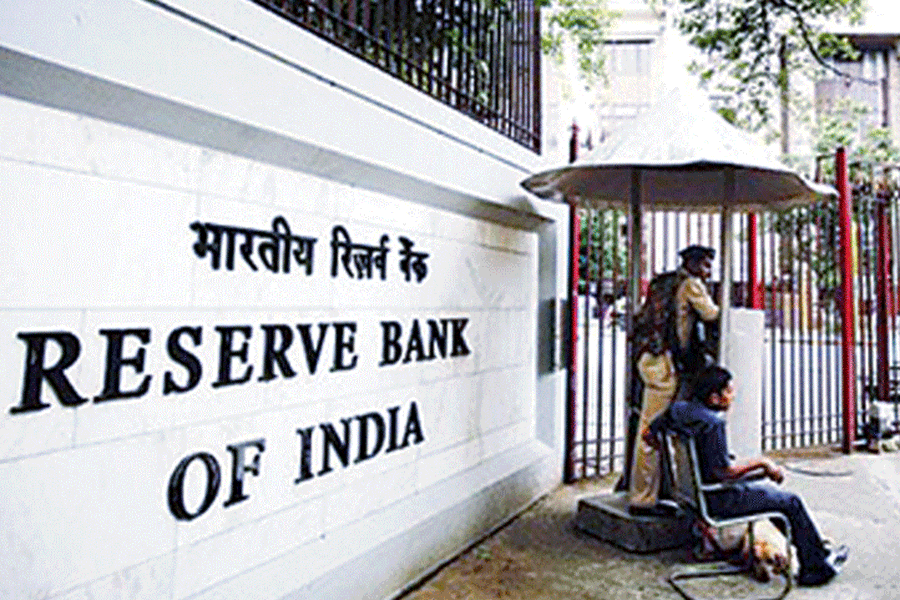
and the Reserve Bank of India tried to control the price
rise with a variety of policy instruments, including some,
which were potentially inimical to growth. However, the
rate of inflation continued to persist above 6 per cent.
Fortunately, seasonal factors came to the rescue in the
form of an increased supply of agricultural commodities.
Prices of several food items fell and helped to bring down
the rate of inflation to more tolerable levels. This brought
much-needed relief to the finance ministry and the RBI bigwigs.
Unfortunately, the relief has
been short-lived. The steady appreciation in the external
value of the rupee is now threatening to cause sleepless
nights to the same set of officials as well as to exporters.
The rupee has been rising against all the major currencies
— the dollar, pound sterling and the euro. The global weakness
of the dollar has meant that the appreciation of the rupee
against the dollar has been particularly alarming with the
rupee recording an 8 per cent appreciation vis-à-vis
the dollar.
Indian exporters earn their revenues
in foreign exchange. And unless an industry is highly import-intensive,
the bulk of its costs are incurred in rupees. So, every
increase in the external value of the rupee means a corresponding
drop in their net revenues. The sharp setback to the export
industry comes just when the industry was being talked about
as one of the leading engines of growth for the overall
Indian economy. Not surprisingly, both the finance and commerce
ministers have been talking about the need for remedial
measures to restore profitability of the export sector.
The government has two broad sets
of options available. It, or more correctly the RBI, can
refrain from intervention in the foreign exchange market,
but use “micro” policies specifically directed to boost
profitability of the export industries. Alternatively, it
can take the “macro” route — namely, tackle the problem
at its source by reversing or at least controlling the appreciation
of the rupee through intervention in the foreign exchange
market. Of course, it can avoid either extreme by adopting
a mix of the two sets of policies.
The micro route has its attractions.
A mix of duty drawbacks and export subsidies in some form
or the other will counteract the fall in net revenues due
to the rupee appreciation. At the same time, the appreciating
rupee reduces the price of imported goods and so has a beneficial
impact on the level of prices. However, as economists are
fond of pointing out, “there is no free lunch”. Of course,
the government has to finance the duty drawbacks and export
subsidies, and this acts as a direct cost.
There is also a more subtle indirect
cost. The duty drawbacks and subsidies distort relative
prices — firms may be tempted to enter the export sector
simply in order to take advantage of the package of incentives
even if their comparative advantage lies elsewhere. This
tendency can have deleterious effects on the overall efficiency
of the economy. That is why it is important to ensure that
such schemes are only of short duration.
What about macroeconomic policies?
At the risk of gross oversimplification, the scope for appropriate
macroeconomic policies in this context is heavily influenced
by the relative priority that the government gives to three
related objectives. There is first the need to ensure some
degree of price stability. The second objective is to maintain
conditions in the domestic economy that are conducive to
growth. Finally, there is also the need to maintain stable
exchange rates. Macroeconomic policy-making would be considerably
simpler if these three objectives were mutually compatible.
Unfortunately, they are not — at least, not always.
The proximate cause for the appreciating
rupee is the steep and continuing rise in the inflow of
foreign exchange into the country. Until recently, the performance
of Indian exporters was exemplary, with the rate of growth
touching almost 30 per cent. Indeed, the economy actually
achieved a current account surplus — a rare event for the
Indian economy. This was complemented by large inflows of
foreign exchange for investment in the stock market.
Despite several attempts by the
government to encourage the outflow of foreign exchange,
there has been a large and steadily increasing net inflow
of foreign exchange. This translates into an excess demand
for rupees. Like any other good or service, the excess demand
for rupees results in an increase in the price of the rupee.
Of course, monetary authorities
need not be silent spectators — the RBI can and often does
intervene in the foreign-exchange market. It can reduce
the excess demand for rupees by buying up foreign exchange.
The cost of RBI intervention is an increase in domestic
money supply. If the scale of intervention is large, then
this could mean a significant increase in liquidity. Unless
the RBI takes any further steps, the excess liquidity can
result in a substantial increase in inflationary pressures.
That is why the Central bank typically
adopts simultaneous steps to reduce money supply. It can
try to put a lid on inflationary pressures by following
tight money policies. For instance, the RBI can sell government
securities in its portfolio in the domestic market. The
RBI can withdraw the proceeds obtained from such sales from
circulation, so as to contract the supply of money in the
economy. However, there are limits to the volume of government
securities that the public is willing to buy. Also, tight
money policies, if pursued too vigorously, may constrain
credit expansion so much that industry can be starved of
funds. Thus, the Central bank and the government are faced
with a trade-off between growth and inflation.
The RBI has also been incurring
a loss whenever it undertakes these open-market operations.
This is because the interest cost of the securities that
it sells to the public far exceeds the returns that it gets
on the foreign exchange deposits held by it. But perhaps
the RBI has been too conservative and risk-averse in its
investment decisions. It goes in for absolutely safe investments
that promise very low rates of return.
The Chinese government has accumulated
huge stocks of foreign exchange because its economy has
been running up very large surpluses in its current account
over several years. Newspapers report that the Chinese have
struck a deal with a big US financial house, which will
buy foreign assets on behalf of the Chinese government.
China has adopted this strategy in order to increase earnings
on its foreign-exchange deposits. Perhaps, the RBI can follow
the same strategy.
What weights should the RBI attach
to the different priorities? The current relatively low
rate of inflation has given it a degree of freedom that
it did not have even a few weeks ago. Perhaps, the time
is appropriate for the RBI to intervene in the foreign-exchange
market, but not attempt to control the increase in domestic
liquidity completely. This may help exporters and promote
growth, but possibly at the cost of a slight increase in
inflation.
|