|
|
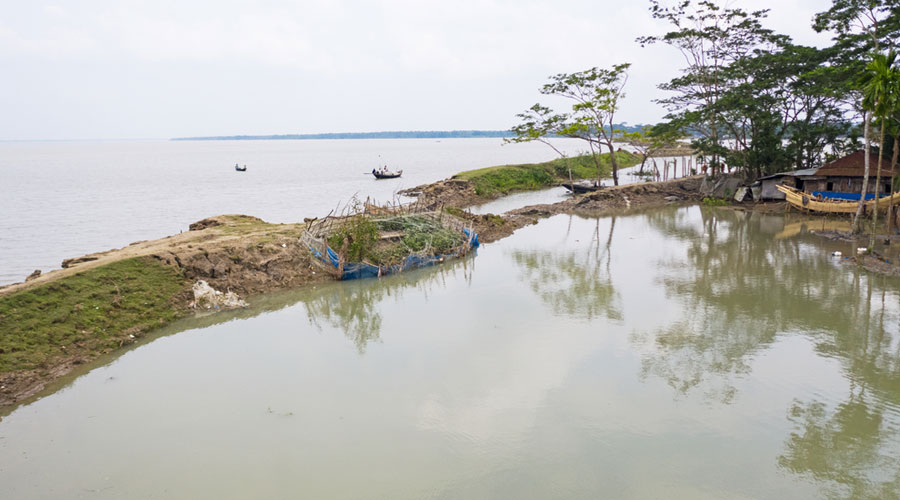
| A tsunami survivor
on Marina Beach, Chennai, December, 2006 |
Global warming is no longer merely
a future prospect. The latest reports of the Inter-governmental
Panel on Climate Change show that we are already witnessing
climate change caused by the burning of fossil fuels. Ironically,
those least responsible for causing climate change will
be its worst victims.
Human activities have generated
carbon dioxide and other greenhouse gases since the dawn
of history. But it is only in the Industrial Age, with the
ever-expanding consumption of hydrocarbon fuels and the
resultant increase in carbon dioxide emissions, that greenhouse
gas concentrations have reached levels causing climate change.
All inhabitants of our planet have an equal right to the
atmosphere, but the industrialized countries have greatly
exceeded their fair, per-capita share of the planet’s atmospheric
resources and have induced climate change. If all countries
had the same per-capita emissions as India, for example,
humanity would not have faced a climate-change problem.
Unfortunately, it is the world’s
poor who will be the main victims of climate change. In
most developing countries, a large proportion of the population
is engaged in traditional farming, an occupation that is
particularly vulnerable to the changes in temperature, rainfall
and extreme weather events associated with climate change.
By contrast, in most developed countries, a large majority
of the population is engaged in the industrial or services
sectors, which are less directly dependent on climate stability.
Moreover, developed countries
possess the capital, technological and human resources required
for successful adaptation. They will be able to construct
embankments to protect coastal areas against sea-level rise
and to build dwellings that will not be blown away in a
hurricane. Farmers in these countries will be able to switch
over to new seeds or plant varieties, new agricultural practices,
new crops or even new occupations. They will not lack the
financial or knowledge resources needed for investing in,
say, patented seeds or drip irrigation and other water conservation
measures.
Developing countries will find
it much more difficult to adapt to climate change because
they lack the requisite resources in terms of capital, technology
and knowledge-based skills. It follows that, for low-income
countries, the key to a successful response to climate change
is accelerated development. Unless they achieve rapid development,
these countries will remain woefully lacking in the financial,
technological and human resources required for adapting
to climate change in coming decades. Accelerated development
is essential to ensure that future generations in these
countries are able to cope successfully with global warming.
Adapting to climate change can
only be a partial solution. The international community
must address the problem of mitigating, or limiting, global
warming. What role should developing countries play in the
international response to mitigate climate change? What
is a fair or equitable distribution of responsibilities
between industrialized and developing countries in the international
response to climate change?
Since the industrialized countries
are responsible for causing climate change, equity requires
that they should sharply reduce their emissions in order
to arrest further climate change and allow other countries
access to their fair share of atmospheric resources in order
to develop. Moreover, the industrialized countries also
possess the financial and technological resources required
for an adequate international response to climate change.
The role of the industrialized countries should reflect
their responsibility for causing climate change and their
greater capability for effectively addressing the challenge.
Thus, the UN Framework Convention
on Climate Change and the Kyoto Protocol require industrialized
countries to reduce their greenhouse gas emissions. These
countries, with the exception of the former Soviet bloc
“economies in transition” are also required to transfer
financial resources and technology to developing countries
for mitigation and adaptation purposes.
This does not mean that the developing
countries have no commitments at all. All countries, including
developing countries, have accepted a common commitment
to implement measures to mitigate climate change. However,
developing countries are not expected to divert scarce financial
resources from their development priorities. They are only
expected to implement measures involving no additional costs,
where reduction of greenhouse gas emissions is a co-benefit
or by-product of measures primarily intended to promote
development priorities such as energy efficiency, energy
security or local environmental concerns relating to water
or air pollution. Projects involving additional costs are
required to be taken up only if the industrialized countries
meet these costs.
This is explicitly spelt out in
the Framework Convention in words that deserve to be quoted:
“The extent to which developing country Parties will effectively
implement their commitments under the Convention will depend
on the effective implementation by developed country Parties
of their commitments under the Convention related to financial
resources and transfer of technology, and will fully take
into account that economic and social development and poverty
eradication are the first and overriding priority of the
developing country Parties.”
The industrialized countries are
now pressing for a revision of this basic compact. Skirting
around the question of equity and responsibility, they are
calling upon developing countries to strike some sort of
a balance between development and reduction of greenhouse
gas emissions. The argument runs that industrialized countries
will not be able, on their own, to effect reductions in
emissions on the scale required to restrict climate change
to acceptable limits and it is, therefore, necessary for
developing countries to curb their rising greenhouse gas
emissions, even if this entails some diversion of scarce
resources from their development priorities. This obviously
has profound implications for development, poverty eradication,
environmental protection and the future welfare of a majority
of the world’s population.
T he argument advanced by the
industrialized countries is misleading because no one questions
the need to moderate emissions originating in the developing
countries to the extent this is feasible. The real question
is, “Who pays for it?” The Framework Convention lays down
that all incremental costs are to be met by the industrialized
countries. These countries are now trying to change the
compact by shifting at least a part of the burden to the
developing countries by imposing mandatory obligations on
the latter.
The proposal is not only inequitable
but also deeply flawed as a response to climate change.
By slowing down economic and social development, it would
deal a severe blow at the efforts of poorer countries to
build up their medium- and long-term adaptive capacity.
Moreover, it would distort the proper environmental priorities
of developing countries. In most of these countries, water
and air pollution and the lack of proper sanitation pose
an environmental challenge that is just as serious as climate
change — and much more immediate. While the dire threats
of global climate change will appear in coming decades,
these local environmental problems are even today taking
a heavy toll in human lives and misery. Not surprisingly,
they are accorded correspondingly high priority in the development
plans of poorer countries. Diversion of scarce resources
to the reduction of greenhouse gas emissions would distort
the environmental priorities appropriate to poorer countries.
It must be recognized that affluent and poorer countries
have different environmental priorities.
Low-income countries should firmly
reject any proposal that requires diversion of scarce resources
from their economic, social and local environmental priorities.
Their development goals must not be sacrificed. Only rapid
development can enable them to adapt to climate change with
any degree of success. |