TT Epaper LHS
The Telegraph
TT Mobile
 
 
IN TODAY'S PAPER
WEEKLY FEATURES
CITY NEWSLINES
FEEDS
  RSS
  My Yahoo!
SEARCH
 
Archives Web
 
ARCHIVES
Since 1st March, 1999
 
THE TELEGRAPH
 
CIMA Gallary
 
Email This Page
TIME PAST AND PRESENT

Gallery Kolkata’s first exhibition, Modern to Contemporary, which concluded on May 27, included works by some of the major names in Indian art.

As the title suggests, the range of this show was not only ambitious but also somewhat audacious. Evidently, construing ‘modern’ and ‘contemporary’ as stylistic categories is in itself a daring theoretical leap, especially when some of the ‘modern’ painters are still alive and productive. To keep the ‘senior’ artists — Paritosh Sen and K.G. Subramanyan, for instance — confined to one stylistic category might suggest, misleadingly, that their works have not evolved over time.

The younger artists cannot be placed in an exclusive temporal frame either. Some of them appropriate the modernist and high-modernist styles instead of departing radically from earlier traditions. Arghapriya Majumdar’s Drowned in a Seductive Shell, reminiscent of early Francis Bacon, and Usmita Sahu’s untitled acrylic, both hark back to the European modernism of the Fifties. Some of the younger artists — Pampa Panwar, Sajal Sarkar, George Martin and Mehzabin Majumdar — with their strikingly technicolour canvases allude to the works of Andy Warhol and Roy Lichtenstein.

These overlaps with the earlier traditions significantly inform individual talent, giving rise to the question of originality. Even within different schools of painting and the two temporally-divided stylistic categories on which this exbition is premised, there are works which stand out for their originality.

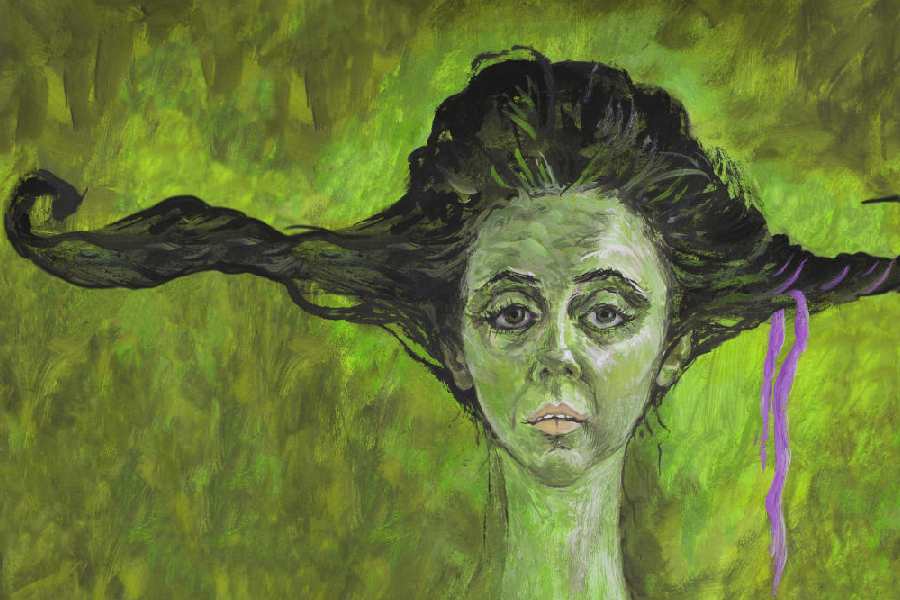
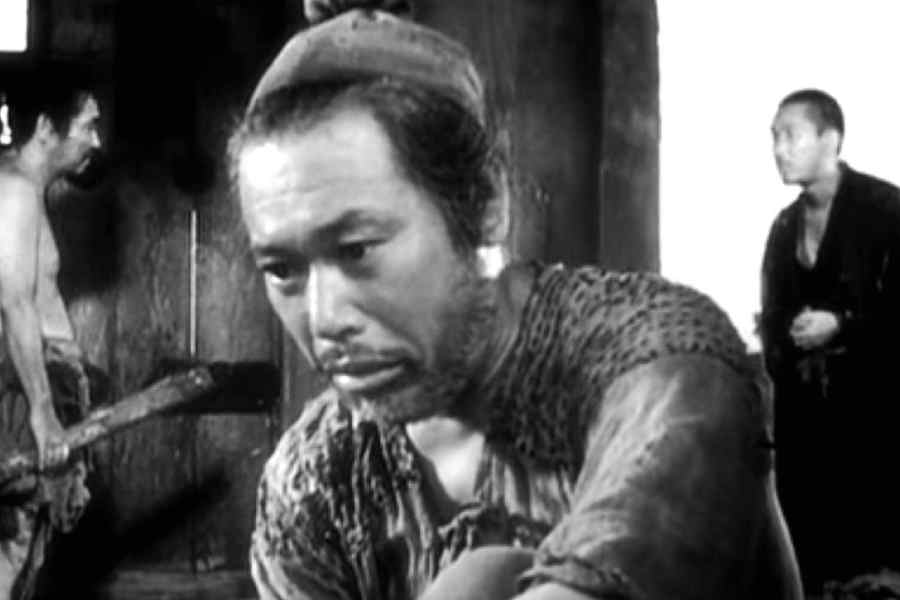
Paritosh Sen’s acrylic on board, coming at the very beginning of the show, depicts the arresting image of a woman combing her hair. It is unmistakably resonant of Picasso’s many portraits of Dora Maar, but Sen reinvents the French Master’s technique by using it on an indigenous figure. K.G. Subramanyan’s haunting sketch of a woman (ink on paper), looking fragile and deformed, is executed with delicate, but confident, brushstrokes. Akbar Padamsee’s Head and Jatin Das’s The Balancing Act are technically excellent, capturing the many delicate lines and angles in human bodies. In Das’s work, the sense of vertigo never leaves the viewer, not only because of the precariously poised figures but also due to the tremulous lines that hold them together. Jogen Chowdhury’s Man Kneeling on the Floor (picture) remains unforgettable for the sense of tranquillity that emanates from it. The seemingly unbroken line that joins together the various aspects of Chowdhury’s fi- gures is perhaps the artist’s very own invention.

Among the ‘contemporaries’, Chandrima Bhattacharya, Bose Krishnamachari and Pratul Dash are memorable, each of them impressive not only technically but also because of their rivetting, mystical visions. However, the close proximity of large canvases, the clutter of too many brilliant artists, too many colours, faces, contours, shapes and vistas proved inimical to a comprehensive viewing of the exhibition. Lastly, a TV blaring in the adjacent room is not exactly conducive to a serious contemplation of art.

Top
Email This Page