The Telegraph
 
 
IN TODAY'S PAPER
WEEKLY FEATURES
CITY NEWSLINES
FEEDS
  RSS
  My Yahoo!
SEARCH
 
Archives Web
 
ARCHIVES
Since 1st March, 1999
 
THE TELEGRAPH
 
 
Email This Page
THE POETRY OF EARTH IS NEVER DEAD

Arunima Choudhury’s Khela: New works on paper, canvas and enamel (Seagull Arts & Media Resource Centre, until June 12) brings together a remarkable range of styles, processes and creative modes. The pictures, prints and painted enamel tiles and plates in this show have all been done in the last couple of years or so. In each of the five rooms of the gallery, Arunima displays a distinct form of imaginative work. ‘Work’ and its twin, ‘play’, are also the keywords in her writings on art, some of which are printed in the beautifully designed catalogue.

Arunima’s work is compelled by three preoccupations. First, the creation of purely imaginative terrains in the acrylics on canvas: large, vividly coloured, unpeopled landscapes that combine light (burnished sunsets, surreal moonlight) and water (still, spiralling, or falling as rain) with woods and fields interspersed with mysterious flora and fantastical trees. Their cobalt and cerulean blues clear out enchanted spaces — lakes, paths and vistas — in the glimmering darkness. These pictures seek a childlike credulity in the viewer and speak of the artist’s closeness to childhood play and fantasy, through her own early memories and from years of teaching art, craft and music to children.

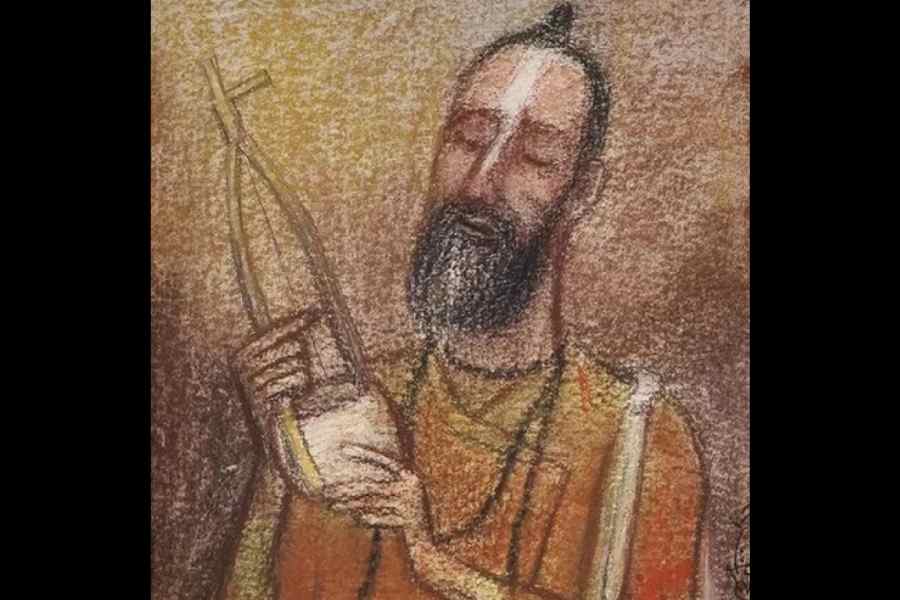
Second, the compulsive pleasures of what she calls “creating new textures”. Arunima makes not only her art, but also most of its raw materials, especially the vegetable colours from trees, plants and flowers in her own garden. (Her daughter calls her a rakkhushi or ogress because of the glee with which Arunima would boil a perfect, red rose in water in order to extract, to her surprise, bright blues and greens instead of the expected red.) For each creative mode, she improvises a distinct process: combining block-printing, scratching and collage for her “printed paperworks” [picture, left] or firing moulded and enamelled iron sheets into painted plates and tiles. Her Urn series on paper, filling up an entire room, places depictions of huge pieces of earthenware — urns, pitchers, amphoras — in the midst of the rich chaos of life. This human and animal life (and death), with all its mischief and randomness, both decorates and surrounds these simple, ancient shapes that could just as fluidly turn into giant, human forms, towering over or crowding out the activity around them. A man with comical eyes lovingly embraces a huge pitcher; a prankster-child lets loose a cockroach on the naked sides of a large and busty amphora-woman. She is encircled, among other things, by little statues of Gandhi and Rabindranath [picture, right].

Finally, the search, at once visual and conceptual, for coherence amidst the variety of expressive forms and processes that Arunima’s art plays with. This coherence is bestowed on her works primarily by a shape — that of the urn or the earthen pitcher, which can become the female or male human form as well as the other pervasive presence in her art, the human face. There are continual variations on these interlinked motifs of vessel, body and face. But an underlying visual unity begins to emerge as the viewer moves from room to room. The urn-as-body mythically combines life and death, the erotic and the grotesque, while the face, echoing the same elongated shape, becomes the vehicle of a whimsical subjectivity that is modern and urban in a very different way. But the earthen vessel ultimately stands for the magic of its maker’s hands, shaping order and form out of natural disorder and formlessness.

Colour becomes another unifying principle in Arunima’s work, especially the vegetable colours and gouache, creating the effect of a visual harmony in spite of the variety. Her colours not only celebrate quietly the process of their own extraction from the natural world, but they also allude to the colour-worlds of the art that has inspired her most: the paintings of Rabindranath, Abanindranath, Nandalal and Binodebehari. These are the colours of the earth, her ubiquitous reds and russets capable of becoming the bloodiness of birth as well as of violence. “The canvas is a battlefield,’’ says one of Arunima’s jottings, “the artist’s work is to keep this battle alive.”

Top
Email This Page