|
|
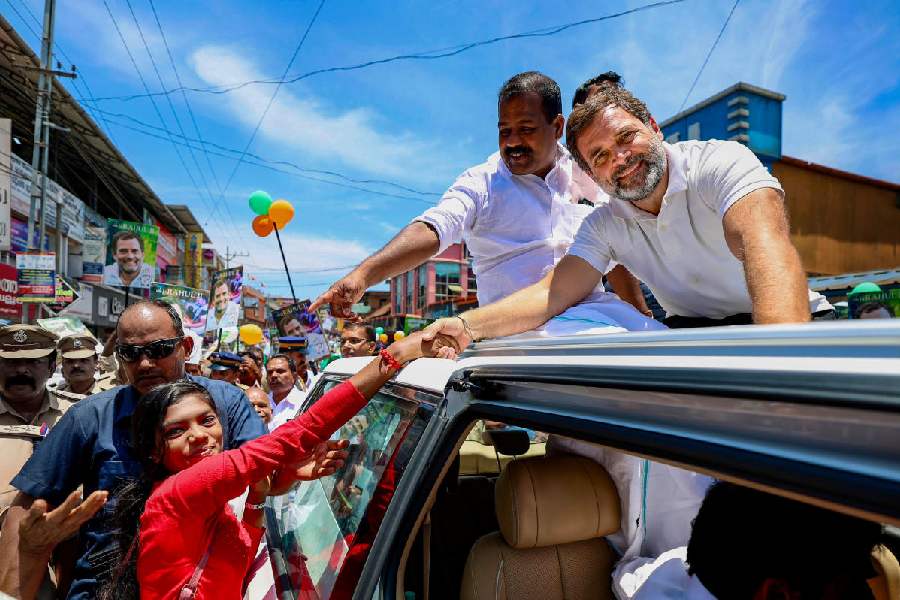
Rahul Gandhi waves to the crowd during a public meeting in Etawah on Tuesday. (PTI)
|
Ghursarai (Jhansi), April 3: Some 36 summers ago, Indira Gandhi had told him to stop bothering about privy purses and start working. Instead, Ranjit Singh Judev has gotten three generations of Nehru-Gandhis working for him — at least during election season.
Braving the searing Uttar Pradesh heat — sizzling at 43 degrees — and clouds of chaff thrown up by wheat threshers, Rahul Gandhi yesterday squeezed out time to catch votes for the reluctant Congress candidate from Gharota, about 100 km from Jhansi.
That was Rahuls way of returning Judevs favour. For, it was after much cajoling from Dynastys rising star and mother Sonia Gandhi that the erstwhile raja of Samtar agreed to jump into the fray.
I had no choice. Madam and Rahul phoned me and said this is a winning seat. We need to pick up as many of such seats as possible and you have to contest. I tried telling them I will give another candidate. But they wouldnt listen, Judev said in his polished, public-school English.
Years ago, in 1989, Rahuls father Rajiv Gandhi had similarly worked to win votes for Judev. And earlier, in 1974, when Judev was fighting his first Assembly election, Indira Gandhi had herself done the honours.
Mrs Gandhi had even put up for the night at Judevs imposing fortress-like Samtar Mahal, a vision in red with sprawling grounds and a moat, and a red-and-white striped flag with a tuft of black hair flying atop.
They are a unique family (the Nehru-Gandhis). People hold them in high regard. In 1971, Indira Gandhi abolished privy purses. It was supposed to hurt us, royalty, but when I met her later, she told me stop bothering about privy purses and start working, Judev reminisced. In a sense, she gave direction to my footloose, fancy-free life.
As for Rajiv Gandhi, vibing with him was never a problem, Judev said, no royal airs whatsoever about his short, fair slightly-built frame.
We have a public school background. This is one reason why I cant vibe with politicians like Mulayam Singh Yadav and Mayavati, the bespectacled 60-year-old said.
Moving on to Sonia, Judev confessed he had little rapport with her. But her son, he said, was a highly intelligent and capable person who doesnt wear these attributes on his sleeve.
Letting out an interesting nugget from his kitty, Judev said he had once tried to wisen Rahul to the wiles of Uttar Pradesh Congress leaders.
But even before he could launch into his lecture, the young MP had left him floored, Judev said. With a click of the mouse, Rahul had shown him all the data he had stashed away about each of them in his laptop. So nobody can take him for a ride, he chuckled.
For a former royal — his ancestors ruled over the erstwhile Samtar principality, one of the largest in Uttar Pradeshs Bundelkhand — Judev is very aam aadmi and greatly loved by the people of Gharota who have sent him to the Assembly six times.
In Samtar, every subject of the raja will vote him eyes shut. He needs to work on voters outside, said Congress activist Babulal Sonkar, explaining why Judev had got Rahul to go to Ghursarai, 40 km from his palace.
Although there is no doubt that Judevs political loyalties are with the Congress, his family network criss-crosses parties.
His daughter Niharika is married to Dushyant, the only son of Rajasthan chief minister Vasundhara Raje. His wife, the Maharani Sahiba, is the sister of Pashupati Rana, president of Nepals Rashtriya Prajatantrik Party. Ranas wife is Vasundharas older sister, Usha Raje.
This relationship recently connected him to human resource development minister Arjun Singh. Arjuns grandson Aishwarya is married to Rana and Ushas daughter, Devyani.
Judev counts the late Madhavrao Scindia as one of his best friends. We studied together at the Scindia School (in Gwalior), he said.
Royal lore has it that Arjun, despite being in his eighties or thereabouts, genuflects before Judev whenever they meet. The 60-year-old reciprocates by touching Arjuns feet.
After Rahuls rally, Judev came across as very courteous and at ease in his interactions with the common people. Rahul, for his part, did not directly solicit votes for Judev. To the jam-packed crowd at Mandi ground who roasted for four hours in the heat to hear him, his message was simple: the time had come to vote in change.
|