TT Epaper LHS
The Telegraph
TT Mobile
 
 
IN TODAY'S PAPER
WEEKLY FEATURES
CITY NEWSLINES
FEEDS
  RSS
  My Yahoo!
SEARCH
 
Archives Web
 
ARCHIVES
Since 1st March, 1999
 
THE TELEGRAPH
 
CIMA Gallary
 
Email This Page
BROKEN PROMISES

What treaty that the whites have kept has the Red broken?/Not one./ What treaty that the white man ever made with us have they kept?/Not one.

— Red Indian Chief, Hunkpapa (considered the last Sioux to surrender to the US government), of the Lakota tribe, 1831-1890

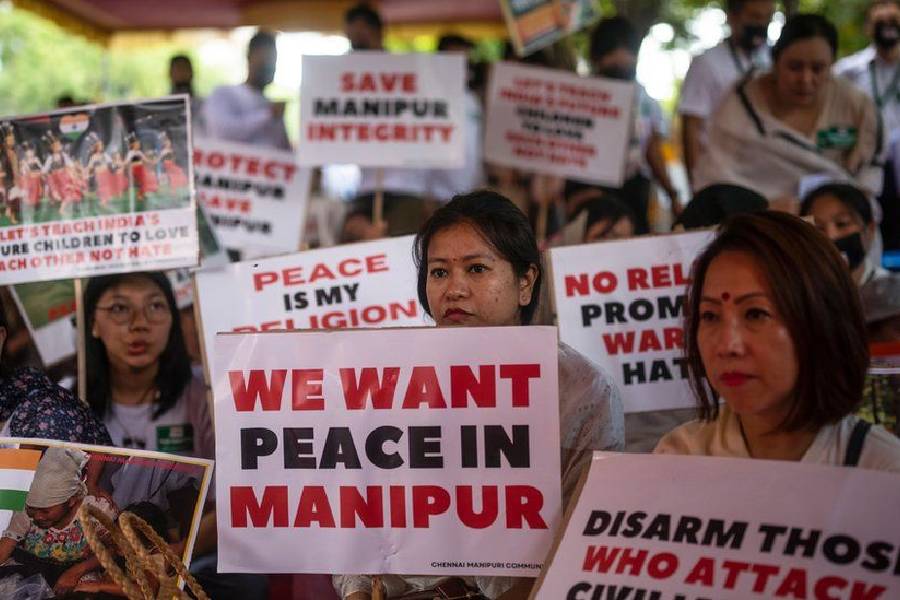
I came across this quote last summer in the National Museum of the American Indian in New York. The words came back to me as I started penning my thoughts on the verdict of the assembly elections in Manipur and on Irom Sharmila, a young Manipuri woman who has been on a six-year-long hunger strike in protest against the Armed Forces (Special Powers) Act, and who had been the main election symbol. While Hunkpapa felt that the whites had betrayed every treaty that they concluded with the Red American Indians, I, as a Manipuri woman, feel that the results of the ninth Manipur assembly election are a betrayal of what the Manipuri people stand for. It is a betrayal of Irom Sharmila and the values she upholds. I understand that there are other issues that confront the people of Manipur besides the AFSPA. But when the core of human existence is challenged by the very continuation of this inhuman act, which is deemed unconstitutional, how can one not feel the betrayal?

The recently-concluded elections in Manipur were fought in the public domain on the issue of the AFSPA. And the single largest party that came to power, namely the Congress, was the only party besides the state unit of the Rashtriya Janata Dal that did not talk about the act’s removal in the manifesto. All other parties pledged to have AFSPA repealed if elected to power. Prior to the elections, it was the Congress which had also blocked an assembly resolution on the removal of the AFSPA despite assurance from the prime minister, Manmohan Singh, that the act would be repealed if there was a “ political consensus” amongst all parties in the state. The Congress in Manipur seems to predicate the repeal of the act on the return of law and order in the state.

Since this is an issue that touches the consciousness of every thinking person and every Manipuri, I am left with no option but to question, who is betraying whom? How can we erase the memory of the marches of thousands of people in Manipur and the rest of India to protest against the rape and killing of Thangjam Manorama, and the uproar against the AFSPA in 2004? Can we forget the nude protest by the Meira Paibi Imas in July 2004, which led to the removal of the Assam Rifles from Kangla and the lifting of the AFSPA from some parts of Imphal? And how can we forget that we had anticipated the election results with hope in our hearts that if the right people came to power, we would see the last of the AFSPA and Eche (elder sister in Manipuri) Sharmila would break her fast? How can one not feel the betrayal when a day after the election results a party worker is heard saying, “How can our speeches of removing the AFSPA and building a new Manipur match the Rs 2,000 that were distributed by other parties. They have money....”

Elections in Manipur do not symbolize a consensual choice of every right-thinking Manipuri. Instead, it has become a game in which the political candidates and their supporters resort to violence of every sort to come to power. Use of guns is rampant during electioneering. Also, during elections, the presence of the armed forces is strengthened by bringing in troops from outside. Elections in Manipur were conducted in three phases despite its small size. It was the invariable “militarized election” of a kind that may astonish many.

There was thus a sense of resignation at the sorry state of affairs. The feeling was heightened when, just after the elections, questions were raised about the fate of Irom Sharmila. The reply was clear. “Let her die. In her death, 2.5 lakh Manipuris will be born again”. But the reality and the violence in the words remind one of the politics that is played in Manipur. Any person who has met Irom Sharmila would want her to live. Her pure and undaunted spirit, firm on the goal of fasting till death for the removal of the AFSPA — be it in the Jawaharlal Nehru Hospital in Imphal or in New Delhi’s All India Institute of Medical Sciences or Dr Ram Manohar Lohia Hospital — would want you to move heaven and earth. Yet, some feel that she must die so that thousands could live. Had Irom Sharmila died, maybe the Congress would not have got the majority it now has in Manipur’s 60- member assembly. How far and how long can a society play and thrive on the politics of the dead and dying?

Irom Sharmila must live as she has become the humane face of Manipur people’s movement, which has spanned five decades. She symbolizes the second and most important stage in the movement. She did what five decades of armed resistance could not do. Her hunger strike to repeal the AFSPA made many people in India and the world realize that something wrong is happening in this corner of the world and that the wrongs have to be addressed. In the words of the Nobel Peace Laureate, Shirin Ibadi, who visited her in November 2006 in a hospital room at AIIMS, she is “The miracle of a six-year hunger strike.” Ibadi wrote, “The resistance of this woman is an unforgettable lesson for all human rights activists — in Iran or anywhere else in the world. Defending Sharmila is an important test for us to show, once again, the unity of the worldwide family of human rights defenders”.

The election results were a betrayal, and not just in the way the AFSPA issue was addressed. No woman candidate was elected in the recent assembly polls in which only 10 women had contested. This despite the fact that in more than 80 per cent of the assembly constituencies, the number of female voters are more than the number of male voters. Women, as a collective political force, have been very effective in dealing with any political issue in Manipur. Women participated in thousands in the first and second Nupi Lan or Women’s War of 1904 and 1939. They later formed Nishabandis in the Seventies to address social ills. The Eighties saw the emergence of the legendary Meira Paibis, the women torch-bearers. The struggle was continued by the Kuki, Anal Mothers and Naga women in Manipur. The absence of women legislators in the present assembly only drives home the point that politics and society are not that inclusive and that there is still some way to go before we start building a just and peaceful Manipuri society.

A “stable” government formation may well be on its way in Manipur, but to many right-thinking Manipuris, who desire peace and dignity of life, the road stretches beyond the ninth legislative assembly.

Top
Email This Page