|
|
|
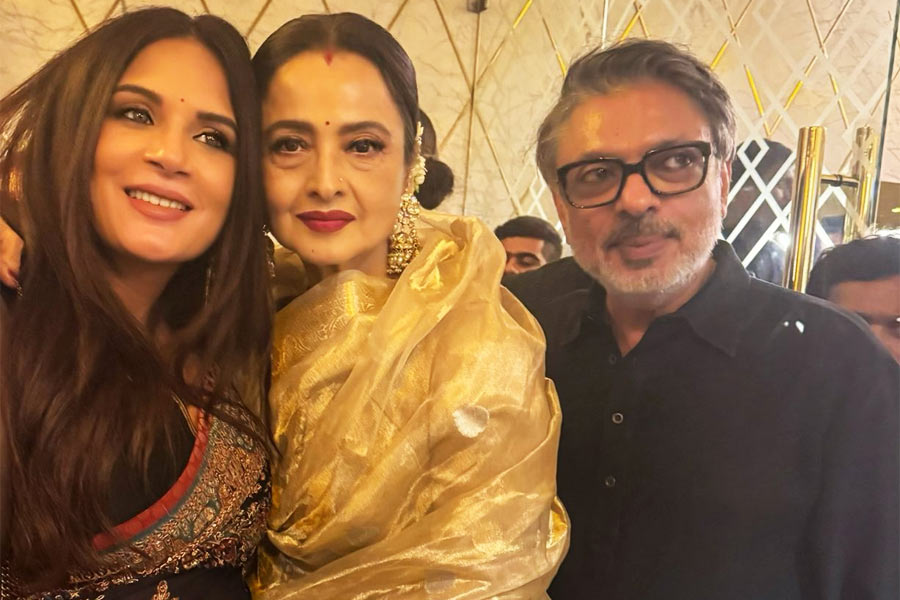
With Miranda Richardson
|
RED CARPETS AND OTHER BANANA SKINS
By Rupert Everett, Little, Brown, £12.99
“The sun rose and the earth fell away. We were driving round a spinning rock.” Rupert Everett was on the outskirts of Paris with John Jermyn, his wastrel friend, looking at the fast-approaching horizon and the sun rising from behind. But this wasn’t Everett, the consummate and suave actor. Or the gay icon of the Nineties.
This was Everett in his teens — impulsive and inspired. And John, by his side, was furious. He had fancied a boy at a club and brought him home that night. The boy was accompanied by his sister. Jermyn, Everett and the ‘brother-sister’ couple herded into the large bed, stoned to the point of passing out. Before long the brother and sister were “hard at it”, to Jermyn’s utter disbelief. Jermyn, in nothing but a fur coat, brought out his Ferrari, with Everett in a T-shirt and trousers next to him. They had no clue as to where they were going. This sense of rootlessness returns with epiphanic force later, when Everett, more settled in his career as an actor, echoes a similar feeling: “…looking back, that was my endless quest. Not acting. Not fame. Not love. Just losing myself.”
Reading Red Carpets and Other Banana Skins, Rupert Everett’s autobiography, is like following in the actor’s footsteps down the slippery aisle of glory. One moment, you are the cynosure of all eyes, and the very next minute, you are made to feel that your whole life is a mistake. Everett’s take on life under the arclights and beyond is ironic yet humane. The book becomes not just the memoirs of an actor, but of a man who has lived a life saturated with travel and adventure (much beyond merely exploring geographical boundaries), and all before his 48th birthday.
Art and its perception play an important role in Everett’s childhood. At six, when he was still growing up “in an old pink farmhouse with a moat, surrounded by the cornfields” in Essex, he watched Mary Poppins in a tumbledown cinema hall with his mother and his nanny. This experience stayed vivid in his mind and, apart from making him imagine that Julie Andrews was actually his mother, defined his passion for theatre and cinema. A full twenty years later, Everett was sitting in a bar in Mustique, when his agent called him, saying that Andrews wanted him cast as her protégé in Duet for One, a film based on the life of Jaqueline du Pré. Everett says, “I nearly fell off my barstool. Could it be true? All those years pretending Julie was my mother, and now art was finally imitating life...”
Everett found more touching theatre in the drunken brawls within a seedy Indian restaurant in London than in the hallowed precincts of the drama school he attended. Everett was a classic drifter. After being thrown out from there for being an ‘upstart’, he landed up in the Citizens Theatre in Glasgow. Initially recruited as an extra, he got a speaking part in Philip Prowse’s A Waste of Time: a play adapted from the complete works of Marcel Proust. According to him, the play “was a work of genius”. During his stint in Glasgow, he got the script of Another Country, based on the school life of the British spy, Guy Burgess, written by Julian Mitchell. With themes of treason, homosexuality and Marxism woven into the plot, it perhaps sent Everett on a nostalgia trip to his own boarding school experiences at Ampleforth College.
It is there that he realized how his sexuality was going to shape up. He did not suffer from the usual guilt pangs of being differently oriented, unlike Martineau in the play. Being queer was always a natural process for him, right since the days he rehearsed being with Mary Poppins in the wardrobe, wearing his mother’s tweed skirt. Although openly gay, Everett talks extensively about his heterosexual liaisons with Susan Saradon, the British TV presenter, Paula Yates, and a beautiful, “haughty and remote” girl in drama school called Suzy. His flitting in and out of ‘straight’ relationships was never at odds with his homosexuality; it only revealed the bohemian streak in him.
His homosexuality also meant that he had to confront AIDS, the full horror of which was becoming clear in the Eighties. During the spring of 1983, in the cold comfort of a hotel suite, Everett turned on the television: one of his ex-lovers, John, had been diagnosed with AIDS, and he was in the BBC news. What he had thought to be a remote possibility was now staring him in the face. About two years later, he met Tina Chow. Little did he realize that he would come to know after seven long years that Tina was losing her battle against the very same malady.
Everett’s writing has a good humoured, self-deprecatory quality that, through sheer negation, serves to highlight his talent. It is supplemented by a stunning set of photographs that shows Everett in all his flamboyance with a host of stars. The pictures are an insight into his life as a model, a socialite and a prolific theatre performer.
His style would have sounded deliberate, had he not written with such cynical conviction. Though he is heard referring to himself as a “devastatingly handsome” man in My Best Friend’s Wedding, Everett never thought much of himself in real life. He spoke of his physical appearance with relentless cruelty: “I walked with a tremendous stoop and had no arse or arms or chest or shoulders.”
In spite of being terribly ambitious, he doesn’t come across as a scheming man, making all the right moves to reach the pinnacle of stardom. On the contrary, it is disasters like Hearts of Fire (where he stars with Bob Dylan) that bring out his truly cavalier take on his profession. A gypsy at heart, Everett is a veritable wanderer, travelling about from London, to Paris, to Los Angeles, to Miami, making lasting bonds of friendship.
|