|
Q: I am working
with a non-governmental organisation (NGO) which is partnering
with the government in development projects. I am in a fairly
senior position. But of late, I have been feeling that I
need to add to my qualifications to boost my career prospects.
If I apply for IIM’s public policy programme, do I
need to take the CAT? Also, could you please let me know
more about the programme?
N.P. Sengupta
A:
IIM-Ahmedabad offers a rigorous one-year full-time residential
programme in public management and policy, which focuses
on public policy formulation and implementation, financial
regulation, infrastructure development and public enterprise
management.
This programme is ideally suited
for bright, motivated mid-career civil servants, managers,
administrators, and NGO professionals aspiring for leadership
positions in management and administration. Given your background,
it will definitely serve as an excellent add-on for enhancing
your career prospects.
The best part is the international
exchange component designed to offer an exposure to work
practices abroad. It will help you to understand the fundamentals
of macro-economics and do a SWOT analysis of the host country
in terms of governance and policy.
Potential partners are departments
and schools of Carnegie Mellon University, George Washington
University, Georgetown University, Ohio State University,
University of Geneva and University of Texas at Austin.
And yes, you need a valid GMAT/GRE,
CAT or the IIM’s specially designed test score plus
work experience of seven or more years to apply for this
programme. For details log on to www.iimahd.ernet.in
IIM-Bangalore also offers a two-year
full-time postgraduate programme in public policy and management.
Hope for BPO job seekers
Q:
I have completed BCom and am very keen to
work in a BPO but since I live in a relatively small town
in West Bengal, there is no possibility of getting such
a job. Also, my English is not very good but with a little
bit of training, I can certainly improve. Is there any hope
for me?
Niranjan Basu
Niranjan Basu
A:
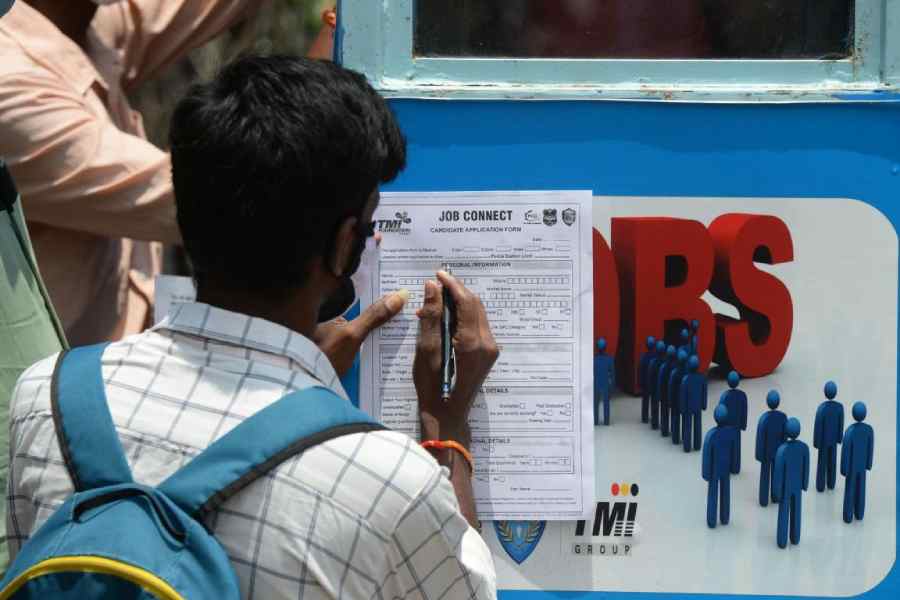
Why not? There’s plenty of hope for
you and several others like you. After all, English is not
our mother tongue, so we do need some practice to speak
it fluently.
Moreover, the employment strategy
of service sector companies is changing in favour of small
town youth. ICICI Bank plans to recruit graduates from smaller
towns and villages who have a government school background.
Wipro has also started sourcing some of its workforce from
this pool.
Dont blink when
optometry brings you success
Q
: Could you let me know about career prospects
in optometry? What is the difference between ophthalmology
and optometry?
Mahua Roy
A:
Often confused with an ophthalmologist,
an optometrist (also known as an ophthalmic technician)
is a professionally qualified primary eye care provider,
akin to your family eye doctor. In India, optometrists usually
assist ophthalmologists or recommend patients to specialists
for secondary and tertiary treatment. An optometrist tests
visual acuity and prescribes corrective lenses. Adept at
handling eye-testing equipment to examine a person’s
vision, the optometrist also fabricates lenses to prescribed
specifications and fits them and other low vision aids to
suit individual requirements. High-precision machines are
used to polish and harden lenses.
With an increase in the aged population and the growing
incidence of macular degeneration and diabetic retinopathy,
optometrists can play an important part in the treatment.
Optometrists usually work in eye
hospitals, clinics and opticians’ outlets or with
multinational vision care companies. You may also specialise
in particular types of vision disorders (i.e. squints, colour
blindness). After gaining experience at a private establishment
or with a lens manufacturer, you can open your own business.
You will be surprised to know
that optometry features among the top ten income-earning
professions in the US. This 700-year old profession is perhaps
one of the nearly extinct breeds of jobs that offer regular
work hours. Flexibility in practice and myriad choices in
geographic location are the icing on the cake.
Whereas India needs at least two
lakh optometrists, the actual number of optometrists stands
at a measly 5,000. Approximately 400-odd students pass out
of various institutes every year.
Moreover, with most people over
40 (and even earlier) requiring glasses/lenses, a skilled
and experienced optometrist is always in demand. With an
increase in the number of unqualified optometrists prescribing
lenses in two-bit optical shops, some sort of regularisation
to prevent malpractice has been demanded. Besides, most
of the courses are still not recognised by the ministry
of health. So you must make sure that you enroll in a reputed
institute.
WRITE IN
Send your queries to Career Hotline, Careergraph, The Telegraph,
6, Prafulla Sarkar Street, Calcutta 700 001. Fax: 22253142;
e-mail: career@abpmail.com |