|
|
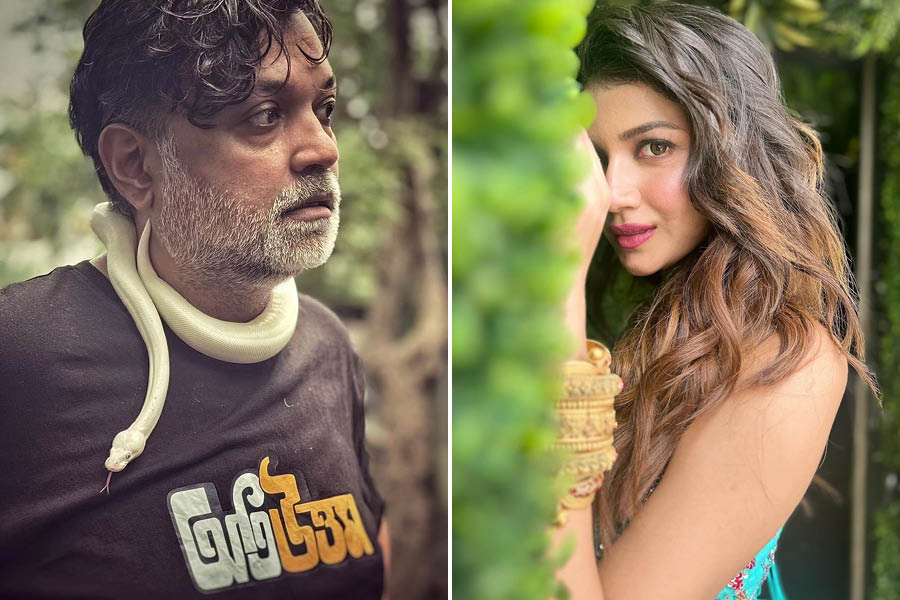
Members of Shastriya Syndicate record at a south Calcutta studio on Tuesday. Picture by Sanjoy Chattopadhyaya
|
Six Indian classical musicians, all in their thirties, have got together to produce music for young ears. The first album of the sextet, which calls itself Shastriya Syndicate, is now being recorded in Calcutta.
Sprawled across a studio at Rashbehari Avenue are sitar, sarangi, veena, tabla and a number of other known and unknown percussion instruments. The musicians themselves come from different corners of India, two from the south (Jayanthi and Pramath Kiran), one from the north (Murad Ali), one from the west (Rakesh Chaurasia) and two from the east (Purbayan Chatterjee and Subhankar Banerjee).
“Each instrument has its own tonality, each raga its spectrum of colours; there are different styles within the Indian classical tradition, from dhrupad and dhamar to kheyal to the Carnatic. Then there are the rhythmic patterns. To fuse one with the other, you need to know the musicality of every instrument,” reflects Banerjee, palm resting on the tabla. “But underlying it all is a common idiom. We are latching on to that,” says veena player Jayanthi, pointing out how Raga Puriya Dhanashree is identical to Kama Bardhini in Carnatic tradition.
Fusion may be the essence of what the group is up to but it has clearly marked out its musical boundaries. “These days everyone tries to mix different genres. This will be a soul-searching within our own tradition which has enough exotic sounds. If we bring these together, we have all the elements for a concert,” asserts sitarist Chatterjee, who conceived of the project.
“We are telling a story through the music and giving it a name. Thus one composition is called The Warrior at Dusk, suggesting the land of sand and camel. Listeners need not know it is based on Raga Puriya Dhanashree. This way they can enjoy a piece of music without getting intimidated,” smiles Chaurasia, a flautist from Mumbai.
Another aim of the project, Chatterjee points out, is to recapture the sound of live ensemble recording which has ceased in the age of multi-track recorders when artistes do not play together. “So many of the compositions are happening on the spot through interactions.” Also on the agenda is a visual form of the album. “Many children do not know what a veena or a sarangi looks like,” he says.
Keeping the younger generation in mind, the compositions are being kept short. Thus one of the compositions, based on Raga Desh, takes off with the jhala or the crescendo, marking a departure from the traditional sequence of a raga and bypassing the alaap or the vistaar. A rhythmic interplay of instruments enriches the pulsating rhythm further. “If they like the sound, they can explore the full form of the raga,” offers Ali, while tuning up his sarangi.
Chaurasia, who has a Bollywood association like his illustrious uncle Hariprasad Chaurasia and has put lip to the flute for films like Eklavya, Umrao Jaan and Devdas, points out that the film songs one hums are often raga-based. “Take Tu Jahan Jahan Rahega on Raga Nand. Raina Beet Jaye starts with Raga Todi.” But the Indian classical influence on film music is on the decline today, he admits. “You can’t have a shirtless Salman Khan dancing to a raga.”
So is the onus on the musicians themselves to produce music that is acceptable to GeNext? “In some ways, yes, as long as we are able to carry forward the tradition by staying rooted to the tradition,” Banerjee tunes off.
|