|
|
|
Home and hearth
|
Suna suna baba mora/ Buru Bonga raksha kara/ Suna suna baba mora Buru Bonga ahar deva (Oh Father, forest-hills protect us; Oh Father, forest-hills give us food)
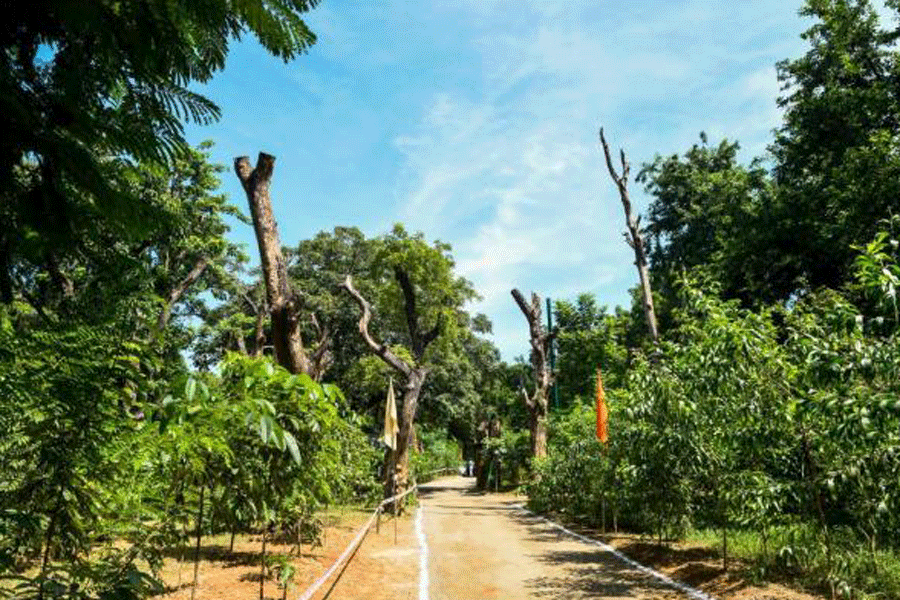
This song sung in the tribal areas speaks of the long and abiding relationship between the tribals and the forests. The Union cabinet seems to have kept in mind this intimate bond when it approved the tribal rights bill on December 7, 2006. The proposed legislation now waits to be passed by parliament. It may, however, receive both bouquet and brickbats from groups which have been spearheading the movement for the restoration of the tribal people’s rights to the ownership of the forests. For though the proposed bill, known as the scheduled tribes (recognition of forest rights ) bill, 2005, and popularly christened as the tribal rights bill, has been drafted with utmost care (it has taken into account the comments of the joint parliamentary committee and the group of ministers), the Union cabinet has taken stands on certain vital issues which run contrary to the recommendations of both the JPC and GoM. The suggestions put forward by the national tribal policy draft of July 2006 may also become the basis for critical evaluation of the proposed bill when it comes to parliament for enactment.
The very first meeting of the GoM, held on July 27 last year, had spelt out that the basic purpose of introducing the tribal rights bill was to confer rights on the forest-dwelling scheduled tribes, who were denied such rights. At the same time, the bill was aimed at ensuring the protection of the forests. The GoM consisted of ten members, including the then defence minister, Pranab Mukherjee, the home minister, Shivraj Patil, the tribal affairs minister, P.R. Kyndiah, the law minister, Hansraj Bhardwaj, the panchayati raj minister, Mani Shankar Aiyar, the minister for social justice, Meira Kumar, the minister for environment and forests, A. Raja, the science and technology minister, Kapil Sibal, the minister of state for women and child development, Renuka Choudhary, and the minister of state for food processing industries, Subodh Kant Sahay.
The GoM meeting had taken note of the fact that the JPC constituted for the purpose had widened the scope of the bill to cover the other traditional forest-dwellers also. At the same time, the JPC had also suggested certain changes in the proposed bill, such as a change in the cut-off date, October 25, 1980, for the recognition of forest rights; revision of the ceiling of 2.5 hectares, up to which forest land can be occupied; and gram sabha as the final authority for approving forest rights.
Some of these recommendations of the JPC, however, seem to have not found favour with the GoM and the Union cabinet. This will, in all probability, cause ripples among the champions of the tribal cause. Reports suggest that the Union cabinet has approved of December 2005 as the deadline to recognize the rights of the forest-dwellers, whereas the GoM had strongly insisted that the cut-off date of October 25, 1980 was determined through a process of consultation with everyone concerned, including the ministry of environment and forests. The GoM also warned that any revision of the cut-off date would go against the basic structure of the bill.
The reports also suggest that contrary to the observation of the GoM that the gram sabha could not be made the competent authority for approving forest rights — the GoM felt that this would go against the basic structures of governance in India — the Union cabinet decided to give panchayati raj bodies a more decisive role in finalizing the rights of those living in forests.
However, the most contentious provision in the proposed bill has to be the one pertaining to the inclusion of non-tribals and other forest-dwellers within the scope of the bill. This is another way of saying that the rights of those living in the forest for three generations would be ensured by the proposed legislation. The consensus at the very first meeting of the GoM was to not include the non-STs within the purview of the bill, since including them was likely to open the floodgates for anyone and everyone to demand the right of ownership.
This has been reinforced by the observations in the draft of the national tribal policy: “Due to the faulty processes of declaration of forests in the past, the rights of the tribals over their traditional land holdings in the forests have gradually been extinguished. Insecurity of tenure and fear of eviction from these lands have led the tribal communities to feel emotionally as well as physically alienated from forests and forest lands. The conditions of the tribals living in and around forests is becoming increasingly precarious and vulnerable day by day due to displacement threats arising out of various causes, such as increasing emphasis on conservation of forests without human beings...”.
But the situation was very different till the British arrived in India. Documents available on the tribal people of India reveal that the adivasis residing in and around the forests have had a symbiotic relationship with their habitat. They enjoyed a natural ownership of the forests in pre-British times. It was, however, during the British period that the traditional rights of the tribals to the ownership of forests received a serious setback.
Will the present move of the Union government to enact the tribal rights bill restore the age-old forest ownership rights to the tribals? One cannot say for sure till the bill is enacted by parliament and executed in its entirety by the forest department officials, who have got used to treating the tribals, not as the protectors of jungles but their predators. In independent India too, the government’s forest policy has always been found to deprive the tribals of their traditional rights of ownership, although several commissions and policies have been instituted by the government to correct the unfairness.
It could well be argued that their rights have to be restored for the tribals as, according to the latest Forest Survey of India report, about 60.04 per cent of the 63 per cent forest cover of the country and 63 per cent of our dense forests lie in 187 tribal districts. That the tribals have been at the forefront of the conservation of forests is affirmed by a comparison of the forest cover in tribal districts in 2001 and 2003. It shows a net increase of 32,100 hectares, underscoring the point of a very strong symbiotic relationship between the tribal people of India and the forests.
The author is professor and head, department of Political Science, St Xavier’s College, Ranchi |