|
|
|
Sunshine territory
|
In an attempt to provide the basis for a more rounded picture of human development, Amartya Sen and certain like-minded economists put forward the argument that the gross domestic product and GDP per capita were inadequate measurements of a nation’s progress. Nevertheless, South Asia hardly benefited from the new formulae. The newly constructed human development index used the yardstick of GDP per capita together with the supplements of life expectancy and a composite measure of education, including literacy and school enrolment. With this revised approach, India climbed from the rank of 132 out of 174 countries in 1999 to 127 out of 177 in 2005. It fared slightly poorly even by the old measurement of GDP per capita by being ranked 131 out of 177 in the United Nations Human Development Report of 2005.
The constant search for new measurements to assess the quality of life continues. Politicians in the West espouse such efforts as an aid to governance. David Cameron, the leader of the British Conservative Party, has said that “improving society’s sense of well-being is the central political challenge of our time”.
Well-being may not be quite the same as happiness, but the concept obviously owes a great deal to the work of another economist and Labour peer, Lord Layard of the London School of Economics. This has led political groups to work out a formula, which would serve to show that their policies are working, even if subliminally. A national happiness audit would clearly be able to inform and judge a government’s performance and its social policies.
There is little surprise in the fact that statistics, based on parameters such as life-satisfaction, life expectancy and ‘ecological footprint’ (the extent to which the ecological demands of human economic activity are within or exceed the capacity of the biosphere to supply goods and services to that community) show that Canada, Denmark, Iceland and Switzerland are, or should be, the world’s happiest nations. And India? According to the Happy Planet Index, the country is ranked as low as 14 in Asia, behind Bangladesh, Bhutan, Maldives and Sri Lanka.
The happiest societies have been shown to be the most equal ones, while unemployment and ill health are two factors that contribute immensely to unhappiness. Creating paid employment opportunities and a level social playing field is therefore good policy, both for the economy and to spread individual happiness. High levels of individual income by themselves will not generate overall happiness, especially in a country where 10 per cent of the population accounts for about 40 per cent of the total income, and where the next ten per cent might own products like cell phones, television sets and two-wheelers in the next five years. This will still amount to only about one-fifth of the population whereas nearly 60 per cent will have to get by on less than hundred rupees a day.
India’s economic growth, with the nation’s attention fixed on the annual percentage growth of GDP, has been largely job-less with even the much-vaunted IT and BPO industries employing less than 1.5 million people. When one adds to unemployment, other problems such as malnutrition, illiteracy, social and economic inequities and discrimination so widely prevalent in the country, there can be little expectation of a higher grading on the happiness index.
India also scores poorly on various other global data-bases. Transparency International’s Corruption Perceptions Index of 2006 puts India in joint 70th position along with Saudi Arabia, Egypt and Senegal, but below countries like Croatia, Cuba, Belize, Jamaica and Bhutan. The Human Poverty Index of 2003, which is based on criteria such as probability at birth of reaching the age of 60, functional literacy skills, the percentage of undernourished children, and the percentage of the population without access to safe water, ranked India in 127th position after Equatorial Guinea, Gabon and Mongolia. In the Pilot 2006 Environmental Performance Index, India is in the 118th position, after China, Pakistan and Sri Lanka. In the recent Mercer Human Resource Consultancy’s Urban Quality of Life Index, Delhi and Mumbai share the 150th position after Colombo and Dakar, while Bangalore and Chennai fare even worse.
Notwithstanding Manmohan Singh’s reputation of being a prophet of economic liberalization, the league tables tell a starkly different story about the success of India’s governments in this century. The World Bank’s ‘Doing Business 2007’ index rates India in 134th position out of 175 countries. For the enforcement of contract, it is second from bottom at 173rd. Nevertheless, influenced by the elite ten per cent who own newspapers and the TV stations, and despite a warning from the prime minister himself that only a small section of Indian citizens could aspire to attain standards of living prevalent in the West, the Indian media only reports on the success stories of the high-consumption class. Thus, we read and hear each year about graduates from IITs and IIMs gloating about lucrative job offers from multinational companies.
One really cannot expect anything better from the media, which has often shown a marked lack of social awareness and sensitivity. But one would have expected intelligent, young Indians to be more modest about their privileged position compared to the a large number of their countrymen.
So we may ask, in the words of Lenin, “What is to be done?” Whereas Lenin provided some answers to his own question, India’s politicians have failed to find any solution to the problems since the time of independence. Even the states ruled by parties that espouse the ideals of secularism and egalitarianism have not shown better economic indicators than the rest of India. The usual excuses cited for this failure are the constraints imposed by the limitations of a democratic polity and the compulsions of coalition politics. But, on many other occasions, these are the very aspects that are subjected to unabashed praise. Clearly, we cannot have it both ways.
There has been no reformation in India, no large-scale peasant revolts, political revolutions, industrial or agrarian revolutions. One of the lasting beliefs in the country is that what does not change is more important than something that does. This, presumably, will continue to hold true.
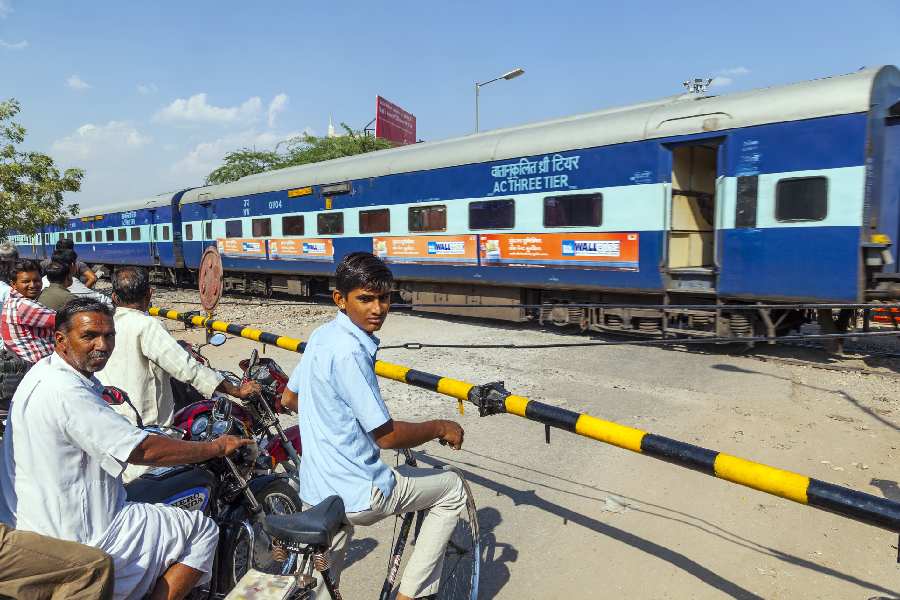
Thus, India, a country that designs software for some of the world’s fastest and technologically advanced railway systems, is apparently unable to produce an adhesive that will stick down Indian postage stamps and envelopes, leading to the ubiquitous, but distinctly environmentally unfriendly, use of staples. Indian citizens are accustomed to such paradoxes and most of us are content to live with them.
|