|
 |
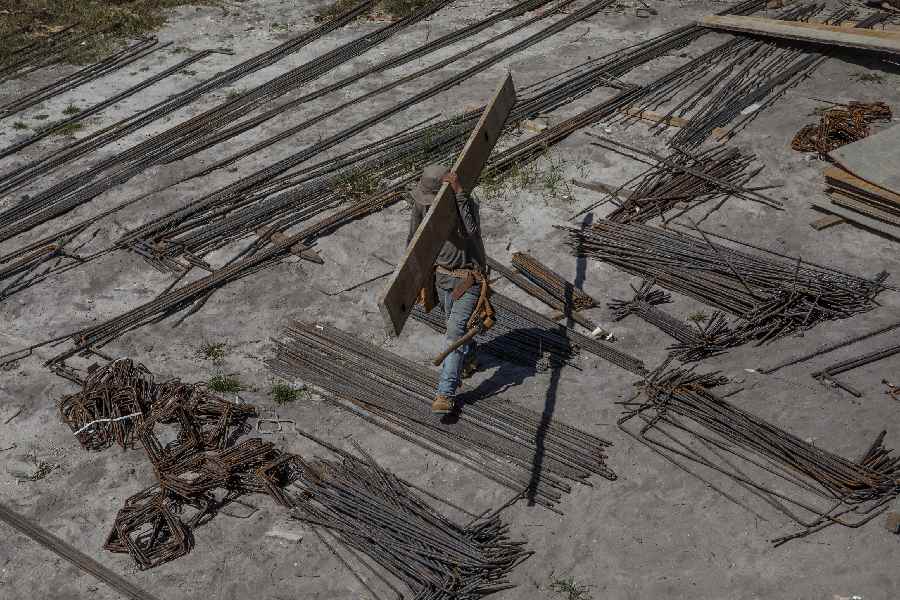
| Indian statuary in the Rietberg Museum. (Below) The subterranean section of the museum under construction |
If you can’t build overground, go underground. This is the principle on which the exhibition space of Museum Rietberg in Zurich is being more than doubled. As the publicity brochure declares: “Everything is new… and remains as it was.” The museum, housed in the old Villa Wesendonck since 1952, is situated in the scenic Rietberg Park which commands picturesque views of the city and the Alps. Here, Richard Wagner wrote Tristan and Isolde, as well as a sketch influenced by Buddhism. Titled The Victors (Die Sieger), the storyline of this fragment is the same as Rabindranath Tagore’s dance drama Chandalika. The only visible sign of the new subterranean extension is a green glass box close to the villa, known as The Emerald, designed by architects Grazioli + Krischanitz (Berlin/Vienna). This underground extension is in two levels — the first houses the permanent collection and the second is meant for special exhibitions. Adjacent to it is the visible storage space open to the public. The new space is accessed by double staircases and the walls are covered with lattices of oak wood. It opens on February 18. The museum has an invaluable collection of 4,000 objects that represents some of the best of Indian, Tibetan, Pre-Columbian and Oceanic art. It was donated to the city of Zurich by Eduard von der Heydt 50 years ago. The Chola Nataraja is the icon of the museum, which will celebrate in 2008, the 60th anniversary of the treaty of friendship and establishment of diplomatic relations between India and Switzerland. Johannes Beltz, assistant curator of Indian art, who showed us around, appealed to the Indian government to loan art objects for this celebration. Switzerland has many other examples of heritage structures being given a new lease of life by reinventing them. One such marvel of reuse in Zurich is the Schiffbau Courtyard Building, Theatre and Cultural Centre in the old shipyard where engines for ocean liners were built. It was turned into auditoriums for jazz and theatrical performances. The exposed brick walls of the building on the former Sulzer-Escher-Wyss industrial site (shipyard) remain intact and so do the rows of huge arched windows. Inside, it is frankly industrial, with its exposed iron girders. The space has been imaginatively divided to house restaurants, the jazz club Moods and the stages of the Zurich theatre, the Schauspielhaus. This newly-developed complex was designed by the Viennese architects Ortner & Ortner, which won the contest to redesign the shipyard The Schiffbauhalle (shipbuilding shed), which is under a preservation order. The workshops, studio, rehearsal stages and other facilities of the Zurich theatre earlier scattered across different sites are under one roof now to form the centre. The new building is organised around a courtyard, which houses all the workshops and offices of the theatre. It also contains privately-owned flats. The courtyard can be used as an open-air theatre. What was essentially a working-class neighbourhood has, thus, been rejuvenated. It draws huge crowds of lovers of music and theatre. The acoustics are near perfect. But Moods notwithstanding, the jam sessions in Park Street restaurants were much better. In Calcutta, on the other hand, we destroy the old. The Dunlop office on Free School Street has left a void after it was demolished last year. And now Lady Ranu Mookerjee’s house, facing already-congested Camac Street, will be turned into another five-star hotel. Nothing is sacred if the realtor so desires. |