TT Epaper LHS
The Telegraph
TT Mobile
 
 
IN TODAY'S PAPER
WEEKLY FEATURES
CITY NEWSLINES
FEEDS
  RSS
  My Yahoo!
SEARCH
 
Archives Web
 
ARCHIVES
Since 1st March, 1999
 
THE TELEGRAPH
 
CIMA Gallary
 
Email This Page
Beautiful mind games

With seconds of the match remaining, I squeezed home the ball with an incredible right-foot shot that soared into the top corner. The crowd roared with a single voice. Goaaaaaaaal!”

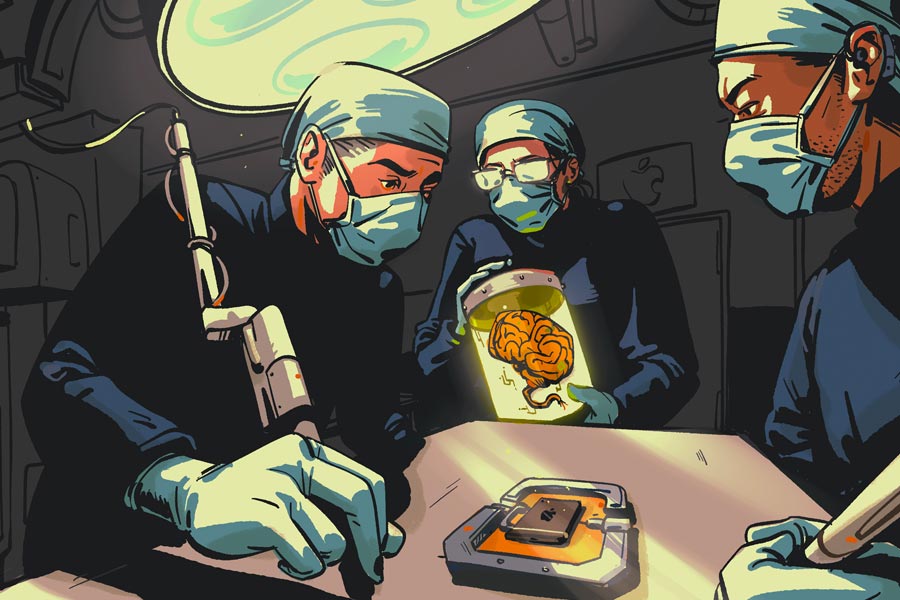
Given everything we know about men and football, it seems odd that a team of Cambridge neuroscientists is in a state of high excitement about a Liverpool fan who can play the beautiful game in his head.

The reason that this feat is so remarkable is that this young man suffered a severe brain injury that left him unable to respond to even a simple request. He can breathe unaided, can open his eyes. But he is unable to move, speak or change his gaze.

But if you put him inside the powerful magnets of a brain scanner and then ask him to play football in his mind, you can see his brain light up, as blood surges into regions to do with memory and movement. The fact that he can score winning goals in his head provides a vivid reminder that an unresponsive body does not mean an unresponsive mind.

The Cambridge team, led by Dr Adrian Owen of the Medical Research Council’s Cognition and Brain Sciences Unit, also described the case of an unconscious and outwardly unresponsive British woman with serious brain damage.

The 23-year-old road accident victim had been diagnosed as vegetative after an exhaustive clinical assessment. Her brain activity was mapped using a technique called fMRI (functional Magnetic Resonance Imaging) as she was read sentences by the doctors — for example, “there was milk and sugar in his coffee” or “the creak came from a beam in the ceiling”. These tests showed she retained the ability to recognise speech.

But the most remarkable results were seen when she was asked to imagine playing tennis. The scientists found she was able to do this, activating different areas of her brain in the same way as healthy volunteers. “Her decision to work with us by imagining particular tasks when asked represents a clear act of intent which confirmed beyond any doubt that she was consciously aware of herself and her surroundings,” said Dr Owen.

This work raises a critical issue. How tight is the coupling between what she was asked to imagine and her brain activity?

Critics pointed out that the brain scanner did not image activity related to a particular “decision” that she had made but could have been charting the activity of what are called mirror neurons, which reside next to the motor cortex (the part of the brain that actually makes the limbs move).

The region where mirror neurons are found forms part of the brain’s centre for controlling speech, leading the critics to suggest that when Dr Owen’s team had measured the response of the 23-year-old, the activity was triggered by the word “tennis” itself, rather than her performing a serve in her mind. “Not so,” said Dr Owen. “We’ve shown that when people just listen to words such as tennis without being told to imagine that they are part of the game, you see nothing like the incredible activity we saw in a patient we had assumed to be vegetative.”

Support for his view comes from a recent University College London study of how mirror neurons go into action, in this case when ballet dancers watch or imagine dance. Do the mirror neurons react to the sight of dancing or really play out the movements as if the observer were doing it herself?

With the help of Deborah Bull of the Royal Opera House, and the Royal Ballet, Prof. Patrick Haggard’s team used a scanner to study the brain activity of expert dancers while they watched brief video clips of familiar and unfamiliar classical ballet moves. “We found greater activity in the mirror areas of the brain when the dancers watched those specific actions that they had learned to perform, compared with watching very similar actions which they often saw, but had not learned to perform,” said Prof. Haggard. Thus, he concluded, the mirror neurons do not simply react to the sight of dance but “act out” the movements.

The research has the potential to open wide opportunities. “There is no reason why we couldn’t adapt the same sort of approach to investigate the extent of residual cognitive function in children with extreme disabilities,” said Dr Owen.

In the longer term, extraordinary possibilities arise, in the wake of other work that has shown how brain scanners can be adapted to control computers. Drs Owen and Coleman are interested in developing their fMRI techniques perhaps to allow some form of “communication” with some of these patients.

The scanners could help identify patients who might benefit from “brain computer interfaces”, where electrodes on the scalp can detect and convert patterns of brain activity into signals that can be used to communicate or operate a computer. Dr Owen said, “That’s when we may really be able to help them.”

Top
Email This Page