|
Q:
First of all, what made you cast Hrithik and Aishwarya
as Akbar and Jodha?
Theres a certain royal quality
to Hrithiks face and body language. Hes just
amazing in those aspects. As for Aishwarya, shes to
me the quintessential princess…straight out of Amar Chitra
Katha…the distressed princess waiting in her chamber. Aishwarya
has the elegance and, of course, the beauty. Calling her
beautiful is an understatement. Though weve seen her
in so many avataars, as Jodha shes something
else. Hrithik and Ash are amazing together.
Q:
How do you tell the two Ashs — Ashutosh and Aishwarya
— apart on the sets?
Ha-ha. I insist everyone call her Aishwarya off-the-sets. On the sets we call her Jodha.
Q:
What about the objections raised by the Animal Welfare
Board?
Ive been in touch with them
and Ive all the required permissions with details
of how many animals Im using and of which livestock.
Ive specified in my letter that Im using 69
elephants, 50 camels and 100 horses. Every four hours the
animals are given a rest period. A member of the Animal
Welfare Board visits the sets. I wanted everything worked
out on paper. But I have to know beforehand what I am not
supposed to do.
Suppose Im suddenly informed that the mukhiya from Lagaan cant be shown smoking, I cant do much about it.
Q:
Do you think the no-smoking clause is a killer for
filmmakers?
It depends. In Jodha-Akbar, Emperor Humayun smoked the hookah. You cant tell me I cant show him smoking. Thats history. And Im being allowed that.
Q:
Youre using authentic jewellery of the Mughal
period?
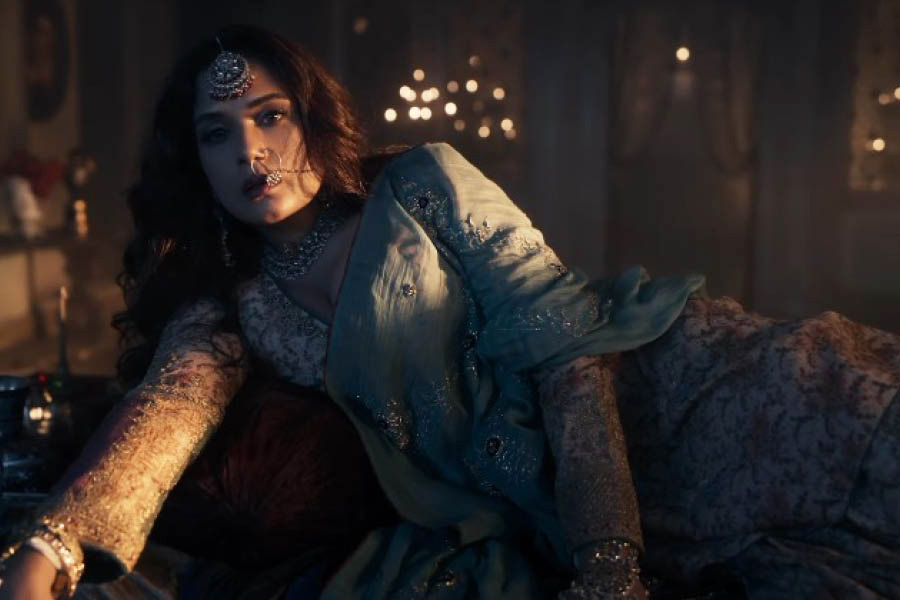
Yes, were recreating the authentic jewellery of that period based on the miniature paintings of Rajasthan. Jodha and Akbars jewellery has to look as it did in that era. Todays jewellery is cut in a different way. Weve several designers on the job. And Neeta Lulla has designed the whole casts look —Hrithik, Aishwarya, the soldiers….
Q:
So much labour, history and effort…tired already?
No, no! Im enjoying myself.
I feel very very excited. All the detailing was done to
make sure no time was wasted when we actually started shooting.
To me direction is 80 per cent on paper.
Q:
Why did it take you so long to actually start shooting?
Hydar Ali, on whose story the film Jodha-Akbar is based, narrated it to me right after I finished Lagaan. Since then Hydar and I were working on the screenplay. I had the option to start making Jodha-Akbar before Swades. But I thought this one needed much more detailing. Though Jodha-Akbar again took me back in time, it wasnt the same thing as Lagaan where I could give free rein to my imagination. Bhuvan in Lagaan and Mohan Bhargava in Swades were my characters. Not Jodha and Akbar.
Q:
You better get the Mughal history right, or else
the historians will clobber your film.
Hah! Thats the first thing
I did. I met a whole lot of historians. After Swades,
Jodha-Akbar just took shape effortlessly. The research
helped me to arrive at a place where my imagination was
completely unfettered. Im sure of one thing. Im
not making a historical document. At the end of the day
Jodha-Akbar has to be a good story told in an interesting
manner. I dont want to make a biopic. The background
is seeped in history. But the characters are mine. No one
knows how Jodha or Akbar behaved. Ive to imagine their
romance, the palace and harem politics. Id say 20
per cent is history, 80 per cent is my imagination.
Q:
Are you ready to deal with the purists?
When I met the eminent historian Irfan Habib of Aligarh University he heard my plot. He thought it was a fabulous idea. He told me to forget about history, or else I wont be able to make my film. Then I had script sessions with the Maharani and Maharaja of Jaipur who are the direct descendants of Jodha. Theyre extremely excited about the film. They did the films mahurat at the Jaipur City Palace. Ive also met historians from Jamia Millia and Mumbai University. And Ive got the well-known Omar Khayyam Saharanpuri as my cultural advisor. These are experts on the subject of Akbars own secular religious order, Din-e-Ilahi.
Q:
What about the Hindu-Muslim love story?
I dont think of my characters as religious entities. I think of them as my two protagonists whose love went beyond all considerations. I cant allow my vision to be coloured by these considerations. If in 1562, when my romance eventuates, political and religious undertones do resonate then I wont try to stop them. But these are not my primary concerns as a filmmaker.
Q:
How different is it occupying a fictional historical
and a historical mindspace in Lagaan and Jodha-Akbar?
My concerns as a filmmaker remain unchanged. I want to create a world where people look and say, Yes, this is how people wouldve lived at that time. I like to fiercely protect my journey into that world from the past. Be it 1892 in Lagaan or 1562 in Jodha-Akbar, the responsibilities are the same. What changed is the scope of the imagination applied. Its a tougher film to make because Ive to fuse my imagination with the legacies of the Mughal empire that still remain, like the fort of Ajmer which still stands.
Q:
Theres a growing feeling that costume dramas
dont work at the box-office?
To me the period is not relevant.
The story has to connect with me emotionally, romantically
and dramatically. Besides, how many of the films set in
present times work? So if Ive to fail I might as well
do so while doing what I want to do.
Q:
How different is Jodha-Akbar from K. Asifs
Mughal-e-Azam?
That youll have to see.
Without explaining what Im doing, Ill say
Im not competing with Mughal-e-Azam at all. Its
a mountain of a classic. No one can surpass it. Jodha-Akbar
is not a remake of any film. Ill just tell my story
as best possible. I want to tell an intense love story.
Im making my own discoveries about the central love
story as seen through the eyes of history. I hope to carry
the burden lightly.
|