TT Epaper LHS
The Telegraph
TT Mobile
 
 
IN TODAY'S PAPER
WEEKLY FEATURES
CITY NEWSLINES
FEEDS
  RSS
  My Yahoo!
SEARCH
 
Archives Web
 
ARCHIVES
Since 1st March, 1999
 
THE TELEGRAPH
 
CIMA Gallary
 
Email This Page
Letters to Editor

Modest proposals

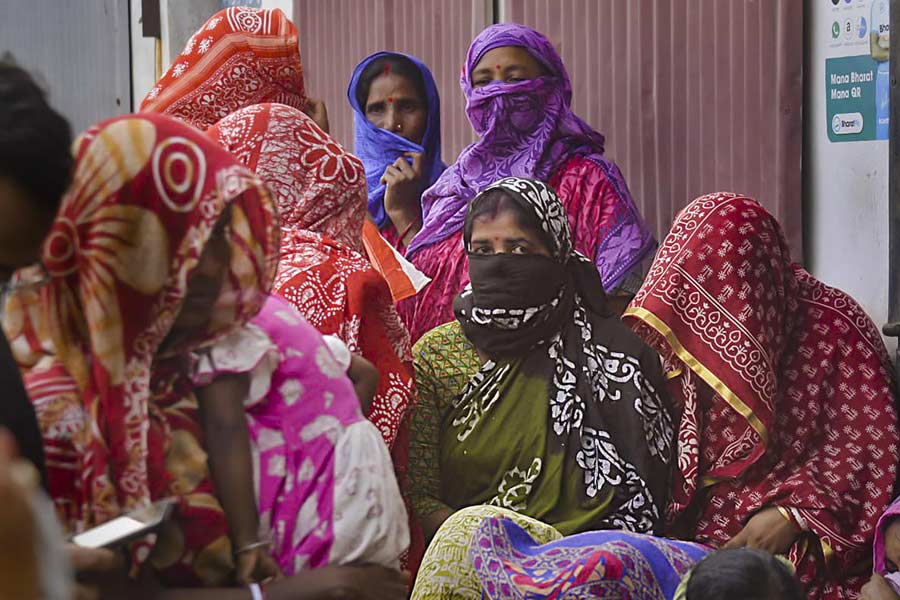
Sir — The debate over the veil continues unresolved, with Shabana Azmi’s contention that women do not have to cover their faces for the sake of ‘modesty’ (“Veil debate takes Shabana detour”, Oct 30). Scholars and jurists hold that a woman’s dress should cover the entire body with the exception of face and hands: “The attire should not be form fitting, sheer or eye-catching as to attract undue attention or reveal the shape of the body”. This view makes out women to be potential objects of masculine desire. If this is so, then the fault lies with the men who consider women to be only sexual beings. This view is absurd in a world where women are becoming increasingly professionally competent. Women have transcended the role of home-maker that tradition has thrust upon them. They have proved themselves equal to men in their ability to hold positions of power and authority in a largely male-dominated world. Subjugating women through religious injunctions thus remains the only alternative for male chauvinists.

Yours faithfully,
Pradip Chowdhury,
Calcutta


Sir — Shabana Azmi’s statement against the veil has come under heavy attack from a section of maulanas. The impression has been created that there is something inherent in Islam opposing reforms or progressive values. There are scholars such as Asghar Ali Engineer, with progressive views on Islam, and yet they do not create as much stir as liberal Muslims, like Azmi, who never fail to draw considerable public attention to themselves, given a chance. The Muslim community has been targeted globally, as well as locally around the subcontinent. This has created a sense of insecurity, leading to emotional and physical ghettoization, within this community. This ghettoization in turn has made the community more inward-looking and susceptible to the fundamentalist indoctrination by clerics. This demonization of the community is at the root of the severe orthodoxy that has become its identifying feature. We need to realize that communities, given the choice, gravitate towards reform and progress, but when they come under siege, they take recourse to any means, however orthodox and regressive, to protect themselves.

Yours faithfully,
Ram Puniyani, Mumbai


Sir — Shabana Azmi might be an entertainer, but the clerics should not forget her role as an activist for several human rights causes. The International Gandhi Peace Prize awarded to her this year testifies to her identity of a thinker beyond that of an actress. Quite justifiably, Shabana wants a debate on the veil, because it is a topic of intellectual as well as humanitarian concern. It seems entirely right that Muslim women should be given the freedom to make their own choice in the matter, just as Christian nuns who wear niqab-like dresses. Shabana has correctly pointed out that the Quran does not mention the wearing of the veil as an inviolable order. Further, there is no such command on women to give up their individual identities by covering their faces with veils. However, the clerics seem to be under the impression that the Muslim community is run solely by their order. It is unfortunate indeed that the trenchant responses to Shabana’s comments go on to prove the supremacy of the clerics over the intellectual and social lives of many Muslims.

Yours faithfully,
Bidyut Kumar Chatterjee,


Faridabad

Sir — Shabana Azmi has, once again, raised a storm with her criticism of the burqa. She has declared quite openly that it is not necessary for Muslim women to wear the veil. Even without going into the minute details of Islamic law, one feels that with the changing times, globalization and modern lifestyles, no community can afford to live in isolation. Although it is essential to adapt to changes without sacrificing customs and values, there should be adequate freedom of choice accorded to individuals in the ways in which they choose to conduct their personal lives. Following a religion as well as choosing what to wear are both equally personal matters. Burqa can, in no way, be imposed as a code of dressing. It should not be made compulsory, nor should women be forced to dress in a particular way or wear the burqa in order to please the Muslim clerics who consider themselves to be the highest arbiters of the religious lives of the Muslim community.

Yours faithfully,
Mahesh Kumar, New Delhi


Correction

Sir — In my letter, published as “Parting shot” on October 27, a gross error had crept in. When the Widow Remarriage Act of 1856 came into being, Gandhi was not thirteen, as I had mistakenly mentioned. In fact, Gandhi was born on October 2, 1869, 13 years after the Widow Remarriage Act of 1856 became a reality. When Vidyasagar died in 1891, Gandhi was about 22 years old. Gandhi continued with determination and compassion what Vidyasagar had begun.

Yours faithfully,
Sanjukta Dasgupta, Oswego, US


Top
Letters to the editor should be sent to : ttedit@abpmail.com
Email This Page