|
|
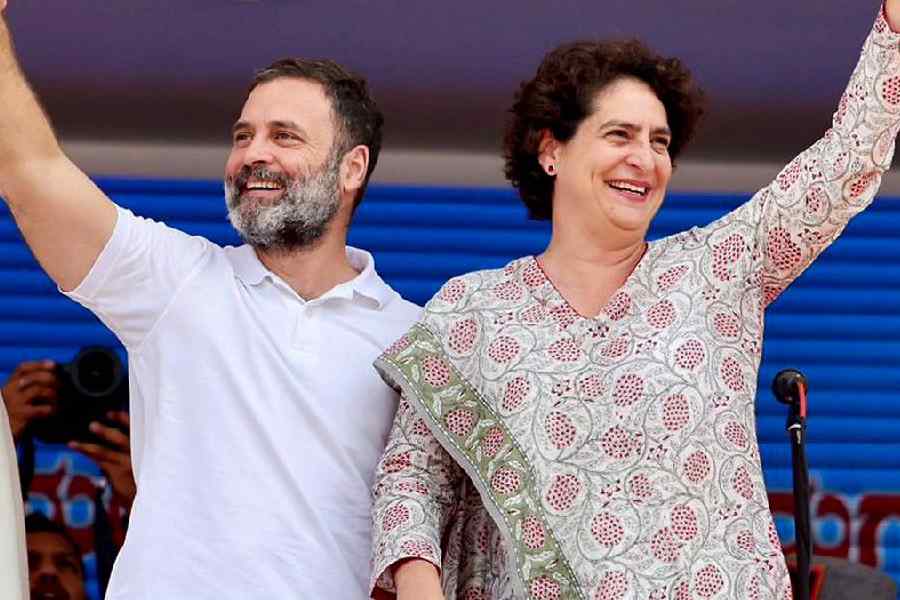
| LIKE FATHER, LIKE
SON: Rahul Gandhi and Rajiv Gandhi |
New York, Oct. 25: For veterans at the UN, there is a sense of déjà vu at the ongoing 61st General Assembly here.
Rahul Gandhis first foray into diplomacy and global politics at the UN headquarters here last week is reminiscent, for those with long memory, of his fathers performance at the 42nd General Assembly 19 years ago.
Rahul quietly arrived in New York early last week and, unlike most of a dozen or so MPs who are Indian delegates to the General Assembly every year, immediately plunged into UN work.
But unlike his fathers visit to the UN in 1987, Rahuls launch into the international arena has been deliberately low profile.
He has steered clear of publicity, he is not listed under his name in the Manhattan hotel near the UN, where Indian MPs are put up and he has refused a local cellphone, preferring to use his Indian mobile to call people in the US.
But that number is blocked and those who receive his calls are unable to trace the Indian mobile number he is calling from.
What has surprised most people at the UN, however, is the way he has insisted on not flaunting his security: many Indian politicians, whose threat levels are far lower than Rahuls, usually bask in the secure status they enjoy.
Because he is covered by the Special Protection Group (SPG), Rahul could have asked for US Secret Service cover, including secure cars.
Not only has he avoided such visible security, he has insisted that SPG officers accompanying him must lie low. In the US, Indian security, especially the SPG, is considered obnoxious because of their irrational and impossible local demands.
But if Rahul believed that he could get away from the rough and tumble of politics in New York, he was wrong.
He arrived at the UN on what has been one of the world bodys most memorable days since the end of the Cold War: an all-out fight broke out that day between the worlds only superpower and its weaker, but dogged challengers from the Left over Venezuelas candidature for a seat in the Security Council.
That fight appeared to be ending today with indications that Venezuela might nominate the equally radical Bolivia to take its place in the Security Council bid against Guatemala.
The first briefing by Indian diplomats to the UN for the batch of MPs, which includes Rahul, was, in fact, dominated by the fight between Venezuela and Guatemala, the latter a proxy for the US.
Since then, Rahul has not missed a single briefing by Indian officials, arriving every day at Indias UN mission here five minutes before 9 am, the time set for the daily event.
Visiting Indian MPs to New York are notorious for missing not only these briefings, but also skipping the General Assemblys committees, where much of the work is done after the high-level segment of the Assembly debate involving heads of state and government.
Some of them, in fact, quietly take off from New York, visiting friends and relatives in the US instead of being at the committees.
Rahul has not only been punctual at the missions briefings, he has been in and out of several General Assembly committees, seeking to understand how the UN system works, on his maiden visit as an MP to the world body.
His first active participation was in the human rights debate in the third committee, which deals with social, humanitarian and cultural issues.
It was an Indira Gandhi-style intervention, replete with phrases reminiscent of the garibi hatao platform.
Rahul said extreme poverty was inhibiting the full and effective enjoyment of human rights and that the right to development was a universal and inalienable right. He criticised the selectivity, double-standards and partial approaches in dealing with the promotion and protection of human rights calling, instead, for an approach based on dialogue, consultation, and cooperation.
The speech, said UN veterans, was reminiscent of his fathers address to the General Assembly on October 19, 1987, one of the first major statements by India on protecting the environment.
Rahul will return home this weekend.
|