|
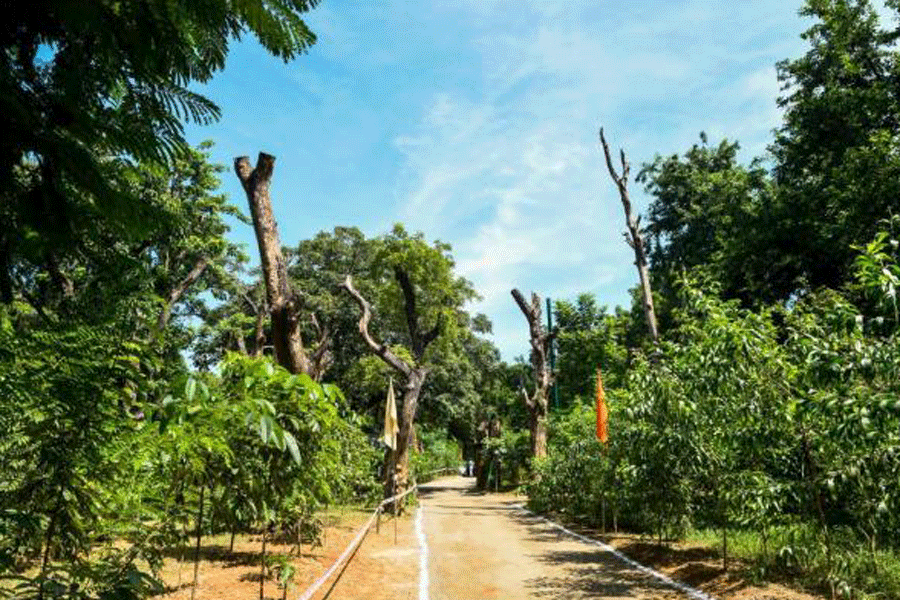
| All fired up: (Clockwise from top)
the CFT campus and students training to be firemen |
Three students of the College of Fire Technology (CFT), Ahmedabad, had to give the most crucial and unanticipated practical exam on March 14, 2005, when the diesel tank of the 5635 Down Okha-Guwahati Express they were travelling in caught fire. And they passed it with flying colours. The very first opportunity they got to play full-fledged firemen — even before they had completed their course — Pratik Bhattacharjee, Rajarshi Bhattacharjee and Shibraj Brahmin saved the lives of 2,500 passengers.
This one incident speaks volumes about the quality of training provided at the institute which was started six years ago by the Champaben Bhagat Education Trust. “The trust decided to set up an institute of fire technology as it realised that there was a growing number of fields which needed such trained personnel,” says Shilpa Trivedi, public relations officer, CFT.
Indeed, there is a rising demand for trained fire protection personnel today in the government sector, defence, railway, airports, electricity boards, mines, automobiles, refineries and petrochemical complexes all over India. There are also job opportunities in major petroleum and oil-based companies like Reliance, Essar, ONGC, etc. “Today, every industrial unit with an employee strength of more than 500 has to have a fire protection department,” says Major B.R. Sabharwal, director of CFT, “Job opportunities for our students can only rise in the future,” he adds.
Besides, those who wish to be self-employed may find opportunities as fire surveyors for insurance companies, fire consultants for commercial enterprises, risk management consultants, manufacturers of fire and safety equipment, etc.
“I always wanted to do something different instead of going for the conventional career choices,” says Vishal Shah, a final-year student of BSc fire. “Nowadays even engineers don’t get jobs. This seemed a better option,” he adds.
At present, CFT offers a BSc course in fire, with a student-strength of 200 and two one-year courses — the ITI fireman course and the safety and securityman course, with 150 and 40 students respectively. The BSc degree is awarded by the Gujarat University. While the BSc course costs around Rs 50,000 per annum, the fireman course costs about Rs 28,000 and the safety and securityman course costs about Rs 20,000 per annum.
The eligibility for the BSc course is a pass in Plus Two with a physics-chemistry-biology/mathematics combination. For the short-term courses the eligibility is a pass in Class X. The institute is also about to start various crash courses for government, industrial or defence personnel.
Although CFT does not offer a masters degree course, they have a tie-up with Leeds University, UK. All students from CFT who wish to pursue a masters course from there get a concession of £3,000 per annum. These students also get to complete their masters degree in one year. The institute has a tie-up with the Worcester Polytechnic Institute in the US as well.
The training, however, is quite demanding. The fact that all students are covered under accident insurance policy speaks for that. The morning starts with a rigorous marching and drill session. From 10 a.m. to 12 noon, it’s time for physical training. After lunch they have the theory classes and, around 3 p.m., they have to be back for physical training classes.
For the three-year BSc course, the last year has to be spent with an industrial group for practical training as a fire and safety officer. For the one-year courses too, one has to get hands-on experience during the last three months of the course.
To make sure that students get first rate practical training, CFT has well-equipped civil, electrical, mechanical, physics, chemistry, hydraulic and hot-fire-training labs. The huge campus, located on the outskirts of Ahmedabad, also houses a library, a computer centre, a drill tower, a sports complex and a fully-equipped fire station.
Besides a highly qualified regular faculty, the institute invites guest lecturers regularly. They also have a 150-seat hostel for out-station students, which charges about Rs 20,000 per annum.
The institute boasts an active placement cell as well. Every year most students get employment with leading companies as fire supervisors or similar posts. The starting salaries for such jobs can be anything between Rs 15,000 and Rs 20,000. “Almost all industrial units require two fire safety personnel today,” says Nishant Bhutani, a final-year student of the BSc fire course, who did his training project with Steel Authority of India Ltd (SAIL) in Durgapur and is all set to join Leeds University for his masters degree. “I’m quite confident of getting a good job after I return from Leeds,” he adds.
And life is not entirely all-work-and-no-play for these young firemen. There is a department of youth welfare too and the students participate in cultural meets, youth festivals, sports meets and the like.
Urmi Mukherjee
Vital Statistics
• WHAT IS IT?
An institute for training firemen and safety personnel.
• WHO’S THE BOSS? Major B.R.
Sabharwal is the director.
• WHAT ABOUT COURSES? Three-year
BSc course in fire, one-year ITI
fireman course and the one-year ITI safety and securityman
course.
• WHERE TO STAY? There is a hostel
with 150 seats.
• WHAT ABOUT JOBS? There is a placement
cell.
• WHERE IS IT? College of Fire Technology,
A-5, Jay Mangal House, Ashram Road, Ahmedabad, Gujarat.
Ph: 79-6584080. Website: www.firecollege.co.in |