The Telegraph
 
 
ARCHIVES
Since 1st March, 1999
 
THE TELEGRAPH
 
 
Email This Page
When Bollywood meets Hollywood
- ‘Hollywood studios see a huge opportunity to cash in’

Elizabeth Hurley and Arun Nayar aren’t the only ones blissfully courting each other. There is a new couple in town — Hollywood and Bollywood. And like Hurley, the famed Hollywood studios are in no hurry to tie the knot with their oriental counterparts.

Last month, Hollywood film magnate Ashok Amritraj was busy scouting for suitable shooting locations in San Francisco. On the face of it, that seems routine. But probe deeper and the unusual surfaces. Asylum, directed by David R. Ellis, is being co-produced by Amritraj’s production house, Hyde Park Entertainment, and Adlabs Films, one of the foremost production houses in India, headed by producer Manmohan Shetty. And this is the first of the three Hollywood films which are to be co-produced by Adlabs Films.

That’s Bollywood crossing the seven seas to meet Hollywood. But Hollywood, going by a spate of recent developments, is wooing Bollywood too. Sony Pictures Releasing of India (SPRI), an offspring of Sony Pictures Entertainment, recently announced a collaborative venture with director Sanjay Leela Bhansali’s production house, SLB Films. Cameras for the mainstream commercial Hindi film Saawariya have started rolling in Karjat, on the outskirts of Mumbai.

Sony Pictures had got a first to its credit when it marketed and promoted the acclaimed Bengali film Saanjh Baatir Rupkathara in 2003. In what was also a first for regional Indian cinema, the Hollywood major tied up with Calcutta-based Planman Life and Deep Films to acquire the rights of the film for India’s first Hollywood distribution in regional language cinema. And now, with Saawariya — a launch pad for debutants Ranbir Kapoor (Rishi Kapoor’s son) and Sonam (Anil Kapoor’s daughter) — it is for the first time backing a commercial Hindi film.

There’s romance in the air — though it’s still anybody’s guess whether or not it will blossom into something more serious. But a union no longer seems far-fetched now that the Hindi film industry has seemingly acquired a global profile and its cinema is under international arc lights. The content of Hindi cinema is changing, giving it a wider global appeal. Rang de Basanti (RDB), for example, received a standing ovation from the Golden Globe jury when it was recently screened in Los Angeles. And while India finally nominated RBD to the Oscars this year, the choice of probables was wide.

Not surprisingly, UTV is now in talks with two major Hollywood studios to release RDB in regular theatres in the US, not just in pockets with a predominantly South Asian population.

Since Bollywood is the flavour of the season, there’s activity all around. A Percept Picture Company (PPC) venture will see Ram Gopal Varma make his international directorial debut with Within, a horror film cast in a genre that’s expected to appeal to a worldwide audience. Touted as a mainstream Hollywood film, it is to be shot extensively in Manhattan and will be released in 2008.

PPC is also the line producer of two mainstream Hollywood films: Racing the Monsoon starring Michael Douglas and Aishwarya Rai and Tree of Life starring Mel Gibson and Colin Farrell. “As line producers, we will be doing the location recee for these films, fix budgets and, among other things, take care of the cast and crew when they come to shoot in India,” says Mahesh Ramanathan, chief operating officer of PPC.

There’s more. UTV Motion Pictures is also co-producing three Hollywood films, two with actor Will Smith’s production company Overbrook Entertainment and one with Fox Searchlight. UTV will be involved in all aspects of production — from script selection and casting calls, to creative and marketing decisions. The agreement also involves Sony Pictures Entertainment which has a “first-look deal” for the projects, which means that Sony can be a co-producer if it so wishes.

Bollywood and Hollywood may have started flirting decades ago with the likes of Indian actors like I.S. Johar, Victor Banerjee and Om Puri finding a toehold in Hollywood ventures and gaining some international recognition. But the corporatisation of the Hindi film world in recent years has brought about a revolution.

As compared to the past, there is accountability and professionalism in the industry. Till just a few years ago, a great many films were funded by the underworld. Now, finances are channelled through proper sources — including banks and companies. Among the companies or business groups involved in cinema in India now are Tata Infomedia, Anil Dhirubhai Ambani Group, the A.V. Birla group, Sahara India and the Oswal group.

The involvement of business groups, feels Ashok Amritraj, has added professionalism and credence to the Hindi film world. “I was approached by various corporate houses in India over the last few years. But as Manmohan Shetty has been a friend and Adlabs has entered into a deal with the Anil Dhirubhai Ambani Group, I think it makes good business sense to enter into a collaboration now,” he says over the phone, on his way to the sets of Asylum. The deal, he emphasises, “is an interesting way to bridge India and Hollywood, merging two cultures and two industries.”

There is, evidently, a market waiting to be exploited. For while Hollywood is the world’s most-powerful film industry and has captured more than 90 per cent of the European market as well as a large share in other movie-going regions, it has barely made a dent on India, where it has managed to control just about four per cent of the market. This, despite the fact that it has most of its films dubbed in regional languages to reach a wider audience.

And that is one reason Hollywood studios have been toying with the idea of co-producing films in India. In fact, in 2002, when Bollywood first started going corporate, Twentieth Century Fox wanted to ink a deal with Ram Gopal Varma to co-produce three Hindi films in India. But Twentieth Century Fox shut operations in India, and the deal fell through.

Now in the renewed game of courtship, Shetty is happy testing filmi waters abroad. “Asylum — which has a $12 million budget — isn’t a mainstream Hollywood film. We will be distributing the film abroad and sharing 50 per cent of the profits of the venture,” he says. As to production houses abroad making inroads on Indian soil, Shetty has a decided viewpoint. “Incoming money is always welcome. It will merely enhance business. But it’s too early to view Hollywood-Bollywood collaborations as a marriage because most of it is on paper.”

Not everyone agrees. Uday Singh, SPRI managing director, is more optimistic. “With India’s film entertainment business valued at about Rs 6,800 crore ($1.5 billion), Hollywood studios see a huge opportunity to cash in on the Bollywood market through co-productions. It would help us move beyond motion picture distribution and tap the inherent potential of the Indian film industry.”

And Bhansali, on his part, is happy with the way things are moving. “There is no comparing an Indian film production house with a Hollywood studio. But so far the going has been good, devoid of any major hitch,” he says.

Clearly, a lot of work has gone into prospective mergers. Gareth Lihan, vice-chairman of Columbia Tristar, which is part of Sony Pictures Entertainment, points out that eight years ago when it had developed a programme to make films in languages other than English and in countries other than America, the fundamental criteria was that the local language should attract a large audience and that the movie should be profitable in a territory.

At a meet organised by the Federation of Indian Chambers of Commerce & Industry in Mumbai in March this year, US media giant Viacom Inc. had identified India as a high priority growth market for television and movies. The company’s former president and chief executive officer, Tom Freston, had then declared: “We want to produce films here, we want to work with Indian producers.” But Freston was handed the pink slip and Paramount Studios — which is housed by Viacom Inc. — is now maintaining a stern silence on the matter of co-productions.

“The market is still not mature in India,” reasons Sarabjit Singh, general manager of Paramount Films of India Ltd, who handles film distribution in India. “Bollywood films comprise just about one to two per cent of the world market. This year has been the best for Indian films so far, but in the global market there has been marginal growth. The box office openings of a Hollywood film can be anything from $20-50 million; but for a Bollywood film, it’s barely $1-2 million,” he points out.

Which is perhaps why Warner Brothers would rather concentrate on grand, innovative premieres, tie-ups for home video and merchandise than make inroads into Bollywood. It has tied up with the music company, Sa Re Ga Ma, for home video and with Raymond for the latest line of Superman Returns merchandise. In Mumbai, the red carpet launch last month of the Warner Brothers Production The Devil Wears Prada saw well-known designers and models walk the makeshift ramp as over 100 photographers were called upon to use flashbulbs akin to those in a fashion extravaganza.

Siddharth Roy Kapur, senior vice-president, marketing and communications at UTV, agrees that despite the collaborations — and UTV has three in its kitty — there is nothing to feel gung-ho about. “One swallow doesn’t make a summer. Yes, there is a huge market in India, creative sources, and a steady revenue stream but eventually such joint ventures will have to balance creativity and commerce. So one has no option but to be cautious.”

In Mumbai, though, there is a spirit of hope about a would-be union. Director Rakesh Roshan, for instance, is upbeat about borrowing technology from Hollywood for Hindi cinema. “We can combine their technical skills and expertise with our content,” says Roshan. He should know.

The 90-minute special effects at a cost of Rs 10 crore in Krrish were executed by Craig Mumma and Marc Kolbe — who worked on Hollywood blockbusters Godzilla and Independence Day — in conjunction with a Chennai-based post-production firm EFX.

One swallow, whatever Kapur may say, could finally usher in summer. Perhaps, one day, when Elizabeth Hurley and Arun Nayar tie the knot, Hollywood and Bollywood will follow suit.

Romance in the air

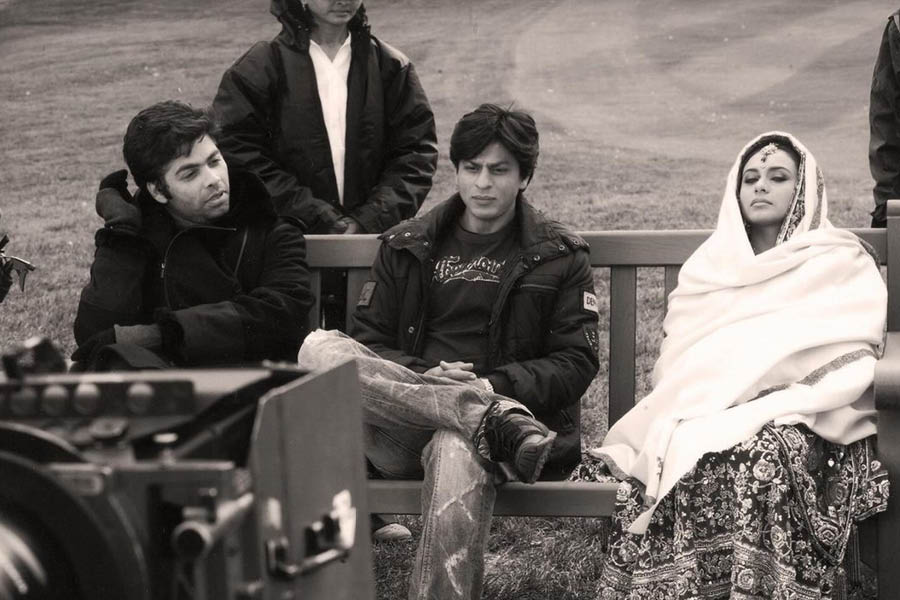
Ram Gopal Varma

Bollywood’s going overseas…

• Manmohan Shetty’s Adlabs and Ashok Amritraj’s Hyde Park Entertainment are co-producing three Hollywood movies. The first of these is Asylum, directed by David R. Ellis.

• Ram Gopal Varma will be directing Within, a horror film to be shot in Manhattan, for a global audience.

• UTV Motion Pictures is co-producing three Hollywood films, two with actor Will Smith’s production company Overbrook Entertainment and one with Fox Searchlight, a 100 per cent subsidiary of 20th Century Fox.

Sanjay Leela Bhansali

…while Hollywood’s cocking an eye at India

• Sony Pictures Releasing of India (SPRI), an offspring of Sony Pictures Entertainment, has announced a collaborative venture with director Sanjay Leela Bhansali’s production house, SLB Films. Cameras for the Hindi film Saawariya have started rolling in Karjat, on the outskirts of Mumbai.

• Earlier, Sony Pictures marketed and promoted Bengali film Saanjh Baatir Rupkathara.

• Warner Brothers has tied up with music company Sa Re Ga Ma for home video. Recently, Raymond bought the India rights to use Superman on its products for two years. The textile major is selling Superman apparel for two of its brands — the kids wear brand Zapp! and the premium outdoor lifestyle brand Parx.

Top
Email This Page