|
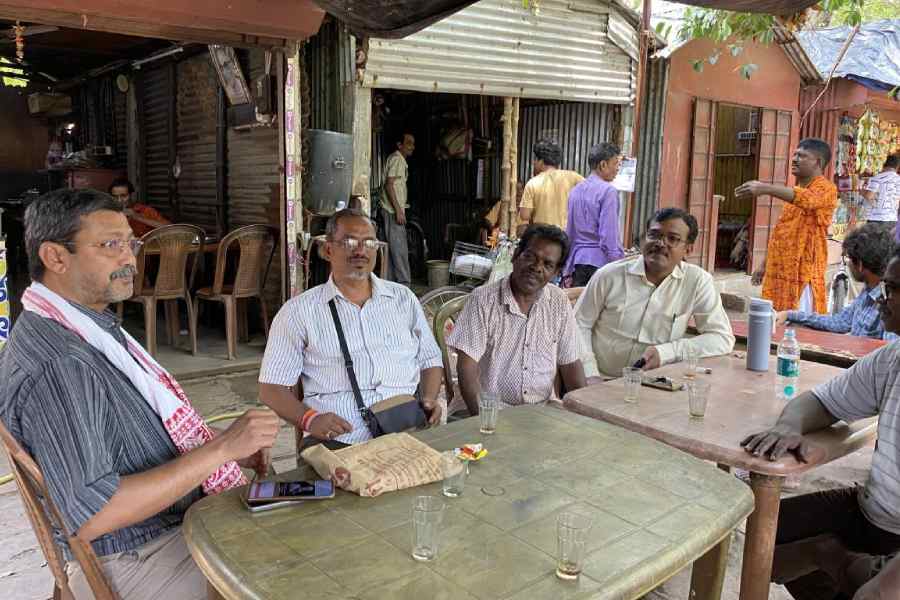
Sitting in his small, book-cluttered home office inside the CPMs headquarters in Calcuttas Alimuddin Street, Benoy Konar fishes out a bidi from his kurta pocket, lights it and takes a deep puff. As the smoke curls up, the 76-year-old Marxist watches it, coughs a little and then, with a wave of his hand, dismisses all the arguments about the so-called conflicts between Marxism and religion.
A believer can be a Marxist. There is nothing wrong with it, Konar, a peasant leader and member of the CPMs state committee, says. Marxists believe in dialectical materialism but are not necessarily atheists.
Such words — coming from a veteran Marxist — might sound a tad odd. But times change and so do the Marxists. Gone are the days when communist leaders studiedly shunned religion — especially public display of religiosity — as it went against the basic tenets of Marxism.
They now not only visit temples to seek blessings but also hop from one puja pandal to another, cutting ribbons. The phenomenon is not restricted to Bengals ruling party for three decades, though. If West Bengal transport minister Subhas Chakraborty, photographed offering puja at a temple in Bengals Birbhum district barely 10 days ago, sees nothing wrong with the puja, since hes a Hindu and a Brahmin besides being a Marxist, two CPM legislators from Kerala who had taken their oath in the name of God in the Assembly in May have shown no remorse either. And in both cases, the party squirmed in embarrassment, but has done little else to the believers who, in the words of a former Marxist functionary, would have been summarily expelled from the party in our day.
|
|
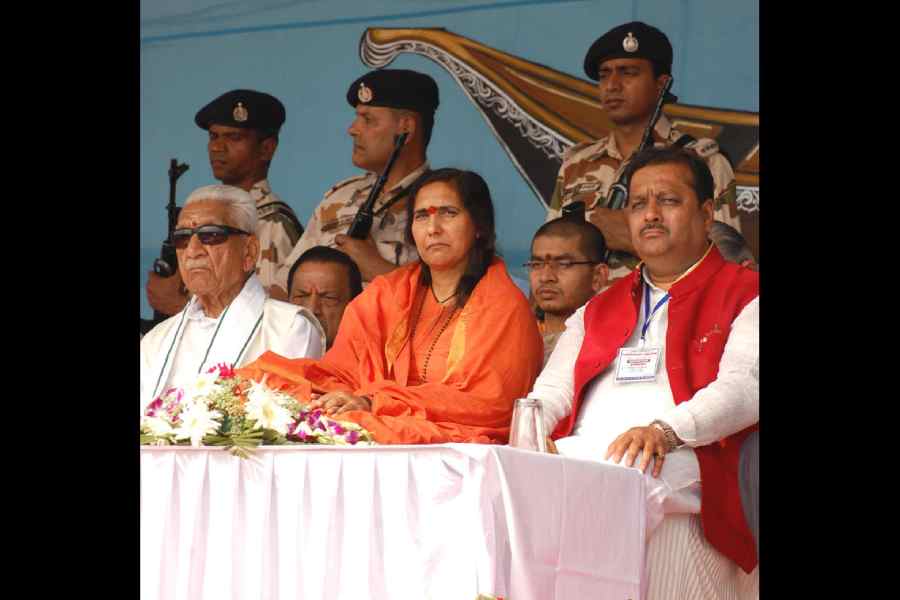
| Like a prayer: Subhas Chakraborty at Tarapith |
Apart from a rap on the knuckles in public by his mentor and former Bengal chief minister Jyoti Basu, the CPMs Bengal unit has virtually let Chakraborty off with a slap on the wrist. He was summoned to the partys state committee meeting a couple of days ago to explain his position after the media widely covered his visit to the temple. But later, CPM Bengal secretary Biman Bose made it clear that the transport minister was neither show-caused nor censured but was asked to clear the air in public. Then, all Chakraborty did was express a feeble regret saying he had not realised his going to the temple would spark off a controversy. I have been to many temples before in different parts of the country but have never faced this (controversy), the Marxist minister told reporters.
Things are no different in the CPMs Kerala state unit. There, too, the party has not been able to lift a finger to reprimand — let alone punish — the religious-minded legislators, Aisha Potti, the Marxist-ruled states first Brahmin woman MLA, and M.M. Monayi, a practising Christian. We dont censure any party leaders for their ignorance or backward consciousness. We try to indoctrinate them into the Marxist way of thinking, says Kerala education minister M.A. Baby, who is a member of the CPMs central committee.
If wooing private and foreign capital is the new economic credo of the ruling Left in Bengal, born-again Marxists see no contradiction between having faith in God and Marxism at the same time. An irony indeed, given the communist propensity to use Marxs overused dictum that religion is the opium of the people… (see box ). If anything, the party is now falling back on a technicality to justify the act of its leaders. Our party constitution does not make it mandatory for a member to be a non-believer. So you can be a member of the party and still practise your religion, CPM Rajya Sabha MP Nilotpal Basu says.
| Karl
Marx speak |
Religion
is the sigh of the oppressed creature, the heart
of a heartless world, and the soul of soulless
conditions. It is the opium of the people. The
abolition of religion as the illusory happiness
of the people is required for their real happiness.
To call on them to give up their illusions about
their condition is to call on them to give up
a condition that requires illusions.
The criticism of religion is, therefore, in embryo,
the criticism of that vale of tears of which religion
is the halo.
From Introduction to a Contribution
to the Critique of Hegels Philosophy of
Right by Karl Marx |
|
To be fair, the communist parties in the country, particularly the CPM, have never been anti-religion as such. But there was always a strict guideline — an unwritten code of conduct — when it came to religion. According to a senior CPM leader, the party permitted religious activities in private but strongly objected to its members participating in public acts of religious faith. In other words, you could be a devout believer in private and an ardent Marxist in public.
But the thick Marxist curtain that has long concealed the religious activities of the party leaders from the public view is fraying at the edges — and the truth is peeking out. Rajashri Dasgupta of the Calcutta-based Centre for Studies in Social Sciences says the distinction between the private and public domain of a Marxist does not hold any more. The Subhas Chakraborty episode has amply demonstrated this. What they practised in private is now spilling over into the public, he says. Dasgupta has extensively studied the religiosity of Bengals Marxists.
Not everyone is convinced about the way the Marxist leaders are trying to explain away the conduct of their God-fearing comrades-in- arms. A Jadavpur University professor, who is well versed in Marxism, says the Marxist attempts to defend the indefensible smack of hypocrisy. God is simply an untenable concept in Marxism, which is rooted in rationalism, he says.
Some also view the Marxist change of heart as a failure of the ideology. Marxism has collapsed all over the world for a number of reasons, especially its failure to come to terms with the religious needs of the people, Trinamul Congress MP Sougata Roy says.
Opposition parties also see a blatant political opportunism in the CPM endorsing the religious belief of its members. Its not possible to be a Marxist and go to capitalists for investment. At the same time, its not possible to be a Marxist and go to temples, BJP Bengal president Tathagata Roy says. But they are doing both just to hang on to power and control the lives of people.
Yet in some ways, social scientists say Marxists in India had never really strayed very far from the countrys deep religious traditions. Historically, upper caste Hindu men dominated the communist movement in the country and it would be wrong to say that all of them have given up their religious identity for Marxism, says Dasgupta of the Centre for Studies in Social Sciences.
True, the social, linguistic, caste and religious identities of the people are too strong for any political party to ignore in India. Aisha Potti, a Marxist lawyer who got elected from Kollam district in Kerala, says she preferred to be sworn in in the name of God as she has never given up her religious faith despite being committed to her party.
CPM leaders cite examples of the Christians, Buddhists and Muslims participating in communist movements in Latin America, East Europe, Vietnam and China. Lenin said even a priest could become a communist if he is ready to fight for the oppressed, Kerala education minister Baby says.
Yet the dilemma over religion persists as Indian Marxists grapple with the idea of marrying a rationalistic ideology with the countrys social reality. For all its public posturing, the CPM hasnt clearly approved of what Subhas Chakraborty has done. Konar says Marxists are supposed to be rational, materialistic and secular. Its unbecoming for a Marxist leader to go to a temple and then brag about his Hindu identity. We should not act like preachers, says the veteran CPM leader, frowning upon Chakrabortys visit to the temple.
And there are differences between the communist parties. The CPI, the party the CPM was born of, feels Marxism and religion are not compatible. As Marxists, we dont believe in God or any supernatural power. We are materialistic and seek to end the injustice and exploitation of the people by the people. There is no God involved in this battle, CPI Rajya Sabha MP Gurudas Dasgupta says.
Clearly, there is a chasm between what the Marxists preach and practise. In the 1980s, E.M.S. Namboodripad, the late Marxist ideologue, would not let Kerala Congress (Joseph) supreme P.J. Joseph into the Left Democratic Front unless he disowned the bishops publicly. Now the Kerala leadership feels no compunction about letting party legislators take an oath in the name of God even though, Baby says, they do not encourage leaders to go to church or temples.
In politics, ideology often takes a back seat as expediency takes over. Some say its not unusual for the CPM to wink at the religiosity of its members. This is simply the consequence of a Marxist party trying to survive in a parliamentary democracy. The CPM has to take into account popular sentiments and cannot afford to be seen as irreligious in Indian context, says Dwaipayan Bhattacharyya, a political scientist, who has widely surveyed the ruling Left Fronts successful reform programme.
More than anything else, Bhattacharyya says the CPM, to stay in power, has transformed itself to a party of accommodation and mediation. The coexistence of different thoughts is inevitable within the party as it accommodates conflicting forces, including those who believe in religion, he says.
Some Marxist leaders feel taking a hardline and purging the party of believers could send many into the clutches of the BJP, something the CPM can ill afford politically. After all, its the BJP that is the Left partys ideological enemy number one.
Shyamal Chakraborty, president of the Bengal CITU, the CPMs powerful trade union arm, believes the party is flexible when it comes to religion. And for good reasons. Chakraborty says most festivals in the country are religious by nature and its hard to keep the Marxists away from them. How can a municipal councillor or an MLA or an MP say no when puja organisers invite them to pandals? Marxists live in society and have to participate in social and cultural festivals like Durga puja, says Chakraborty, a former minister in the Jyoti Basu government.
A CPM minister says the political cost of turning down requests to cut ribbons at the puja can be very high. Dont forget these are the people who vote for us and stay with us year round as many of the puja organisers are our workers, he says bluntly.
Not all Marxists share that viewpoint, however. Konar, for instance, says he is personally against party leaders inaugurating a puja or attending an iftaar party. Such acts can be misleading, he says.
But make no mistake, Marxists are no longer squeamish about displaying their religious faith. After all, as Konar puts it, Marxists, being secular, are the most religious people around. We are not disrespectful of God. Nor do we blame God for all our ills and pains unlike the so-called religious parties, the veteran Marxist says, stubbing out the bidi.
|