TT Epaper LHS
The Telegraph
TT Mobile
 
 
IN TODAY'S PAPER
WEEKLY FEATURES
CITY NEWSLINES
FEEDS
  RSS
  My Yahoo!
SEARCH
 
Archives Web
 
ARCHIVES
Since 1st March, 1999
 
THE TELEGRAPH
 
CIMA Gallary
 
Email This Page
Elephant trio on maneater’s trail

Lucknow, Aug. 5: Roopkali, Champakali and Pawankali are leading the hunt for a tiger in Dudhwa National Park that is suspected to have become a maneater.

Forest officers perched on the three elephants and armed with tranquiliser guns are scanning the jungles for the big cat after the killing of four villagers since May 21, the last one as recently as this week.

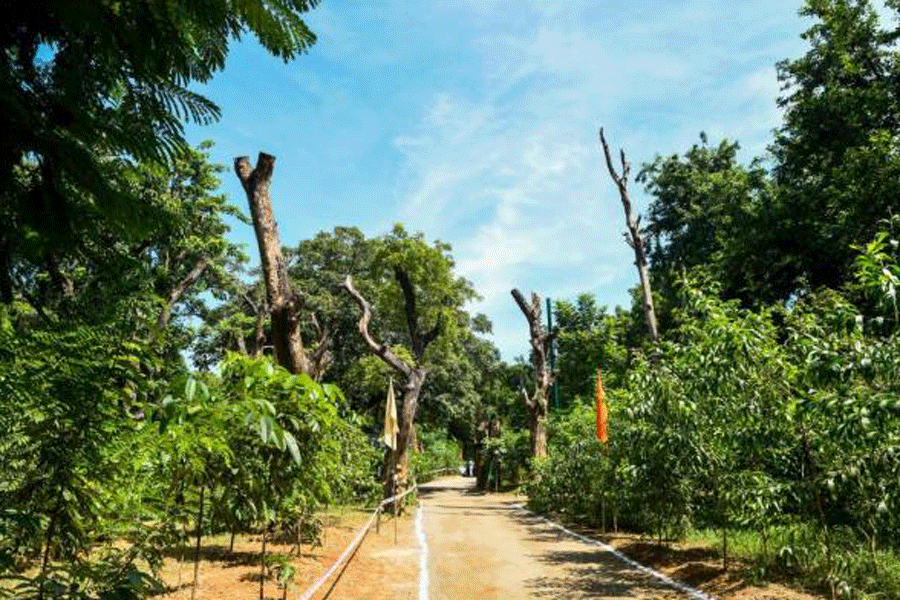
The hunt begins at daybreak, as the sun’s rays cut through the 50-feet-tall sal trees. “We are scouting every nook and corner of the jungle but there is no trace of the tiger as yet,” P.P. Singh, the deputy director of the park who is leading the hunt, said.

Till late in the evening, the elephants walk through the dew-drenched leaves in search of the elusive tiger.

The forest officers believe that the tiger might have been driven out of his lair by others, forcing it to venture into the human settlements aro-und the park and kill human beings. “It may not be a man-eater yet, although the villagers are asking us to declare it one. We want to trap the tiger and send it back to its lair,” Mohammad Ehsan, chief wildlife warden, department of forests, said.

Villagers near Dudhwa forest have been living in fear for the past two months. On May 21, Ram Singh, a 30-year-old farmer, died after he was mauled by a tiger near Kishanpur sanctuary, a part of the park.

On July 27, Kundan alias Munna, a 24-year-old farm labourer, was killed near the forest’s Khutan range, allegedly by the same tiger. The next day, Keshri Singh, in his late forties, became the third prey.

On August 1, Karan Singh, 20, was killed when he had go-ne to a tubewell near the Veera range to fetch drinking water. The same tiger was the suspect again. Deputy director Singh informed the state forest department, expressing his fear that the suspected tiger might have become a maneater. The forest officers, who are under pressure from the villagers protesting at the district headquarters, have launched a hunt.

Around 420 km from Delhi and 260 km from Lucknow, Dudhwa National Park is spread over 490 sq km and has a buffer zone of over 100 sq km. Besides grasslands and swamps, the park has the finest sal trees in India.

The first instance of man-eating by a tiger in the park was reported on March 2, 1978. Whenever any tiger turns maneater, forest officers are reminded of Tara, a tigress thought to have been put down after it allegedly turned a maneater.

Tara was born in a London zoo, brought up in animal lover Billy Arjan Singh’s farmhouse and rehabilitated in Dudhwa as a part of an experiment to see if tigers can coexist with human beings. After 24 people were killed in nine months in the late seventies, the killer tigress was put down on November 11, 1979. Tara, which was one of several tigers in the park then, was not sighted after that, leading to speculation that she was the maneater.

But the claim could not be proved and the debate still continues, with one group led by Arjan Singh denying the charge.

“That story of the man-eating tigress of Dudhwa is very much alive in the memories of the elders in Dudhwa National Park,” P. P. Singh said.

Top
Email This Page