|
Forget about snake charmers and
Indian swamis on beds of nails. Susanna Nicklin belongs
to a new generation of globetrotting Englishwomen whove
dumped all those old images of the spiritual Orient. Ive
heard that its a very intellectual society. That it
is a dynamic one with people who are always trying to improve
themselves. I have heard that India is the envy of the world,
says Nicklin, director, Literature Department, British Council.
Perhaps its not surprising
that Nicklin has such a positive picture of 21st century
India. After all, she has been involved as an agent in the
translation of some of Indias top authors like Arundhati
Roy, Vikram Seth and Kiran Desai. Their works are
remarkable, says Nicklin. Desais Hullabaloo
in the Guava Orchard, was translated into 15 languages.
Vikram Seths was translated into more than 25 languages.
Arundhatis God of Small Things was translated
into even more.
Perhaps it was inevitable that
Nicklin would build her career in a field like translation.
She was brought up in Sussex where her parents ran an English
teaching school for foreigners who came from all corners
of the globe. Nicklin recalls that her childhood was a like
a mini United Nations sessions with about 100 students at
any given time of a score of nationalities.
It was like in one room
there will be a Turkish student and in other would be a
Spanish student, says Nicklin, 42. My whole
upbringing was with people from different parts of the world
and it was interesting. It made me clear that I wanted to
do something with languages. She speaks French fluently
and knows a smattering of Spanish which is enough to get
her around the world. She read English at Oxford before
taking a plunge into the world of publishing.
She started out at Bodley Head,
one of the venerable London names in those days. But she
soon switched and joined an international literary agency
which specialised in translation rights. As a result she
ended up working with lots of internationally famous Indian
writers and other top-notch names like Sue Townsend, Fay
Weldon and Kate Atkinson.
In 2002 she decided to leave the
world of translation behind and became the director of English
PEN, the writers association promoting literature,
literacy and freedom of expression. She stayed for a few
years before joining the British Council last October. Nicklin
says India is high up in their priority list and there is
a large audience for Indian writers in the UK. Most
Indian writers have narrative skills. Often they are able
to produce works that are interesting and new to readers
in Britain, she says.
But the exploration of Indian
writers, according to Nicklin is nothing new. It happened
some 15-20 years ago. During this era readers in England
became interested in the world beyond the White Cliffs of
Dover. They began reaching out for authors like Czech writer
Milan Kundera, Gabriel García Márquez and African writer
J. M. Coetzee.
In that scenario Indian writers
turning out English prose suddenly found themselves in the
fast track simply because they were more accessible compared
to writers in other languages. Says Nicklin: we have
no language barrier with Indian authors. And that,
according to Nicklin is a big asset. Editors and publishers
read their work with interest. And when language is not
a barrier, there is nothing that separates authors from
editors and publishers. If there are different manuscripts
in different languages like Spanish, French, German and
English, the editor is most likely to pick up English manuscript.
This is where Indian writers score over non-English writers.
But Nicklin insists that writers
like Vikram Seth, Salman Rushdie and Arundhati Roy have
resulted in a high regard for Indian writers. Thats
because, adds Nicklin, They are different compared
to other writers from other parts of the world. Lots of
Indian writers have storytelling skills. And it is important
for Anglo Saxon readers to read them.
Her personal favourite is Vikram
Seths The Suitable Boy . It completely
pulled readers to a new world. It was captivating as it
was set in post-Raj era, an era that is unknown to the Britain.
Nicklins experiences with
writers and publishers around the world is bound to stand
her in good stead in her new job. In the last few months
she has been on the move, travelling to different countries
around the world. One new aim is to bring writing in different
languages to audiences in the United Kingdom.
Inevitably, Nicklin needs to understand
the Indian publishing scene in her new job. She has already
made the rounds and dropped in on top publishers and visited
bookshops to get a feel for the trade in this country. Also,
shes checking out the market to see what British authors
are available in the local market. When we have writers
from the UK coming here, I want to make sure that their
books are available here.
She insists that after years in
the book trade she can almost tell a good book just by looking
at its cover. Whats she reading right now? One book
thats in her travelling kit is Suketu Mehtas
Maximum City. Im loving it. Its
so alive and vibrant, she says. She says that non-fiction
books are hot favourites in Britain currently. So, theres
lots of demand for non-fiction and travel so writers like
William Dalrymple are in hot demand.
Nicklin says she decided to come
to India skipping the other countries in the sub-continent.
But shell be visiting them all soon and its
a safe bet that shell be back in India before long.
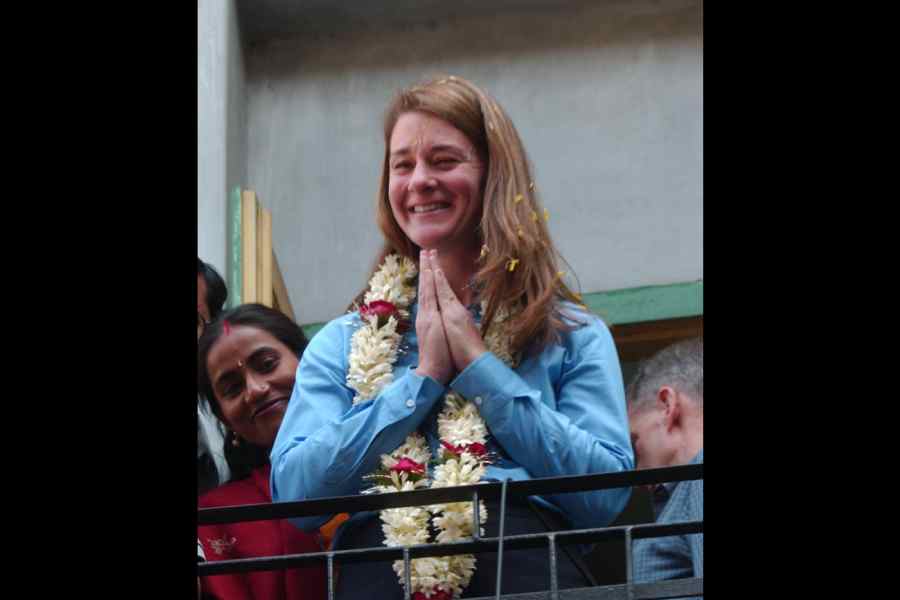
Photograph by Rupinder Sharma
|