|
|
A Chinese soldier stands guard while his Indian counterparts work at Nathu-la on Tuesday. (AP)
|
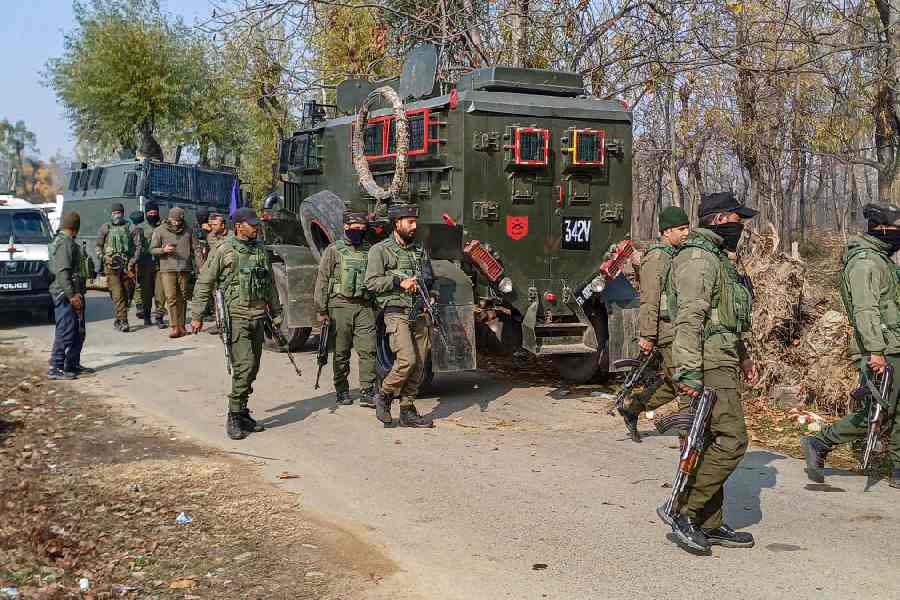
Gangtok, July 4: A huddle of uniformed officers in a first-floor room at the district courts this evening scanned maps and graphics of Nathu-la in minute detail, some 60 km from the pass that is to re-open for trade on the Dalai Lamas birthday, day after tomorrow.
Sikkims East District commissioner Ravindra Telang and SP Sasidhar Rao are worrying about how to sort out what is expected to be the worlds highest traffic jam ? another superlative to be added to the many the mere prospect of reopening the pass has thrown up.
A desolate border post where Indian and Chinese soldiers have been eyeball-to-eyeball for the larger part of 44 years is to be the venue of a frenetic burst of activity. But there is only so much that the Himalayas here have room for.
Cutting through the diplomatese and the political innuendo, the hyperbole and the statistic, this is what Nathu-la trade boils down to ? traffic management. During a mock drill today, an officer said, the Chinese gawked as usual at the activity this side of the border.
There doesnt seem to be such intensity on their side. They are much more structured. One person takes the decision and the others execute it. We have to be more democratic and consensual, he said.
So the army has advice to offer, the Indo-Tibetan Border Police have to counsel and the commerce and industries department must make its own statement for this is its show.
But the Chinese have come to the aid of Indian traffic managers. They have told them that even if the trade protocol allows for 100 traders and 60 vehicles to cross over, that cannot happen for now. There isnt enough space to park 60 vehicles at Rinchengang, the trade mart on the Chinese side of Nathu-la.
So the 100 traders ? who will be given passes for the season till September tomorrow ? will be boarded on four buses and taken to the border. That still leaves the Indian side worrying about how to accommodate more than 30 vehicles at Nathu-la Dwar, a point 3km short of zero-line from where the road is one-way only. In those 3 km the road climbs steeply by a 1,000 feet from about 13,500 feet.
The managers of Thursdays big event from the two countries will meet in a conference hall ? said to be the worlds highest and built by the Indian Army ? tomorrow to help with the logistics.
The ITBP will secure the corridor from Nathu-la to Sherathang, the trade mart on the Indian side 7 km from the border, where the formalities of immigration, customs and quarantine will have to be gone through. Chinese traders will not be allowed beyond Sherathang just as Indian traders will not be allowed beyond Rinchengang.
So bleary-eyed officers from India will wind their way up from Gangtok for the 8 am meeting when it is 10.30 in China. We have been doing this for nearly six months off and on now, a tired deputy secretary said.
Unlike the two other passes ? Shipki la in Himachal and LipuLekh in Uttaranchal ? there is actually motorable road to China from here. A police officer regrets that. I wish it wasnt there and trade was continuing on mule-back, he said.
So much has happened since 1962 when the pass was closed and the Dalai Lama took it for a visit to India before he moved in to the country on near-permanent exile. This Thursday, he will be far away from the exhaust fumes belched by a hundred vehicles in this pristine paradise.
With the first crossing of the traders, Beijing and New Delhi will note that China was endorsing Sikkim into India on a day the followers of the worlds most famous exile will celebrate.
|