|
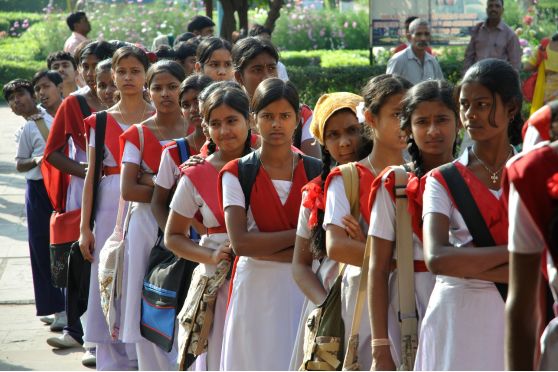
| WE ARE THE WORLD: Students take a
break in Pathways World School, Gurgaon |
When the Delhi-based Institute for Integrated Learning in Management (IILM) set up the IILM World School in Gurgaon in Haryana in April this year, they chose to offer a blend of two international curricula rather than a syllabus based on national school boards. At around the same time in Pune, the newly launched Sharad Pawar International School too opted for the International Baccalaureate (IB) curriculum. By choosing global study programmes, the two schools have only supported a growing trend ? one that has resulted in the slow penetration of the IB and the Cambridge International Examinations (CIE) curricula in Indian schools.
In fact, as many as 26 schools have IB affiliation and over 150 schools follow the CIE, which offers International General Certificate of Secondary Education (IGCSE), and A levels in India.
Globalisation and the ensuing desire for all things international are the reasons Indian parents and schools opt for these global curricula. Moreover, supporters of these curricula say that they come with some inherent benefits that are lacking in our national boards. These benefits include easier access to international institutions of higher learning, a flexible education system that allows the student to mix and match different subjects and streams, and a practical and application-based learning that prompts students to think and form their own opinion.
Although our national school boards are trying to change, their teaching methodologies are still largely memory-based. Students just cram from their textbooks and then vomit out what they learn in the exams. International curricula on the other hand are application-based and are not restricted to textbook knowledge, says S.C. Arora, vice chairman of Lotus Valley International School in Noida, UP. The school offers both CBSE and IGCSE curricula.
The IB, for example, believes that freedom of learning and knowing how to learn is more important than what one learns. It allows students to choose from a variety of subjects and is flexible enough to let them mix and match unrelated subjects in a way that is unthinkable in the Indian educational system.
In the IBs diploma programme (DP), which is taught in Class XI and XII, students have to choose one subject from six groups. These are first language (English), second language (French, Hindi, etc), individuals and societies (history, economics, business etc), sciences (biology, chemistry, physics), mathematics and computer science, and electives (either a vocational course or a second subject from one of the other groups). In the IGCSE curriculum, a Class IX student has to choose one subject from five groups. And if they study seven subjects, they become eligible for the more prestigious International Certificate of Education (ICE).
Such flexibility of subjects gives the student the opportunity to study and understand a wide range of subjects.
The IB is a very rigorous and holistic programme that is not centred on just improving a students academic performance, says Lalage Prabhu, principal of Pathways World School, Gurgaon, which follows both the IGCSE and IB curricula.
All DP students have to write an extended essay and engage in Creativity, Action and Service (CAS), which involves taking up a creative activity, playing a sport and doing social service. For instance, Namrita Rai, who passed out from Pathways in 2005, chose to work in the school newsletter team, took up swimming and taught workers in her school and also collected aid for tsunami victims as part of the CAS. The students also have to write an extended essay based on original research over a period of two years. Rais essay of 3,500-4,000 words was on capital account convertibility in India. All the research and writing helped me immensely while applying to college, says Rai, who is currently pursuing an undergraduate business degree from Wharton Business School in the US.
Recognised abroad
There are also those who believe that many parents and students choose international curricula as they are widely recognised abroad and therefore make it easier for students to get admission in foreign institutions. Says Lorraine Mirza, principal of Pailan World School in Calcutta, Most of my students want to apply to foreign institutes for higher education.
The assessment process too varies from the methods followed by the national boards. Its not limited to conventional written papers ? a variety of tests are used, including oral and listening tests. Even the grading system is determined by grade thresholds, which are devised by examiners based on exam results every year.
Teacher training
Both the IB and the CIE also give a lot of importance to teacher training. The International Baccalaureate Organisation conducts frequent workshops for prospective and experienced IB world schoolteachers. The CIE, too, has teacher training courses and online interactions.
Notwithstanding the inherent advantages of these international educational programmes, they continue to be seen as elitist in India. The high fees charged by schools that offer international curricula make these programmes very expensive. While the CIE charges Rs 10,000 to Rs 15,000 for the final exams, the IB charges each of the affiliated schools a fee of US $3,800 (Rs 1,74,000), irrespective of the number of students. However, the schools have separate fee structures, irrespective of what they pay to these bodies.
Nevertheless, seeing the increasing number of global
schools mushrooming in India, global education seems here
to stay.
Programme Highlights
IB: The IB programme
is run by the International Baccalaureate Organisation (IBO),
which is based in Geneva, Switzerland.
There are essentially three programmes under it ––
the primary years programme (PYP) from nursery to Class
V, the middle years programme (MYP) for Classes VI to X,
and the diploma programme (DP) for Classes XI and XII.
CIE:The University of Cambridge International
Examinations (CIE) offers the International General Certificate
of Secondary Education (IGCSE).
This is a two-year curriculum taught in Classes IX and X
and is equivalent in standard to the British GCSE (General
Certificate of Secondary Education). Another variant of
the IGCSE offered by the CIE is the Cambridge O-level, which
is equivalent to the British General Certificate of Education
(GCE). The CIE also offers the Advanced Subsidiary (AS)
for Class XI and A-level programme for Class XII students.
|