|
|
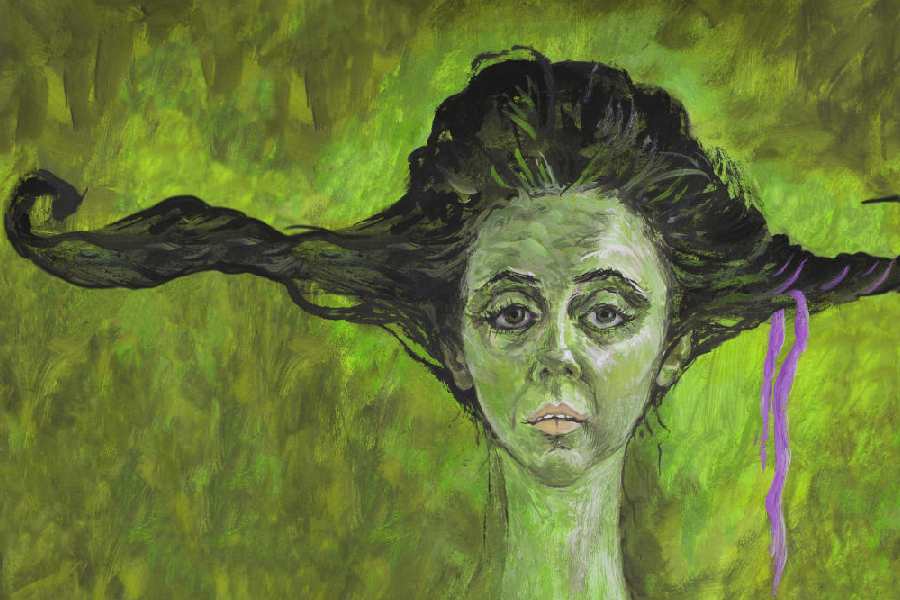
| Shakuntala, by Abanindranath Tagore
|
At the time Tagore was writing, traditional Indian
literature was seen (as it still is sometimes) to be almost indistinguishable
from mythology and religion; Tagore himself, although his own poetry and imagination
were radically secular, was translated as a public figure into the realm of mythology
and mysticism, partly because of this reason, and partly through his own connivance.
Yet the nature of his engagement with Kalidasa tells us of a very different concern,
a different agenda, which also brings him much closer to the modernist preoccupation
(prevalent in Europe at the time) with exactness, concreteness, and sensory perception
than one would ordinarily think.
The reasons for Tagore more or less ignoring, as a
practising poet, the influence of his immediate as well as not-too-distant precursors
in Bengal, such as the devotional poets Chandidas and Vidyapati (except in a youthful
pastiche he did of the latter?s work), and turning to a north Indian Sanskrit
poet of antiquity are manifold. In claiming Kalidasa as a precursor, Tagore is
seeing him as a proto-modern, as someone whose primary subject was the physical
universe, unmediated by religion, and whose primary concern was language itself,
and its ability to convey and enrich ways of seeing. The devotional poets of India
referred to the physical world ? to the landscape and to the weather ? in stock
images that circulated in their work; one would expect, then, that Tagore learnt
to ?look? at the real world from the English Romantics he admired. Tagore is aware
of this, and is at pains to tell us that he learnt it from Kalidasa, from whom,
too, according to Tagore, the Romantics inherited, consciously or indirectly,
the habit of looking at the world.
It?s no accident, surely, that the lines Tagore quotes
from Kalidasa in his essay, ?The Meghadutam?, about Kalidasa?s great poem-sequence,
not so much invoke tradition as much as contemporariness: they?re lines in which
perception, memory, and immediate physical sensation have come together in a single
moment and image, and are quite unlike anything in Chandidas or Vidyapati: ?The
breezes from the snowy peaks have just burst open the leaf-buds of deodar trees
and, redolent of their oozing resin, blow southward. I embrace those breezes,
fondly imagining they have lately touched your form, O perfect one!?
Kalidasa is crucial to Tagore?s revisionist notion
that a fundamental strain of enlightenment humanism ? the idea that the individual
fashions and reorders his relationship to the physical universe through language
? is more authentically Indian, or Oriental, than European. As a colonial subject,
Tagore would have known that, ever since James Mill wrote his contemptuous diatribe
on the Indian epics, the Ramayana and the Mahabharata, the common
English view of Indian writing was that it was overblown, grotesquely overwritten,
and excessively romantic. In Mill?s words: ?These fictions are not only extravagant,
and unnatural, less correspondent with the physical and moral laws of the universe,
but are less ingenious, more monstrous and have less of any thing that can engage
the affection, or excite admiration? Of the style in which they are composed it
is far from too much to say, that all the vices which characterise the style of
rude nations? they exhibit in perfection. Inflation; metaphors perpetual, and
these the most violent and strained? repetition; verbosity; confusion, incoherence;
distinguished the Mahabharat and the Ramayan.?
Through Kalidasa, Tagore wishes to show his readers
that classicism ? refinement and obliqueness in language, impersonality in perception
? is not only native to India, but has older roots there than in Europe. In another,
brilliant essay on Kalidasa, in which he compares Shakuntala to the Tempest,
Tagore turns Mill?s rhetoric upon Shakespeare, claiming, in effect, Hellenic classicism
as an essentially Oriental literary characteristic, and Orientalizing, in Said?s
sense of the word, Shakespeare and the European poets: ?Universal nature is outwardly
serene, but a tremendous force works continually within it. In Shakuntala
we can see an image of this state. No other drama exhibits such remarkable restraint.
European poets seem to grow wild at the least chance of displaying the force of
nature and impulse. They love to bring out, through hyperbolic utterance, how
far our impulses can lead us. Examples aplenty can be found in plays like Shakespeare?s
Romeo and Juliet. Among all Shakespeare?s dramatic works, there is no play
as serenely profound, as restrainedly complete and perfect as Shakuntala.
Such love dialogue as passes between Dushyanta and Shakuntala is very brief, and
chiefly conveyed through hints and signs.... Precisely where another poet would
have looked for a chance to let the pen race, [Kalidasa] quells it.?
Reading the essays on Kalidasa in the Oxford Tagore
Translations, one feels that Tagore is trying, in recuperating the Sanskrit court
poet, to do in the realm of literature what Rammohun Roy and his own father, Debendranath,
had done not very much earlier in the realm of religion and philosophy. Faced
with the charge that the Hindu religion was incorrigibly polytheistic, these figures,
instead of rejecting the European humanism from which that charge emanated, turned
to ancient texts like the Upanishads to claim that, in a sense, the Enlightenment
had an older lineage in India than it did in Europe.
The story of that Indian rewriting of humanism wouldn?t
be complete without an acknowledgment of how Tagore enlarged it in the field of
literature; for him, and for the narrative of Indian literature in the context
of humanism, Kalidasa and his arcadia are as significant and loaded with meaning
as the discovery of the Upanishads was to the Brahmo Samaj, the reformist
sect that Roy and Debendranath founded. ?Universal nature is outwardly serene,
but a tremendous force works continually within it?: it?s as if, in speaking of
nature, Tagore actually means literature, and the politics of literature, as it
appears to a man living in a momentous and turbulent time.
|