|
Chief minister Buddhadeb Bhattacharjee speaks to The Telegraph about policy debates in the CPM, the party-government relationship and his priorities, if elected back to power.
The Telegraph: There is
an atmosphere of faith in Bengal, but those outside Bengal
are often scared away by the statements of your party leaders
in Delhi ? do you think the CPM politburo is detrimental
to Bengal?s economic growth?
Buddhadeb Bhattacharjee:
As a communist party, we are going through profound changes.
Earlier, the party would regard such changes in a theoretical
context, but we have begun to view them from a practical
standpoint.
Our party has traditionally opposed foreign direct investment, technology inflow and lately FDI in retail. But there was a breakthrough in the last party conference on FDI and related issues. We were also opposed to the World Bank and other international funding agencies. The debate is still on, but the attitude has changed.
We now accept international funds for development in ?standalone? sectors like health. We tell the funding agencies we will pay the interest for the assistance, but we will not allow you to come into Asim?s (finance minister Asim Dasgupta) budget-making exercise.
At times, I may have to work in the face of what Fidel Castro has famously described as opposite current. But my objective is to strive towards the goal, carrying the party along, without getting deflected by the debate.
TT: But then Bengal is
most affected by ?scary? statements?
BB:Our party is on a learning
curve. But we have made it clear (to investors, planners
and decision-makers) that we in Bengal decide what
needs to be done in Bengal. (We have been able to convince
the leadership that we cannot be tethered to dogma.) But
there are (weighty) issues which I cannot clinch independently
of the party.
TT: Such as?
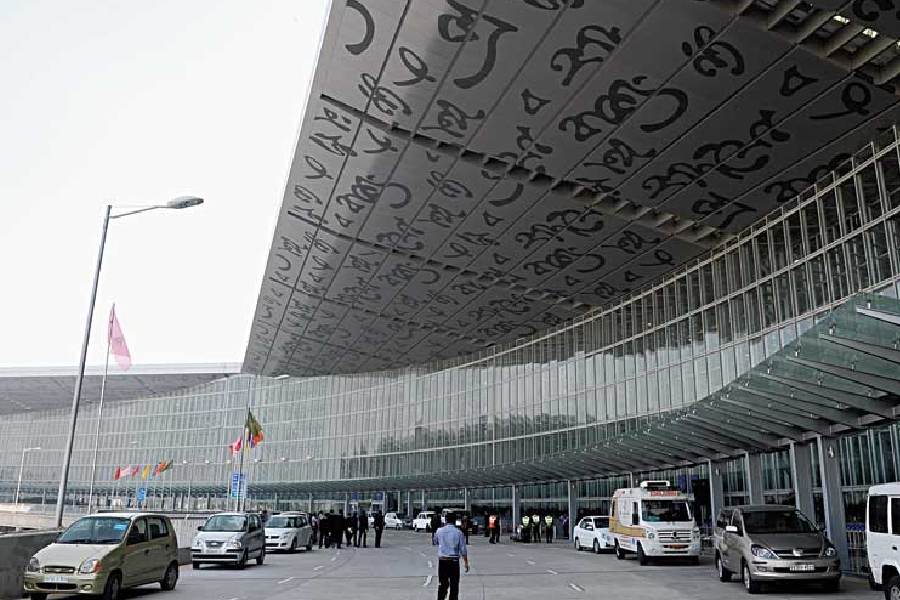
BB: Airport modernisation. I have explained to Prakash (CPM general secretary Prakash Karat) I have got to have Calcutta airport modernised but there are hurdles. We as a party insist on modernisation through public-private partnership but Delhi wants to hand over airports to private parties. As a CPM member I cannot accept it, yet as head of the government, modernisation of Calcutta airport is a priority for me. Prakash says we will address the issue when we confront it. This will be among the areas of concern for us in the days ahead.
TT: And CITU?
BB:IT and trade unions
will be another concern. We broadly agree that in IT, an
employee or a professional has the right to form or join
a trade union, but the choice must be left to him. Outsiders
cannot be allowed to disrupt working or agitate in IT units.
TT: Why IT alone?
BB:Absolutely. In certain
industries like jute or tea, wage agreements are already
being concluded bypassing unions. But IT is structurally
different from other industries, so the question of outsiders-run
unions assumes a different hue here. However, Prakash is
personally looking into various aspects to fix the party?s
approach to IT.
TT: Bengal has lost
precious time. Aren?t you late in your reforms?
BB:The past we all know
? Delhi politics and bureaucracy had us cornered, nothing
much could be done till the eighties. Even after we announced
in 1994 the industrial policy, the negative stereotype about
Bengal continued. However, our image has begun to change.
Ratan Tata feels strongly about Bengal, so do the ?Reliance?
brothers (Mukesh and Anil Ambani), the Japanese are showing
their faith in us by expanding investments in Haldia. Salim
and a few other groups from Southeast Asia, too, are showing
interest. Overall, the confidence level is rising.
TT: The Comptroller and
Auditor General paints an alarming picture of state finances.
After paying salaries, pension and repaying debt, your government
has very little money for development. How would you service
debt now standing at Rs 104,334 crore?
BB: That report relates to 2003-4, when we were in a critical condition. But the scene improved in 2005-06, thanks to the introduction of value-added tax, higher tax realisation and maximised excise revenue. We closed the 2005 fiscal with a surplus. However, the high debt remains a concern.
TT: You?ve been in power
for 29 years, of which you had the same finance minister
for 20. Should he not share the main burden for the mess?
BB: (Laughs) Well, permit
me to own responsibility for the mess.
TT: You have been owning
up for too many departments ? education, health, horticulture?
Aren?t you being a little hard on yourself?
BB: People have different
or unusual work styles. There are some colleagues who would
share details only with their diaries, not with the cabinet
or me, even if they are of a critical nature. As a result,
the government?s overall goal remains unrealised. But they
are no shirkers, they work in this fashion only to suffer
quietly. These days I summon the secretaries concerned and
ask them to share things with me directly. ?Sir, satya
katha balbo (Do we tell the truth?),? they ask. ?I must
know the whole truth, including the files that have been
put on ice without reason,? I tell them.
TT: In most democracies,
cabinets are frequently shuffled to reward the performers
and penalise the laggards. The Left Front has never done
so. Why?
BB: Shuffling the pack
midway is a culture at the Centre. Be it the UPA or the
NDA, the people running a coalition at the Centre are always
under pressure from various quarters to accommodate power
players. For the sake of continuity of policies, we allow
a minister enough time to deliver.
TT: And 29 years is not
long enough to deliver?
BB: If we are able to return
to power, the next cabinet will judge its members only on
performance. We are going to pick cabinet members carefully.
TT: How much freedom will
you have in picking your team? Aren?t your hands tied by
quotas ? from affiliated units, districts?
BB: It is true. The CPM?s take on the government is different from other parties. For instance, being a member of a communist party, I regard myself as one of the ministers who also heads the government. However, this time our thrust is on having only those in the cabinet who can perform. There will not be any other consideration. By dropping so many ministers and sitting MLAs and fielding new faces, we have issued a statement of our intent.
TT: You have cleaned the
education stables. But what about those who have spent more
than 20 years in the same office and have not delivered?
BB: I would rather stop
this discussion here. Suffice it to say we have already
completed the preliminary work, after taking the district
units into confidence. Let the election be over, you will
see how we deliver on the statement of intent.
TT: For you integrity and
honesty constitute a mantra ? but the same cannot be said
about several of your cabinet colleagues, a few of them
are managing important departments.
BB: I am aware of it. Just wait for a while.
TT: Does the new
approach include splitting the IT and environment ministries?
BB: I think IT and environment
may have to be separated for efficient functioning.
TT: You have taken some
initiatives in improving the state of education in Bengal,
but structural hurdles remain.
BB: Without going into
specifics, let me say universities and colleges have suffered
because of political interference. I shall refrain from
naming individual names, but it is a fact that our higher
education minister ? Satyada (Satyasadhan Chakraborty, who
has been dropped this time) is a good soul. He had come
under intense pressure from different quarters (read CPM
hierarchy) when he tried to implement government policies.
Political people, lobbies made things difficult in higher
education.
TT:Let?s take just one
hurdle. The government recruits teachers for private schools
or colleges. Should such a system exist in a free market
economy?
BB: The structure we have
constructed over time will have to be examined, and, if
necessary, changed. Our current exercise in granting autonomy
to some government colleges offers an insight into our plans
for re-creating centres of excellence. Certain noble, progressive
concepts relating to higher education came unstuck in the
past few decades, thanks to inefficiency of the (education)
department and tinkering by lobbies and politicians.
TT: The CPM has historically
opposed excellence. Even Amartya Sen?s appointment in Jadavpur
University was opposed ? by Jyoti Basu himself. Can you
change all that?
BB:Our new agenda for education
will emphasise quality and nurturing of talent. I have asked
the department to ensure that an unbiased recruitment mechanism
is put in place before it is too late. Just because one
is aligned with the CPM does not mean he will have to be
given a teaching or non-teaching job in an educational institution.
|