|
|
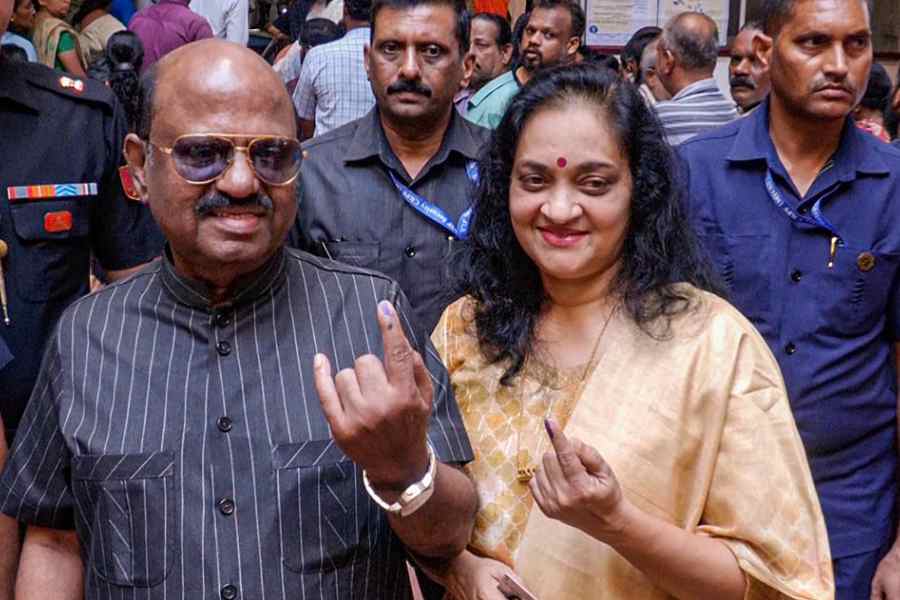
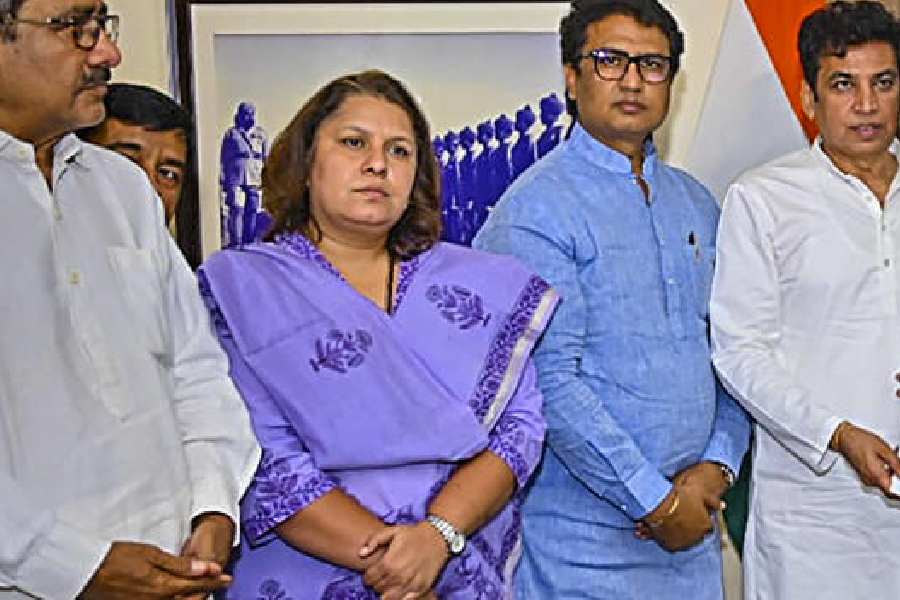
A child-friendly Bharatanatyam item on a Calcutta stage. (Inset): Mamata Niyogi-Nakra
|
What do you do when you are not dancing? Is it as cold on Mt Kailash, where you live, as here? Does the tiger skin protect you from the cold? How do you drink water or eat when your Neelkantha has poison in it? Which hand do you use to write?
Basic questions that never bothered the devotee but bugs the young mind being introduced to Lord Nataraja?s tandava nritya in dance school. These were what children in Canada wanted to ask the dancing god when they were given to write a letter to him. Such exercises have given birth to an entire repertoire of child-friendly Bharatanatyam. Last week, a dance school was inaugurated in Calcutta with a choreographed show inspired by it.
Mamata Niyogi-Nakra has been working with children for years at her dance school, Kala Bharati, in Montreal, Canada.
?I wanted to do something that would be relevant to those living outside the country. Though guardians want their children to learn about Dashavatara, Shiva or Krishna, it has to be acceptable to children,? says the disciple of Bangalore-based U..S. Krishna Rao and Chandrabhaga Devi, who took to teaching after an accident pushed her off stage.
The questions of the children were sent to a lyricist in Chennai and A Letter to Nataraja is now a full-fledged Bharatanatyam item.
?It is tough for a child to comprehend an abstract concept like showing reverence to god. In this composition, he hugs the lord instead, thanking him for inventing dance. But the steps are drawn purely from Bharatanatyam.?
The idea blossomed out of a piece of music on Radio Canada called Carnival des Animaux. ?I could actually visualise animals dancing. It was a moment of epiphany that made me compose a traditional tillana based on animal movements. The children just lapped it up,? says Nakra, adding that anthropological study of dance shows how it evolved out of animal movements.
Her work, the linguist insists, is not without a context. ?A recent survey by Vote For Arts, a movement to advocate promotion of arts through education, showed that 96 per cent Canadians believe the arts are integral to education. The Kennedy Center in the US has even come up with ways to test children?s progress in academics through the arts. We have to bring in a sensibility where arts are appreciated in education.?
In keeping with the trend, India International Centre in Delhi organised a seminar on making the arts child-friendly, where Nakra presented her thoughts to teachers from various schools. ?A small band of teachers there have formed a group called Dhitang to take this movement forward. A Calcutta chapter is opening as well.?
Says Shreeparna Ghoshal, whose school Nrtyaadhar will work with Nakra?s ideas, ?Last summer, we had done a workshop on Jungle Book. The kids were so excited that they fought over who would do which animal. Dance develops a child?s spatial intelligence while the present academic curriculum deals only with logical and verbal intelligence.?
?We have to enter the child?s world rather than take him by the hand and drag him into ours,? sums up Nakra.
|