|
Purulia,
April 14: Police in Maoist-insurgency Purulia, Bankura
and West Midnapore have made a case for helicopters to be
used to combat the extremist armed squads.
The helicopters are to be used
for rapid deployment of security forces because fear of
landmines laid by the insurgents is slowing down security
forces.
The police want to requisition
at least one helicopter for each district that will be capable
of ferrying 20 personnel. But, to start with, a request
has been made for at least one helicopter to cover the hilly
and forested belt stretching from West Midnapore to Purulia
along the border with Jharkhand.
Earlier, a study by Jharkhand
police and the civil aviation department had made a case
for a Jharkhand Air Guard. The study was submitted to the
Union home ministry late last year.
The use of helicopters against
Maoist armed squads in Bengal can necessitate the creation
of a separate force or the creation of a special component
in the security grid for the state. The Andhra Pradesh government
did it a few years ago with a force that it calls the ?Greyhounds?.
The Union home ministry and the
security establishment in Delhi, too, are grad-ually veering
round to the view that extraordinary steps need to be taken
to curtail Maoists across seven states. Last month, the
cabinet committee on Security approved enhanced reimbursement
of security-related expenditure in these states.
Helicopters would be used in the
first phase of the Bengal Assembly elections due here on
April 17 to ferry polling personnel.
But these choppers would not be
at the disposal of the state government after the polls.
The police have already been given
digital maps and global positioning systems and these are
in use in Bengal. Night vision devices have also been given
to a Special Operations Group of the state armed police.
Each of the three districts in Bengal have a special operations
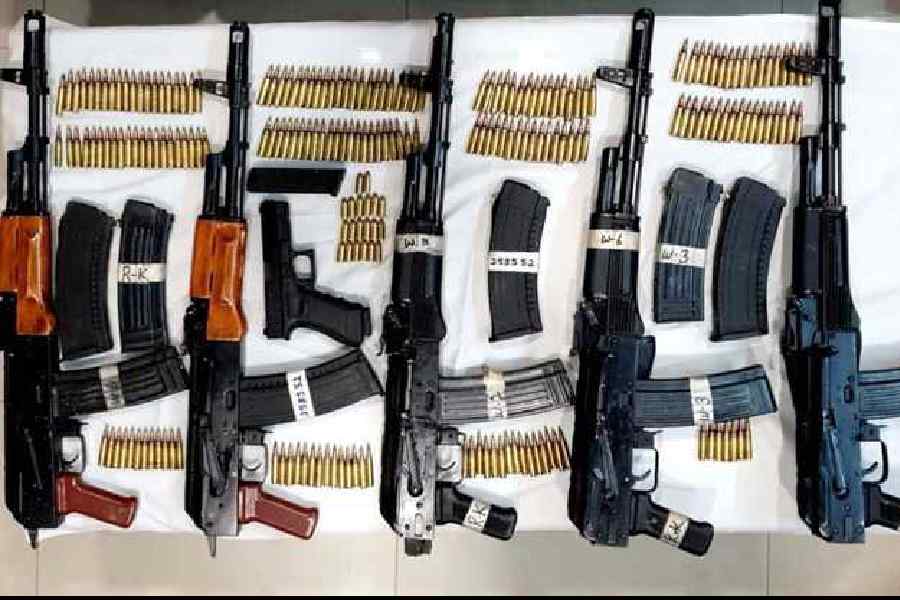
group equipped with AK 47 and Insas rifles, night vision
devices and a digitised map of their area of responsibility.
Armed police director-general
Rajat Majumdar is also understood to have demonstrated a
US-made human detection system that is in the process of
being acquired. The system works on the ultra low frequency
radiation emitted by a human body to detect movement within
a radius of 500 metres. They are different from the thermal
imaging systems used by the army along the Line of Control
in Jammu and Kashmir.
The Maoists? arsenal comprises
mostly .303 rifles and 7.65-mm SLRs snatched from the police
? mostly in Jharkhand but also in Bengal ? and Claymore
mines that can be buried on the road but also hung from
trees.
The latest incident of rifle snatching
in Bengal was in Purulia on February 13. One officer said
it was within ?audible range? from Purulia town.
This is how he described the incident
at Katadi: ?A few young men walked up to a police chowky
(outpost) next to a primary health centre. They pretended
that they were engaged in a scuffle in the train and had
come there to lodge an FIR and then to get medication at
the primary health centre. Having gained access, they neutralised
the sentry, picked up about six guns and fled. They were
mostly .303 rifles.?
The real challenge for the administration
will be immediately after the polls ? of which the Maoists
have called for a boycott but at the same time are saying
they will not engineer major disruption ? after most of
the paramilitary forces are deployed for duties elsewhere
during the five-phase elections.
Just before the polls there were
five companies of the CRPF, Eastern Frontier Rifles, and
the India Reserve Battalion deployed in the region.
For the elections, an additional
161 companies ? more than 16,000 personnel ? from the CRPF,
BSF and Haryana police are in the process of being deployed.
The need for helicopters will
be felt most after the central forces are withdrawn. |