|
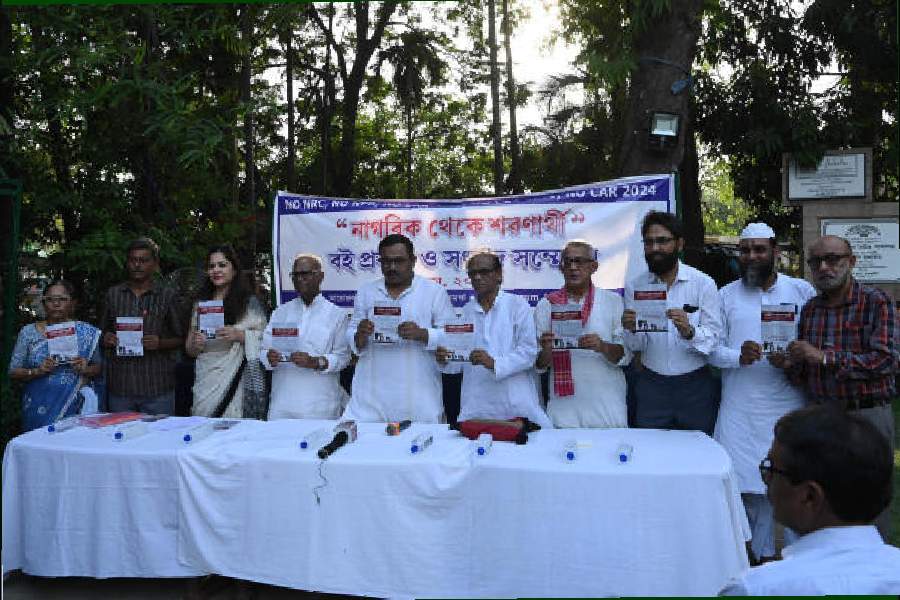
| ALL FOR IT: Nafisa Ali attending a meet on the right to information
in Calcutta |
The story of a slum dweller in Mumbai is the stuff
that legends are made of. He had filed an application for a ration card but decided
against paying a bribe for it. Youll never get it, people told
him, for the going rate for a ration card bribe in that area was somewhere around
Rs 2,000.
The would-be ration card owner went ahead and filed
an application under the Right to Information Act, asking how many people had
been given their ration cards ahead of him, despite having presented their forms
after he had submitted his papers. He got his ration card.
The ration card episode, activists hold, is an important
outcome of the Right to Information (RTI) Act which came into effect on October
12, 2005. Whats not as known is the flip side of the law ? an issue that
brought supporters of the Act, as well as some careful dissenters, to a seminar
in Dehra Dun last week.
That the RTI is a landmark Act, activists stress,
is an established fact. The right to information is a fundamental right,
says Justice Surya Kant of the Punjab and Haryana High Court. And access to information
is directly linked to the freedom of expression.
Those were the considerations that gave momentum to
the movement for the right to information, spearheaded by activist Aruna Roy and
her Rajasthan-based Mazdoor Kisan Shakti Sangathana. The Act gives any citizen
of India the right to seek information from the government on any subject, barring
what the government considers sensitive subjects that include national
security and issues that could cause a breach of privilege of Parliament or state
legislatures.
But supporters of the Act believe that the time has
come to critically look at the law and bring about some changes. Some of the problems
are functional ones that can be sorted out; some, they stress, need widespread
consultations. We need to have an awareness campaign on this, says
Vinay K. Dharmadhikari, a scientist at the Central governments department
of information technology.
One of the serious issues of concern voiced by many
is the fear that bureaucrats may ride roughshod over the law and take over the
commissions set up to facilitate its use. It is clearly stated in the Act
that public servants and administrators come at the end of the list of appointees
for the state chief information commissioners, says Avdhash Kaushal, the
head of the Dehra Dun-based Rural Litigation and Entitlement Kendra (RLEK), the
organisers of the seminar. However, in a state like Uttaranchal there is
not even a single appointment of a person of eminence in public life other than
bureaucrats, he says.
Members of the government, too, believe that there
is a need for bringing in people other than bureaucrats and politicians into the
ambit of national or state-level commissions.
For 50 long years, the establishment in India had
its system of safeguarding information. And though its too early for the
Act to bring about change, most experts on the right to information believe that
not every state is willing to share information with what it sees as a common
applicant.
Several government departments dont have a single
window for those hoping to file an application under the RTI Act. The National
Campaign for Peoples Right to Information, a New Delhi-based organisation,
pointed out to the National Advisory Council earlier this year that several departments
had multiple public information officers (PIO), which meant that an applicant
had to run from pillar to post to get to the concerned authority.
The Act states that there should be people dedicated
to the RTI in every department. But Justice Surya Kant points out that there are
many cases where government employees do the work of information officers while
attending to their earlier duties. We need a separate cadre to deal with
this, he says.
Clearly, not everybody is keen on transparency. The
Official Secrets Act has led to the establishment of a close, intimidating
structure, says Faizan Mustafa, registrar, Aligarh Muslim University (AMU).
On the other hand, there is the issue of opening the floodgates with the enactment
of the RTI Act. People have been flooding various departments of the government
with applications for information on diverse topics. At the AMU itself, Mustafa
has had to cope with a questioner who wanted to know everything about appointments
since 1976: who had been appointed, who had been rejected and why. Another person
wanted to know where AMU printed its question papers. And this is obviously
something that we cant divulge, Mustafa says.
The law, many believe, needs to be tweaked for better
use. And one of the ways of doing that is by bringing some of the lacunae to light
? which is what the Act itself seeks to do. After all, sunlight is the best
disinfectant, says Mustafa.
|