|
Hope Foundation, an NGO for street children, held a workshop on January 30 at Indian Institute of Training and Development. The aim was for the children to speak their minds on issues that affect their lives, and to figure out how to deal with their problems. It was headed by Sarbani Das Roy, who stressed that the children ?would be in the driver?s seat and would guide the adults, since the day was meant for them?.
The workshop followed a meeting on January 24 that included a talk by the Society for Peoples? Awareness (SPAN). The meeting concluded that Calcutta should be divided into four zones to make the process easier and more effective. Certain criteria were established for the selection of the children to participate in the session on January 30, including their ability to express themselves.
The kids had to be in the age group of eight to 16 and there was to be an equal ratio of girls and boys. Das Roy also made it clear that ?there is no relation between academic qualification and the enlightenment of children?.
The workshop?s emphasis was on establishing communication with the children. The exercises were designed to make them express their opinions. The kids were then asked to imagine that they were political leaders and each one express personal likes and dislikes.
The session culminated in the adults and children being split into four groups, with the youngsters constructing a story encapsulating the spectrum of emotions they experience in their lives. This was done with little help from the grown-ups.
The groups then performed the stories, with adults playing appropriate parts. Almost every danger and trial that street children experience was portrayed ? with rag-picking, begging, torture, domestic violence...
The stories were then discussed within the larger group, and positive conclusions were drawn. The 12 resolutions included stopping pickpocketing, establishing a helpline and acquiring vocational training. Finally, the kids were asked if they would stand by these resolutions. The reply was a resounding yes. Additional workshops for the facilitators and chief functionaries were held on February 13-14.
From child rights workshops to fundraising for education. The mantra ?freedom through education? was put into practice recently with a large amount of donations to schools from the international organisation Round Table. Eight schools in Calcutta received around Rs 52 crores in funds.
A significant proportion of the money has come from the Round Table of the Netherlands, three members of which were in town inspecting the fruits of their contributions. John Reinerie, former national president of Round Table Netherlands, visited Calcutta along with friends Henk van Heijst and Wolter Brinks.
The Dutchmen were impressed with what they saw at Nabadisha Primary School, partly funded by Round Table 34 of Park Street. ?The school was originally one-storey high. We have provided some of the money to extend it. The capacity now is 600 pupils,? said Reinerie. Half of the funding for the schools was provided by the Dutchmen. The remainder was given by the Round Tablers of India.
?We hate having middlemen involved when giving money for such projects. You?re not sure whether the money is being diverted or not. What we like about the Freedom Through Education project is that the money is being managed directly by local people,? added Reinerie.
But what enthused Round Table Netherlands to make such significant donations to schools in India? Reinerie?s answer is disarmingly simple ? ?We understand that the best way to alleviate the position of the underprivileged is through education. Our belief is particularly relevant to India.?
Van Heijst was keen to point out, however, that they are not concerned with pressing their own educational ethics on Indian schools. ?We are simply providing the money with which to improve the schools. We do not want to influence the education system,? he stressed.
Reinerie was also full of praise for the Round Table organisations that they have encountered in India. ?In the Netherlands, the Round Table is very male dominated. In India it seems to be more of a family affair. For example, there is a Ladies? Circle, which also holds fundraising events.?
The next major fundraiser for Round Table India is the Merchants? Cup Go-Karting Competition, at Clown Town from February 23 to 25. The proceeds will go towards the building of more schools under the Freedom Through Education initiative.
COMING UP...
Bengal Engineering and Science University, Shibpur, in Howrah, will present its annual fest Rebeca 2006, in assocation with The Telegraph, from February 24 to 27 on campus.
The line-up of events includes usual suspects like debate, quiz and antakshari, the popular choreography contest (Rhythm Divine), and off-beat ones like a rock competition (Livewire).
Others to watch out for are T-shirt designing (Xpression), face painting (Face-Off), Rabibasorio Adda and alumni contests like The Telegraph football match and the business meet.
There will also be band nights with performances by Jal, Parash Pathar and the college band, and Mumbai Night with Shaan
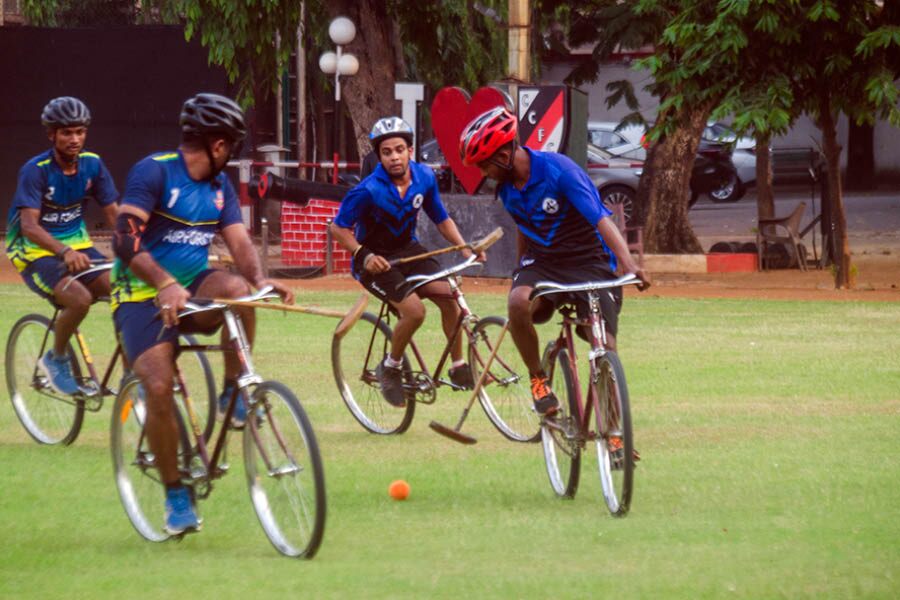
The youngsters displayed their sporting skills with gusto at the annual YMCA TTIS Inter-school Athletics Meet, held on February 17 and 18 on the YMCA grounds.
|
| The youngsters displayed their sporting skills with gusto at the annual YMCA TTIS Inter-school Athletics Meet, held on February 17 and 18 on the YMCA grounds.
|
Mathemagic
The SIP Academy Regional Abacus & Brain Gym Championship was held on February 18 at Nehru Children?s Museum. Dinesh Victor, managing director, SIP Academy India, was the master of ceremonies. Around 450 SIP students from all the centres in the region participated, solving complex calculations in a matter of minutes.
The enthusiasm was evident, and the children put in their best efforts with no sign of nervousness or tension. Along with prizes for various levels of the course and the age groups, each child went back home with an attractive gift packet and certificate of participation.
The evening ended with the area partner Janaki Venkataramani and Dinesh Victor distributing the prizes. SIP plans to hold such competitions annually.
Theatre treat
Sangeet Natak Akademi, New Delhi, has begun its informal comprehensive theatre training programme in three phases for young theatre artistes in direction, acting, designing (sets, lights, costumes, props), playwriting, make-up, theatre music and singing, mask-making and more. The country has been divided into six zones (north, south, east, west, central and northeast).
In the first phase, a 30-day Young Theatre Artists Workshops was held in Bihar, Jharkhand, Orissa, Sikkim and West Bengal in the east zone. Participants for the second phase were selected from these workshops.
The Akademi, in collaboration with Padatik, organised a 75-day residential Young Theatre Artists Workshop East Zone from December 5 to February 17. The closing ceremony was held at Sisir Mancha on February 18. Actor Soumitra Chatterjee was the chief guest.
Students of the workshop presented some of their work at the event. An exhibition of artefacts made by the students was also organised.
Bookworms
Delhi Public School Newtown had organised a book fair in association with Scholastic India Pvt Ltd on February 18 on campus . A wide array of children?s books, from educational to fantasy, folk to science fiction, mythology to fairy tales, were on display. An art exhibition was held simultaneously, allowing the students to showcase their artistic talents through paintings, sculptures, glass-paintings, masks, collages and more. A book cover-making competition with Time Machine as the theme was also held.
Sporting success
The track fields were on fire on February 15, the annual sports day at Heritage Institute Of Technology (HIT). Staff and students took an active part. There were innovative events, too, like the 25 m marble race ? participants had to run with a spoon laden with marbles balanced in their mouths. It was a fun day for all and a great experience.
Fahd Nizam,
4th year IT, HIT
|