|
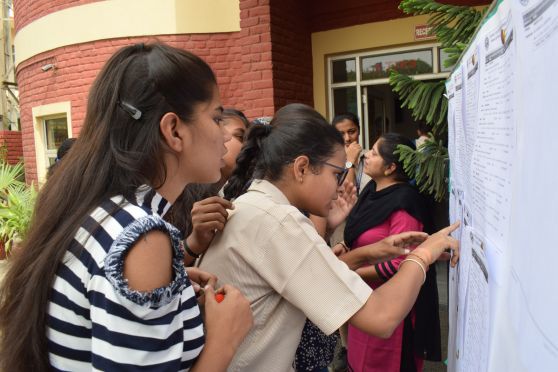
| BIO-INFO TAKE: A student pointing at an intricate cell design on the computer screen |
In the last few decades, advances in molecular biology and the equipment available for research in this field have allowed the increasingly rapid sequencing of large portions of the genomes of several species. In fact, several bacterial genomes, as well as those of some simple eukaryotes (e.g., Saccharomyces cerevisiae) have been sequenced in full. The Human Genome Project, designed to sequence all 24 of the human chromosomes, is also progressing. Popular sequence databases, such as GenBank and EMBL, have been growing at exponential rates. This deluge of information has necessitated the careful storage, organisation and indexing of sequence information. Information science has therefore been applied to biology to produce the field called bioinformatics . Informatics is the management and analysis of data using advanced computing techniques. Bioinformatics is particularly important as an adjunct to genomics research, because of the large amount of complex data this research generates. Thus, it is a field of science in which biology, computer science, and information technology have been merged into a single discipline. What do I have to do' The simplest task used in bioinformatics, concerns the creation and maintenance of databases of biological information. Nucleic acid sequences (and the protein sequences derived from them) comprise the majority of such databases. The most pressing task in bioinformatics involves the analysis of sequence information. Computational biology is the name given to this process, and it involves the following: • Finding the genes in the DNA sequences of various organisms • Developing methods to predict the structure and/or function of newly discovered proteins and structural RNA sequences. • Clustering protein sequences into families of related sequences and the development of protein models. • Aligning similar proteins and generating phylogenetic trees to examine evolutionary relationships. The process of evolution has produced DNA sequences that encode proteins with very specific functions. It is possible to predict the three-dimensional structure of a protein using algorithms that have been derived from our knowledge of physics, chemistry and from the analysis of other proteins with similar amino acid sequences. What should I study' You need physics, chemistry, mathematics and biology at the Plus Two level with at least 60 per cent marks in each of these subjects. You should have a strong background in two areas ' biology and computer science. You need to be either a computer science graduate with an additional degree in biology or a biologist with a degree in computer science. Biotechnology, computer simulations in biology, genetics, biochemistry, cell biology, structural biology, biostatistics and mathematical biology, are the topics that you will study. What next' Bioinfomatics is one of the fastest growing sectors identified by NASSCOM among the emerging industries. Hence, there is a huge demand for trained bioinformaticians in the USA, Europe, Australia and India. Looking at the immense potential of this sector, the Government of India has funded several institutes across the country to carry out research in this field. The notable ones are the Jawaharlal Nehru University, New Delhi, Indian Institute of Science, Bangalore, Bose Institute, Calcutta, Institute of Microbial Technology, Chandigarh, Centre for Cellular and Molecular Biology, Hyderabad and the University of Pune. Therefore, if you are a biology student with a keen interest in computers and software, this is a career avenue with a lot of potential. There is scope for creativity and innovation in developing software to leverage research breakthroughs. Biotech industries and premier scientific institutions like Celera Genomics, CuraGen and Centre for Cellular and Molecular Biology recruit experts in bioinformatics. Apart from positions in the academic and pharmaceutical industry, the typical jobs include that of a systems analyst, applications analyst, database designer or administrator, network designer or administrator, programmer, technical support, marketing, systems engineer and others. Various Indian biotech and pharmaceutical industries like AstraZeneca Research Centre, Bangalore, BioCon, Bangalore, Torrent Pharmaceuticals and reputed research institutes like the Centre for Cellular and Molecular Biology, Hyderabad and others employ professionals in this field. Where to study • Bioinformatics Centre, Jawaharlal Nehru University, New Delhi • Indian Institute of Science, (IISc) Bangalore. • Bioinformatics Division, Bose Institute, Calcutta • School of Biotechnology, Madurai Kamraj University, Madurai • Indian Agricultural Research Institute, New Delhi |