|
| Karat and Sitaram
Yechury leave the Prime Ministers residence after
the co-ordination committee meeting. (PTI) |
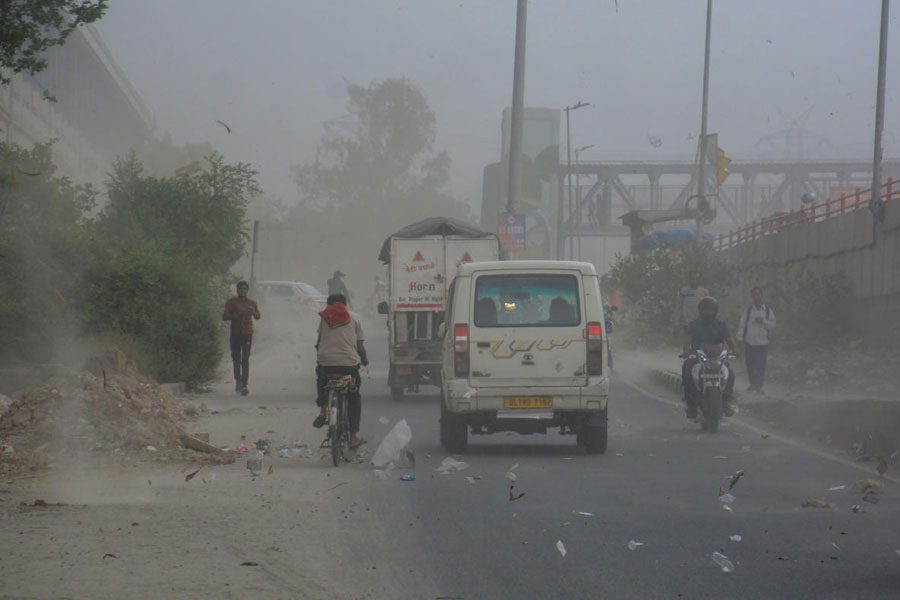
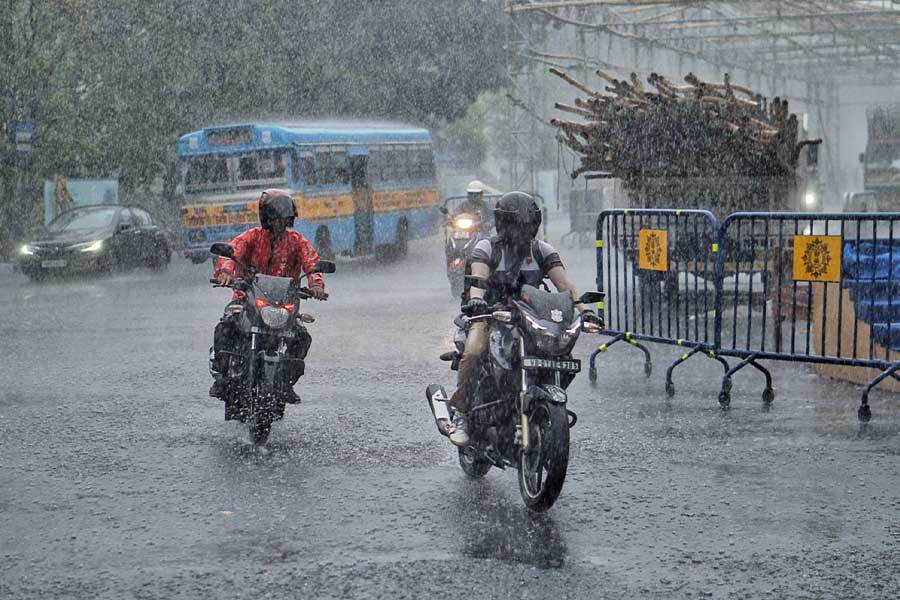
The blue skies across north India
have sent temperatures soaring in New Delhi. There were
no winter showers this time and the mercury is already rising
above 30 degrees Celsius.
As it turns out, the political
scene is also hotting up, with rumblings of a third front
for the first time since May 2004. Close on the heels of
the initiative by Mulayam Singh Yadav, the chief minister
of Uttar Pradesh, comes a thinly- veiled warning from the
soft-spoken CPM general secretary Prakash Karat.
The Samajwadi Party has been feeling
the Centres heat for some time now. There is little
doubt that Congress managers are waiting for the right time
to unleash Rahul Gandhi on the state to question Mulayams
secular credentials and recapture the traditional support
bases of the Gandhi family.
Given the sorry state of the Congress
in the state, this may be a pipe dream, but the chief minister
is taking no chances.
The pressure on the Samajwadi
Party chief has come from different directions. The Centre
has bent over backwards to help his bete noire Mayavati
in the Taj corridor case, only acting after being prodded
by the Supreme Court.
Most recently, Congress spokespersons
have publicly welcomed the rebellion by Lok Sabha MP for
Agra Raj Babbar.
Mulayam has hit back in a way
he knows best, by politically taking on the UPA. Interestingly,
he has chosen Indias stance on Iran as a test case.
This is clearly a bid to appeal to anti-American sentiments
as well as reassure minorities that he is not drifting towards
the Sangh parivar.
The choice of N. Chandrababu Naidu
is significant for he was the convener of the United Front
for two years before deserting it in 1998 to extend outside
support to the second Vajpayee government.
Naidu, like Mulayam, knows the
way ahead is to combine forces and take on the ruling combine
in New Delhi. To do so effectively, they need to puncture
its claim of protecting minority interests.
Few have grasped that the move
for a debate in Parliament comes on the eve of the visit
of President George W. Bush to India. There is little doubt
that his actions in Iraq and in the war on terror
in general make him unpopular among large sections of Muslims
worldwide.
The Congresss anxiety on
this score is evident in the Prime Ministers appeal
not to view foreign policy via prisms of community identities.
Yet, this is no exception. The late Indira Gandhi was hailed
as Durga after the Bangladesh war. Vajpayee gained from
saffron overtones of Pokhran and Kargil.
The Congresss worry is less
about ethics in the political sphere and more about self-interest.
It can ill afford a strong Opposition combine that reaches
out to minorities and farmers, two groups which played a
key role in voting it back into power, albeit at the head
of a coalition.
No such formation can succeed
without a strong base in Uttar Pradesh in the north and
Andhra Pradesh in the south. The Congress re-established
its dominance in the latter two years ago and is hoping
to rebuild its base in the Hindi-belt state in the near
future.
There is a second dimension to
the Mulayam-Naidu combine. In April 1999, it was the socialist
strongman who blocked the emergence of a Congress-led coalition
after Vajpayees defeat on the floor of the House.
It is only logical he should seek to revive an anti-Congress
platform. Naidu was the prop that held up three successive
non-Congress ministries from 1996 right through till 2004.
He now realises he needs to move beyond his dalliance with
saffron.
There, the similarities end. Mulayam
is sitting pretty as the single-largest party from Uttar
Pradesh in the Lok Sabha. The Telugu Desam Party is yet
to recover from the drubbing it got in May 2004 and has
not recovered ground in subsequent by-elections.
The real test will be whether
they can reach out with a broadly secular platform to constituents
of both the NDA and the UPA. This will be the real litmus
test.
The CPM and its allies have reason
to adopt a more confrontational stance. The defeat of the
airport employees strike marked a new low in its relations
with the Manmohan Singh ministry. Not only was there no
rollback on the bids for the Delhi and Mumbai airports,
the victory may well embolden the government to press ahead
with other reforms unpalatable to the Left.
The timing of the Assembly elections
due in May in Kerala and Bengal adds to but does not entirely
account for the chill in ties between the Marxists and the
Congress. The larger factor surely is the marginalisation
of the Lefts influence on economic and foreign policy-making.
No third front is possible without
the Left but the latter is not yet ready to take the plunge.
The larger strategic goal of keeping the BJP out of power
seems less urgent but has not disappeared from its calculations.
The problem is that the Congress is slowly inching its way
to a more dominant role, and hemming in the CPM.
Yet, the third front has only
become attractive in the past when there has been a complete
collapse of the Congresss plans. This was the situation
in 1989 and again in 1996. Today, the Congress, though depleted,
is in no mood to retreat.
More seriously, the ties forged
with the Left in the NDA regime are still intact. They are
fraying at the edges but are yet to unravel.
Till that happens, the third front
will be like the clouds in the skies over New Delhi, visible
but quite a distance away.
|