|
 |
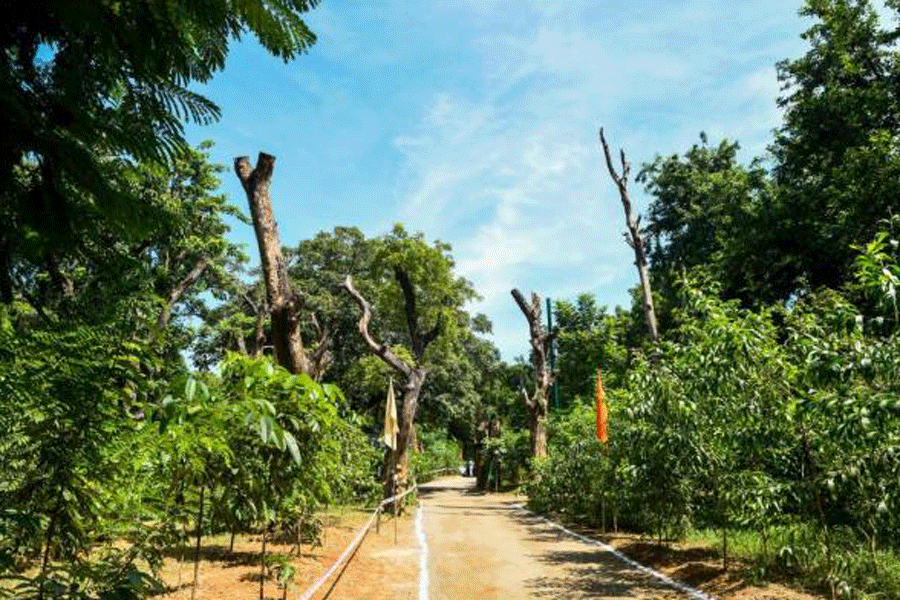
| The entrance to
the Hinglaj cave where the goddess resides: There is
no imposing architecture or riveting sculpture... but
there is great theatre |
Hinglaj (Baluchistan): Her
face may not have launched a thousand ships but it nearly
ended Creation. The beauty may have been compelling but
it did not lead to any seizure of the realm.
Yet for over a thousand years,
the legend of Sati has held sway.
It still does. Even in Talibanised
Pakistan. I accompanied the 86 pilgrims and BJP leader Jaswant
Singh to find out what it means to be an almost-forgotten
Hindu god in a forgotten part of the world.
This is how it all began. Sati,
Shivas consort, ended her life by jumping into a pool
of fire to protest against the humiliation of her husband
by her own father.
Heaven hath no fury like a god
bereaved. So Shiva responded by going into the dance of
destruction. But the guiles of Vishnu saved the day. The
remains of Sati were cut in 51 pieces and scattered across
India. The 51 places where the remains fell are known as
pitha and constitute the Grand Slam of Indian pilgrimage.
As many as 49 of the 51 pithas
are within India. A few lie outside its current geographical
boundary. One of them, Hinglaj, is in Baluchistan.
The scalp of Sati, replete with
vermilion, the mark of the married woman, fell in Hinglaj.
On this corporeal relic grew a
place of worship ?somewhat in the fashion of Buddhist stupas.
Thus bloomed the Hindu flower in the barren wilderness of
Baluchistan.
In truth, the goddess at Hinglaj
began her reign much earlier but as an unknown regional
satrap. Once assumed in the 51-strong National Democratic
Alliance of Sati, her munificence stood vastly enlarged.
Hinglaj, born non-Aryan, became part of the Shakti diaspora.
Her humble origins were soon forgotten.
Despite the lineage, Hinglaj never
quite received the attention it deserved.
The journey was arduous and long.
The 250-km trudge across an unfriendly desert was an ultimate
test of faith. (Every pilgrim, says Jaswant, deserved a
Victoria Cross). The entire route was and remains infested
with dacoits. The visitors, mainly local Hindus from Sindh,
were routinely robbed.
The only other pilgrims the goddess
attracted were the steady trickle of Rajputs ? kings and
kin ? from Rajasthan and neighbouring Gujarat. Even that
ebbed with Partition. Outside of Rajasthan, only Bengal
had a certain familiarity with Hinglaj. This was due to
a Bengali tantrik who visited the shrine before Partition
and wrote a harrowing account.
His best-selling journal is the
only modern chronicle of the pilgrimage. It later spawned
a hugely successful Bengali film with Uttam Kumar as the
pilgrim. Despite a fascination for Aryanised native gods,
few Bengalis were willing to hazard a perilous journey.
Hinglaj for them was a romantic
interlude. But as a token Bengali among the yatris, I was
recognised as the representative of the states undying
Shakti cult.
It would be quite wrong to blame
the declining interest only on bigotry. The fact is, getting
into Pakistan is complicated enough unless one is a cricketer.
Even for those granted a visa,
Baluchistan falls in the forbidden zone.
In the best of times, Baluchistan
is an Allah-forsaken country. With 43 per cent of Pakistans
land and only 5 per cent of its population, it defines nowhereness.
Hinglaj, where the goddess resides, is 110 km from the nearest
police station. The village panchayat in Hinglaj rules over
an area that is 160 km in length.
There is no electricity or telephone
or post office. Not even a chai shop. The only local
population appears to be Russell vipers and Ibex goats.
And it is hardly the best of times.
Baluchistan is divided into tribes. Their current preoccupation
is fighting among themselves, which, to be fair, is what
they have always done. They are also fighting with Islamabad
which appears to be a contemporary undertaking.
Pakistan is convinced that India
is behind these troubles, as much as India believes Pakistan
is behind every act of arson on its soil. Baluchistan houses
the countrys missile-testing zone, making the region
security-sensitive. The long and largely unguarded coastline
is a standing temptation for the drug traffic. The trades
current capo, Pappu Arshad, runs his fief from the region
with, it is said, the administration turning a blind eye.
Enter Jaswant Singh. The man from
Jaisalmer pestered the Pakistan government into allowing
him to lead a group of Indian pilgrims by road from India
to Baluchistan. Even for Singh, whose persuasive skills
have put him in the race for the UN secretary generalship,
it was not easy. But Singh was not one to give up easily.
He met the Indian Prime Minister who agreed to speak to
Pervez Musharraf and only then did Islamabad relent.
Singhs trip marked the informal
opening of the Rajasthan gateway to Pakistan. And Singh
did it with great style. Some 86 pilgrims, mostly Marwari
Rajputs from the Jaisalmer region, crossed the Munaba
border on foot and then boarded four-wheelers to cross
the Thar on an ancient pilgrim track in disuse for years.
Two of them were Rajasthan-registered vehicles fitted for
the occasion with special sand tyres.
Once in a while even a pilgrim
needs to make his point.
Opinion remains divided as to
why Singh undertook this trip. Pakistan believes that for
the BJP leader, it is a positioning game. The parivar factotums
in the Hinglaj entourage saw no reason why opening up a
Rajasthan corridor to Pakistan will impact national politics.
But they readily concede that
Singh will be seen as being occupied with larger issues
at a time when the next generation in the party are busy
sniping at each other. Singhs detractors in the party
point to the fact that the gateway to Pakistan falls conveniently
in his son Manavendras Lok Sabha constituency.
While the younger Singh has done
well by his electorate, the significant Muslim population
could become hazardous to his political health. The opening
of the borders ? the railways will begin their service later
this month ? will prove a boon to the many Muslim (and some
Hindu) families divided by Partition, thereby earning the
Singh khandaan political brownie points.
Judging by the initial reaction,
Singh may be heading for a home run. All across the route,
Pakistanis lined up to welcome the Indian guests. In Umraokot,
where Emperor Akbar was born, flower petals were thrown
on the Indian cars. This was a spontaneous act of goodwill,
given the fact that the parivar is unlikely to have engineered
support in Pakistan and the ISI would hardly be that ingenious.
If politics is what brought Singh
to Hinglaj, it was politics that gave Hinglaj its eminence.
Hinglaj was one of the many small-time
local gods that existed all over India. They were pre-Aryan
and had little or nothing to do with Hinduism as we know
and practise it. Very cleverly, the early Aryans imbibed
them in their midst, thus giving birth to the politics of
coalition.
In contrast, the latter invaders
? Islam and Christianity ? sought to expand through conversion.
Hostile takeovers, as L.N. Mittal is learning to his chagrin,
leave residual bitterness. Babri being just one consequence.
The first versions of Satis
tale were far less dramatic. The Mahabharata and the philosophical
canons known collectively as The Brahmanas recount
Satis discomfiture and eventual suicide but make no
mention of Shivas anger. Vishnus delightful
antic, almost Bollywood in character, of slicing the body
in many pieces was introduced many centuries later.
But this simple extension, innocuous
on the surface, had much larger implications. It provided
the intellectual argument and a simple but clever way for
the Aryans to reach out and absorb gods and ideas native
to India. Existing places of worship were identified and
declared Hindu pithas. Native gods were not left
in the lurch but admitted to the pantheon.
In the spirit of a common minimum
programme, the idols or the objects of worship were left
untouched while non-Aryan rituals, such as tantra,
were allowed into the fold. Even the idea of corporeal relic,
the leading Indian scholar on the subject, D.C. Sarkar,
has argued, was merely an early attempt to regain lost territory
from the Buddhists. Subsequently, Buddha was declared a
full avatar of Vishnu.
The adaptation of Hinglaj in the
Hindu family was thus good politics. In the absence of local
history, it is difficult to say when all this happened.
But a distinguished scholar, David Gordon White, professor
at the University of California, Santa Barbara, in his book
on Siddha tradition claims that a fourth century Greek geographer,
called Ctesias, has referred to Hinglaj in his work.
Little has changed in the intervening
years. The early travellers used camels as means of travel.
Today they use four-wheelers. But the Baluchi desert remains
as ever, mildly vegetated and as uninviting. Just like Rajasthan,
said Hukum Singh, the Jaswant family driver, who steered
the Mahindra Scorpio all the way from Jaisalmer.
And just like Baluchistan, deserts
in Rajasthan can sometimes be unfriendly. Either side of
the fence, the camel drivers can be enterprising: visitors
to the Jaisalmer dunes, for example, often find their burden
lightened if they are not too careful.
The great desert bonhomie is,
thus, one of lifes enduring fictions. Those who live
with natures hostility learn how to avail of lifes
opportunity. No one would know this better than the chief
minister of the state, Mohammad Yousaf Aliani.
In yesteryears, he was the Jam,
i.e. nawab, of the region. Today he is the elected
chief minister. While his son, a Pramod Mahajan-like figure
who sports a rather visible Giorgio Armani shirt under the
Baluch tunic, is the district Nazim or head of the zilla
parishad. Hinglaj is part of his charge.
The father-and-son team rule Quetta
with an iron hand. Together with the federal government
in Islamabad, they have assembled a 40-strong convoy to
take the yatris to the shrine. The convoy included federal
troops, provincial police and elite anti-terrorist commandos
equipped to the teeth with German machine guns and American
rocket-launchers.
The surrounding hills were sanitised
with soldiers taking charge. The entire 250-km route from
Karachi was manned by the men in black.
Even the Indian high commission
was impressed. They are not leaving things to chance, said
an accompanying member of the Indian mission.
Why? I asked.
They do not wish any untoward
event to take place.
 |
| A signboard points
to Nani Mandar, as the shrine is known in Pakistan |
It was not only the show of strength
which impressed the Indians. The Baluchistan government
sent its ministers along with a Lexus 4x4 sports utility
vehicle ? the sort Amar Singh uses ? at the Sindh-Baluchistan
border to receive the Indians. The chief minister himself
drove a few hundred kilometres from his capital just to
host a lunch at Hinglaj and even left his son, the Nazim,
to spend the night with the yatris. They have spent
crores, said a member of the Indian mission, to
make you feel at home. The unused bottles of the branded
water are enough to fill a swimming pool.
Such expression of goodwill did
not hinder the little one-day internationals the two foreign
ministries play. Indian diplomats are rarely allowed a peep
into this side of the world. The Jaswant Singh trip was,
in a sense, a godsend.
There was no harm in pushing our
luck, reasoned the Indians and requested a recce
trip. No deal, said Islamabad. Can we at least send an officer
a day in advance to Hinglaj so that he can go through the
arrangement and is in situ to welcome the Indian leader
of the Opposition? the official tried again.
Shoaib Akhtar did not blink.
There is more than one reason
why Pakistan is reticent about allowing Indians in Baluchistan
and one good reason why it is being plain silly. There is
strife and allegations of an Indian involvement and there
is the missile-testing zone. But the Chinese have built
them a spanking new port on the Arabian Sea with, it is
said, tacit approval from the Americans. The Persian Gulf
is a potential tinder-box and should the occasion demand
it, Washington would have one more springboard for an operation.
But such arguments are silly because
satellites have made nonsense of yesterdays idea of
security.
What is food for the mullah, though,
is food for the kafir. A spanking new port requires a spanking
new road. So the Chinese have built one to facilitate traffic
between Karachi and the new port at Gwadar.
The road cutting through the spectacular
Makran Coast Range passes through a village called Aghore
which is merely 20-odd km from the shrine. (Aghore is the
place through which Alexanders army returned after
the battle with Porus). The once inaccessible goddess has
thus been brought to the doorsteps, ending over 1,500 years
of travellers nightmare. So the pilgrim progresses.
But the goddess?
At first sight, the She could
disappoint. There is no imposing architecture or riveting
sculpture. Hinglaj is not 10 Janpath but a minor coalition
partner. It is tribal paganism Aryanised only at the fringe.
But there is great theatre. The goddess resides in a cave
sculpted by nature with wind and water in a narrow canyon.
The opening of the cave would
be about 30 feet in height and around 60 to 70 feet in breadth.
A river ambles its way in the bottom of the gorge. Its placid
existence ? and in patches non-existence ? is misleading.
With the right rain, its passion could be aroused and then
it cuts completely the access to the goddess.
Inside the cave, there is no idol
to speak of, though there is an object of worship. Part
of the rock is dressed in a sari and painted with vermilion,
invoking awe and creating an atmosphere of reverence. Here
the offerings are made. There is a U-shaped tunnel just
underneath the deity.
The ritual act of pradakhsheen
(going round a place of worship) is done crawling in the
labyrinth. The majesty of Hinglaj lies not in its details.
One looks not at the snapshot of a planet but at the portrait
of the Milky Way itself.
The 20-km ride from the highway
prepares one for the spectacle. A lazy dirt track moving
in and out of the embrace of the mountain, crawling across
the river bed? the side of the mountains almost sculpted
by wind from the sea? this is nature unspoilt to perfection.
Civilisation has spared Hinglaj.
Barely 20,000 visit the shrine in a year and that too in
the few comfortable months of the year. Then nature takes
over. The angry sun of the desert and the sudden flashes
of flood in the rain ensure the deity her seclusion.
All that may change with progress.
The new coastal highway cutting down travelling time to
a mere three hours and an improved India-Pakistan relationship
could cost even the Mother of the Universe her privacy.
The gods, like men, can survive
apathy. Can they, unlike men, survive the adulation?
|