|
|
|
Dangerous liaisons
|
There are some simple truths about elections that your neighbourhood politician knows better than the best psephologist in town. One such truth is that straight, one-on-one contests against Left Front candidates all over Bengal can dramatically improve the opposition?s score. Theoretically, such contests can also end the left?s long reign in the state.
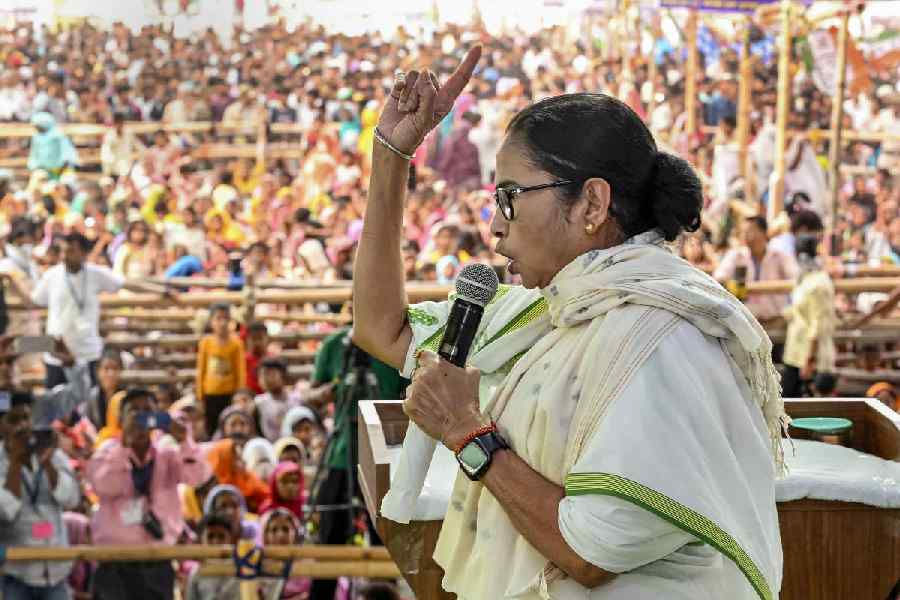
So, Mamata Banerjee is only stating the obvious when she insists on all opposition parties uniting against the left for the coming assembly elections. She must be just as certain that no such thing will happen. She knows that the Congress and the Bharatiya Janata Party have their own reasons for not openly joining hands even against a common enemy.
Why then is she making the noise for an unrealistic mahajot against the left? There is, of course, a simple answer to this. The Trinamool Congress leader hopes that even if the Congress and the BJP cannot publicly share the platform with her, activists and supporters of the parties can do so with the common objective of defeating the left. But she seems to be using this cry for opposition unity as a justification for her own strategy. She will not part ways with the BJP as she did in 2001, and she still wants the Congress to be part of the grand alliance against the left.
The ?mahajot? idea is not new; it has been tried in panchayat and municipal elections in parts of Bengal over the last five years. Banerjee cites the examples of a few municipal boards in order to argue that it can work in the assembly elections as well. She knows it cannot happen ? not at least before the elections.
The real thing behind the alliance rhetoric is that Mamata Banerjee had to make a choice, as in the assembly polls in 2001, between the Congress and the BJP. It was not a simple choice; she had to take some risks either way. I tend to think that she made the wrong choice by deciding to stay in the BJP?s company. Choosing to ally with the Congress would have been a better bet for her.
I am aware of the two obvious objections to this argument. She tried the alliance with the Congress in 2001, it would be said, but that failed to dislodge the left from power. So, why try that failed experiment again? Second, it may be argued that her political credibility would suffer yet another blow if she deserted the BJP one more time and teamed up with the Congress. Will not such a move be particularly bad for her at a time when the Congress-led government in New Delhi has to survive on the left?s support?
Both arguments have their merits, but they are also based on assumptions whose validity is rather doubtful. One such assumption is that the Trinamool?s loyal voters care a great deal about its flip-flop politics. The fact is, they do not. To them, any poll alliance is good enough as long as it achieves their goal of defeating the Communist Party of India (Marxist). In fact, Banerjee herself is not too worried about any loss of credibility because of any electoral deals. That is why, despite her hatred of the Congress-left understanding at the national level, she wants a tie-up, open or secret, with the Congress.
And, the failure of the Congress-Trinamool alliance in 2001 is not really relevant to the context of the elections this time. The national political scene has changed dramatically since the Congress?s return to power in New Delhi at the head of the United Progressive Alliance. The BJP is no longer seen as the winning party. Even in Bengal, all elections since 2001 have seen the Trinamool-BJP combine lose ground; by contrast, the Congress?s fortunes, as the Lok Sabha polls of 2004 showed, were turning around.
The Congress, in power at the Centre and rising from the ruins in Bengal, is thus not in the same situation as in 2001. Despite the compulsions of national politics, the Congress has a greater stake in the Bengal elections this time. The party would like to hold on to its recent gains in Bengal; more important, a weakened left in Bengal can make it rule more freely at the Centre. The polls in Bengal are, therefore, more crucial to the Congress than those in Kerala because the left?s new-found clout in New Delhi derives primarily from its strength in Bengal. A Congress-Trinamool alliance could be a far stronger challenge for the left to tackle.
By contrast, Banerjee?s possible gains from the alliance with the BJP may be limited. The BJP being a minor political party in Bengal, such an alliance would be entirely dependent on her personal appeal as the main anti-left force in the state. Also, the tie-up with the BJP will force her to carry the latter?s communal baggage. This is a major political liability in a state where Muslims comprise over one-third of the electorate.
True, not all sections of the Muslims in Bengal vote on communal lines. In the rural areas in particular, they vote on political lines as much as any other community. But Banerjee?s alliance with the BJP makes her susceptible to the left?s charge of a communal agenda in her politics. It is difficult to justify her partnership with the BJP, from which she has so little to gain and so much to risk.
It is possible that she has a post-election scenario in mind. In the event of a fractured verdict, the Congress may not have an option but to support her. Even this scenario is not as fanciful as it may appear to be. The model was tried successfully in the Calcutta municipal corporation, in which a Trinamool-BJP board survived its full term with the Congress supporting it from outside. There is absolutely no doubt that the BJP would have no problem supporting a Congress-Trinamool government from outside if such a situation arises after the assembly polls.
Interestingly, the BJP is even more keen than the Congress in trying everything to end the left regime in Bengal. The BJP?s reason, though, is different. BJP leaders are convinced that the Congress can never win enough Lok Sabha seats to form a government on its own. The best way to attack the Congress in New Delhi, they believe, is to strike at the left in Bengal. For the left is the strongest pillar on which the Congress stands at the Centre. Break the pillar and the weak Congress edifice will come crashing down. In the BJP?s scheme of things, the left?s defeat in Bengal is far more crucial than the end of Lalu Prasad?s reign in Bihar.
But the Bihar story should have indicated to Mamata Banerjee the importance of choosing her poll allies right. The cry for the so-called Bihar model of election is just claptrap politics. Anyone who cared to read the Bihar results correctly would know that it is the division in the UPA, and not the Election Commission?s tough monitoring, that brought the National Democratic Alliance to power in Patna.
Despite the growing anger among some classes of people at the Lalu Prasad-Rabri Devi regime, the Rashtriya Janata Dal?s votes remained largely intact. Add them to the votes secured by the UPA?s breakaway partners, such as Ram Vilas Paswan?s Lok Janshakti Party and the Communist Party of India, an undivided UPA would still have returned to power.
The EC?s vigilance may help Banerjee to a point. But it cannot undo the damage caused by a faulty alliance strategy.
|