|
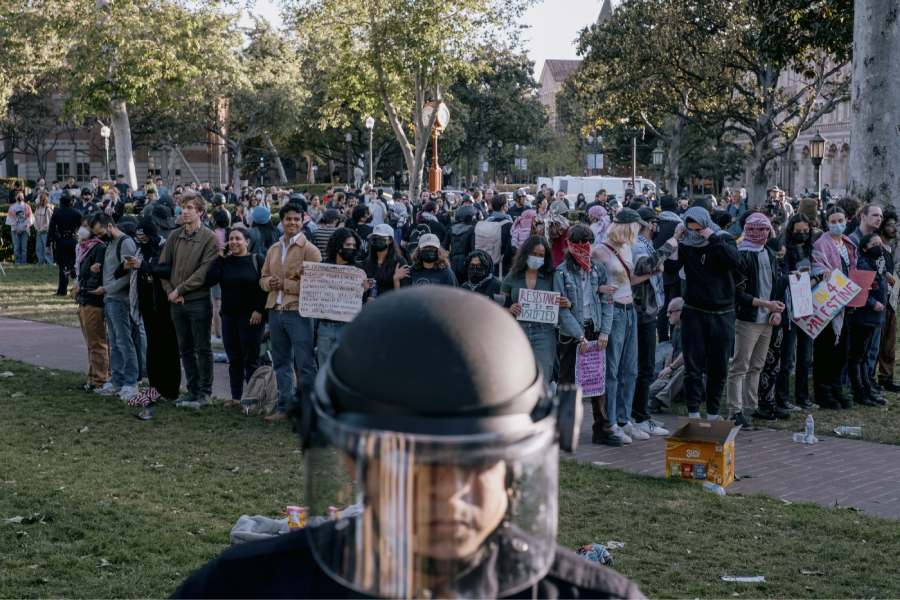
| Inhuman act: Students
in Bhubaneswar protest against the killing of tribals
in Kalinganagar |
Forensic science, many would agree,
is a rather enigmatic subject that begins with death and
seeks to make dead men tell tales. Its a difficult
job, no doubt. But prosectors ? personnel who conduct autopsies
? in Orissa have apparently found an easier way to pull
it off. If the dead cant be made to speak, turn to
their palms for answers.
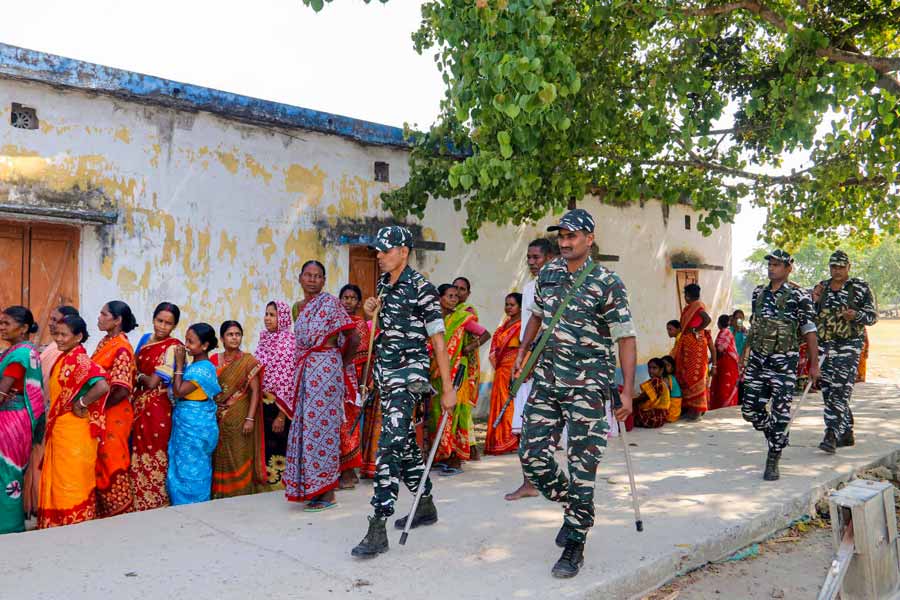
In Orissa last week, the bodies
of five tribals ? killed in police firing while protesting
at the site of a proposed steel plant in Kalinganagar ?
were mutilated during autopsy. The bodies were returned
to their families but their palms had been chopped off and
retained for purposes of future identification. The act
was interpreted by local tribals as payback by the police
who wanted to avenge the death of one of their colleagues
killed during the clashes.
The incident kicked up a domestic
furore. And the human rights lobby swung into action, demanding
swift redressal against the perpetrators of what was criticised
by many as a gross violation of human rights. The Orissa
police began to pass the buck. After having said that their
rule book required palms of corpses to be retained for identification,
they went on to blame the doctors who conducted the autopsies,
saying that they had dismembered the bodies out of their
own will.
It will be a while before things
get sorted out. But what is perhaps the need of the hour
is to take a deeper look into the regulations under which
autopsies are conducted in India.
The supreme guideline to this
effect is the Model Autopsy Protocol, included in the UN
Manual on the effective prevention and investigation of
extra-legal, arbitrary and summary executions (1991). First
adopted by the Economic and Social Council of the United
Nations in a 1989 resolution, the manual lists several checkpoints
that need to be followed while investigating executions
such as assassinations, deaths resulting from use of excessive
force by law enforcement personnel and acts of genocide.
The detailed manual lays down
elaborate guidelines regarding key issues related to autopsies,
such as scene investigation, identification, photography
of objects and findings, examination of the body, collection
of specimens, toxicologic tests and retention of evidence.
But while the protocol recommends thorough autopsies in
investigating controversial deaths, it does not endorse
the mutilation of a body either for identification or for
collecting evidence.
Under normal circumstances, the
manual prescribes routine collection of 150g each of the
liver and the kidney. In cases where the presence of drugs
or toxins is suspected, it says that the brain, hair and
adipose tissue may be additionally saved. After the
autopsy, all unretained organs should be replaced in the
body, and the body should be well embalmed to facilitate
a second autopsy in case one is desired at some future point,
it states.
These are norms, human right bodies
stress, that India should follow. The UN Protocol
is what is called a customary international law, explains
Ravi Nair, executive director of the Delhi-based South Asia
Human Rights Documentation Centre (SAHRDC), a body which
is part of the Asia Pacific Human Rights Network. It
is universally applicable, and does not need any ratification
from states to be implemented. Hence, all countries are
subject to its regulations. Nair says that SAHRDC
has already shot off letters to the National Human Rights
Commission (NHRC) and the Medical Council of India (MCI),
urging the authorities to look into the matter.
But things dont appear all
that simple when one considers that all Indian states, the
UN Protocol notwithstanding, have their own sets of guidelines
for conducting a post mortem. And an autopsy performed
in a certain state will only be governed by the guidelines
formulated by that particular state, says an official
at the MCI.
Autopsies in Delhi, for example,
are carried out according to a set of medico-legal procedures
laid down in 1983 by the ministry of health and family welfare
for the capital. And the regulations do allow prosectors
to retain the terminal portions of fingers for identification
in certain cases, says a doctor at the department
of forensic medicine, All India Institute of Medical Sciences.
Thats not to say, however, that a whole palm
can be chopped off.
But if the Orissa police are to
be believed, their rule book allows just that. We
suspect it to be a very old manual, dating back to the days
when body parts were stored in formaldehyde for future reference,
says Nair. But why it should be followed in the age
of DNA fingerprinting is the question.
The answer to Nairs question
is simple. India is yet to familiarise itself with the process
of a routine updating of legal and administrative manuals.
In a country where the police force operates according to
century-and-a-half-old legislation, it comes as no surprise
that mutilation of bodies during autopsy may still be deemed
permissible by the guidelines of a certain state. Hopefully,
the Orissa case will bring about some serious introspection.
And a dead man will have his rights.
|