The Telegraph
 
 
ARCHIVES
Since 1st March, 1999
 
THE TELEGRAPH
 
 
Email This Page


Some parents do have them

Natwar Singh’s problems over his son, Jagat, will evoke a sympathetic response from many senior British politicians, among them Margaret (now Lady) Thatcher and Tony Blair.

At least, Lady Thatcher’s daughter, Carol, 52, who last week emerged the winner in a downmarket TV reality show called I’m a Celebrity'Get Me Out of Here!, has managed to keep out of trouble. Her journalistic career never really recovered from being sacked as a feature writer on The Daily Telegraph by its then editor, Max Hastings. But she has kept going with articles on skiing and the odd book here and there.

That is more than can be said for her troubled twin brother, Mark, who has long been a worry to his doting mother. In January this year, he was fined $500,000 and given a four-year suspended jail sentence in South Africa after pleading guilty over his involvement in an alleged coup plot in Equatorial Guinea. He is banned from the United States where his ex-wife and two children live.

Five years ago, Blair’ son, Euan, then 16, was picked up drunk and incapable in Leicester Square. He is now a fashionable man of 21 with a Johnny Depp-style goatee beard and attends the best parties in London and the odd lap dancing club in Paris.

Euan has caring parents. But the point is that it is not easy for senior politicians to run the country and be good parents. It’s inevitable that the new Tory leader, David Cameron, 39, will now see very little of his wife, Samantha, 34, who is expecting their third child, his severely disabled son, Ivan, 3, and daughter, Nancy, two.

Psychiatrists would be able to speak volumes if they could discover just how much Jagat, for instance, saw of his father.

Black Britain

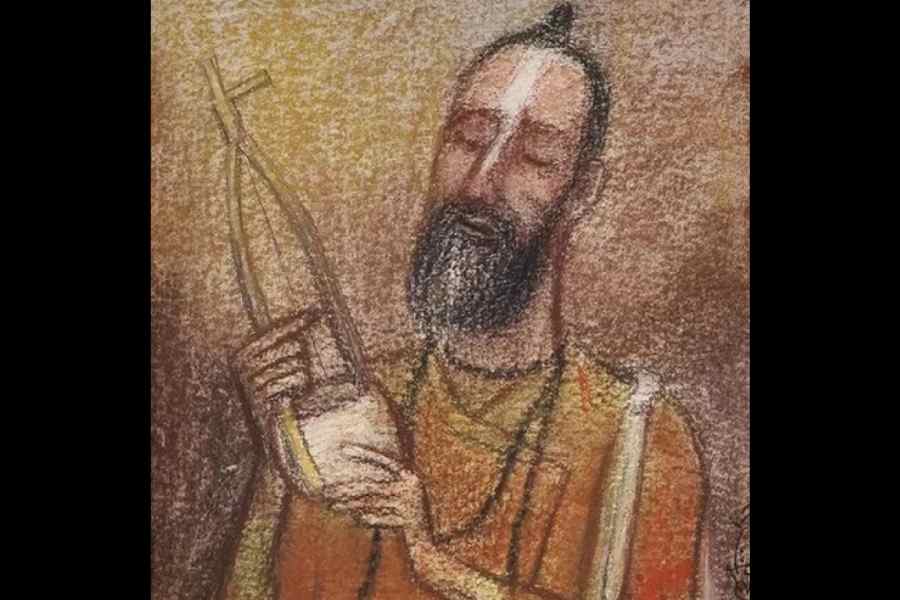
How Britain has changed ' for the better. The recent controversy over the so-called “Hindu stamp” has reminded the artist Prafulla Mohanti of the occasion way back in 1968 when his painting of Jagannath was not acceptable to the British.

At his town house in west London, Prafulla dug out the painting to show me why the British turned it down when it was offered as a possible illustration for a Christmas card.

“Jagannath’s face is black,” he explained.

Prafulla recalled that in 1968 he had been commissioned by UNICEF to do a painting, which was sent to countries around the world for use as a Christmas greetings card. The card was turned down only by UNICEF UK.

“I was told the British people would not like it,” said Prafulla, who is best known for championing the cause of his impoverished village, Nanpur, in Orissa.

There has been a revolution in British attitudes since Prafulla arrived in Britain in 1960. Last month, for example, the Royal Mail came out with a beautiful Hindu stamp. But because of a campaign by a handful of militant Hindus, Royal Mail has decided to sell the stamp very much under the counter and only when specifically requested by a customer.

Bigotry is unattractive wherever it raises its ugly head. One of Prafulla’s English friends, Derek Moore, who has developed an admiration for Jagannath, said he had given up hope of entering the Jagannath Temple in Puri “because they don’t allow in foreigners”.

PICTURE PERFECT: St Andrew and St Mary’s church in Grantchester (above); an idyllic sketch (below) of the area recalling Rupert Brooke’s poem

Poet’s corner

How I love old England ' and there is nothing more ye olde England than the idyllic Cambridgeshire village of Grantchester, once the home of the poet Rupert Brooke (1887-1915).

We had just come out of the ancient church of St Andrew & St Mary’s when its clock struck the hour of five, prompting my brother-in-law to remark that its hands were obviously not stuck at “ten to three”.

This was a reference to the poem, The Old Vicarage, Grantchester, where Rupert Brooke had lived after moving from another cottage, The Orchard, where tourists are now served tea and scones:

“Say, is there Beauty yet to find' / And Certainty' and Quiet kind' / Deep meadows yet, for to forget / The lies, and truths, and pain' ... Oh! yet / Stands the Church clock at ten to three' / And is there honey still for tea'”

Grantchester’s most famous (notorious') resident today is the novelist (Lord) Jeffrey Archer, who lives in The Old Vicarage. Archer, who was deputy chairman of the Conservative Party under Margaret Thatcher, was sent to prison for four years for perjury and seeking to pervert the course of justice after a case involving a prostitute. He was released on parole after two years.

Last Sunday, when we walked past The Vicarage, Archer was in Australia, promoting False Impression, his new thriller written in the aftermath of 9/11.

No doubt, Archer will hope his words will be remembered in the way the English cherish, say, the lines from The Soldier by Rupert Brooke.

Only, Indians, who have settled in this country, could find their own personal substitute for the word, “England”, in this wonderfully evocative poem:

“If I should die, think only this of me: / That there’s some corner of a foreign field / That is forever B/62 Joginder Chowk (next to petrolle pump, above paan shop) Jalhandhar.”

All change

It is difficult for me to know what to make of David Cameron, the new Tory party leader who beat his rival by an impressive two to one majority. Since he is only 39 and has done nothing before, except possibly smoke a joint when he was at Oxford, nothing can be held against him. It is a little like making Rudra Pratap Singh, 20, captain of the Indian cricket team. It might work, or it might not.

Cameron has appointed defeated Tory leaders from yesteryear, William Hague and Iain Duncan Smith, on his top team. To stretch the cricketing analogy, this is akin to an England team recall for cricketers Peter May and Colin Cowdrey ' I know they are dead but let’s not get too technical.

All I can say is that the Tories will never beat Labour without the support of Indian voters. The Indians and Pakistanis, although only 2.5 million in number, live in key marginal constituencies which make their bloc vote disproportionately influential.

In many ways, the Tories are the natural party for, at least, well-off Indians. However, the Indian drift towards the Tories, which began under Edward Heath and continued under Margaret Thatcher and John Major, was reversed when Hague, Duncan Smith and, most recently, Michel Howard moved the party back to the far right.

If Cameron can rid the Tory party’s image as reactionary, racist and anti-immigrant, he stands a pretty good chance of becoming prime minister in the election after next.

Tittle tattle

Lord Meghnad Desai, who remains on the teaching staff of the London School of Economics, can look forward to bumping into a lively collection of new students in the corridors when he comes in to deliver his next lecture.

Among the freshers is one Monica Lewinsky, the woman better known in America for not having sex with President Clinton.

Top
Email This Page