|
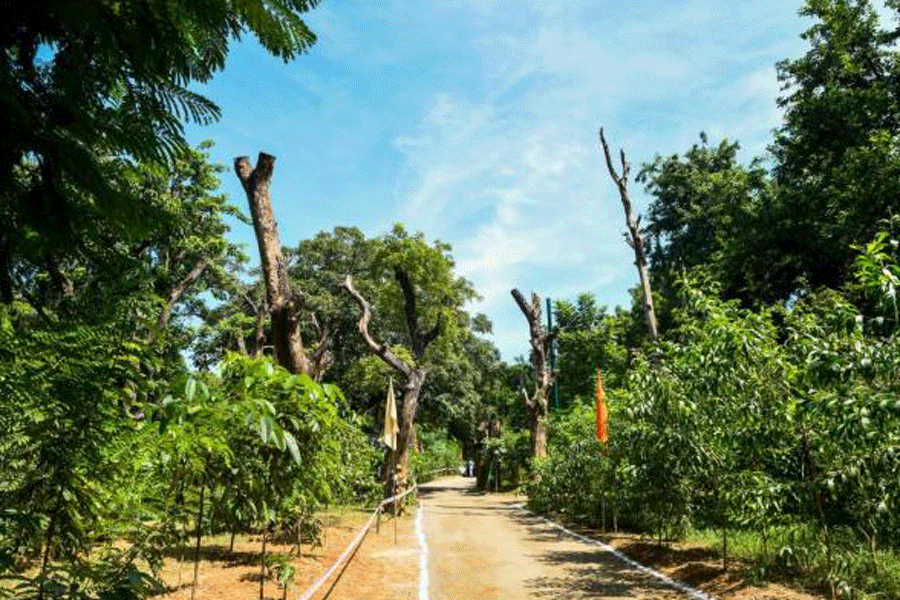
Playing saviour Sir ' It was no surprise to read another tirade directed at the forest department in Mahesh Rangarajan's 'To douse the raging forest fire' (Oct 26). I wonder why people forget so easily that to conserve the forests and wildlife is the duty of the department, as assigned to it by the state of India, much in the same way that the tribal welfare department is supposed to work for the welfare of the tribal communities. In fact, the forest department, in its new people-friendly incarnation, has been performing the role of many other departments in areas where the latter scarcely venture, leave alone undertake welfare work. Had it not been for the incessant efforts of the forest officials, even the remaining paltry 23 per cent forest cover would have gone, in much the same way that the community forests across the northeastern states have disappeared. It is worth pondering if the forest department, given its resources and power, is not in a position to completely protect the biodiversity in India, how will the forest communities, without means and measures, be able to address and accomplish the mammoth task of protecting and increasing the precious treasures of the forests' Welfare of the local people, a majority of whom belong to tribal communities, has always been a major concern of the department. The forest department has provided succour to thousands of tribals who have turned refugees overnight on being displaced from mega project sites. If these so-called 'ecological refugees' are being able to survive, it is because of the support the forest department has extended to them, one way or the other. Thus, it is not right to say that the forest department, by voicing its concerns over the passage of the tribal bill in its present form, is opposing the welfare of the tribal communities. In fact, the main argument of the forest department has been that in its present form, the bill is not going to be of any help to the tribals, neither economically nor ecologically. The tribals have now themselves realized that a better future lies waiting for them outside the forest. Many tribal communities in Tripura have voluntarily left the forest and done well for themselves. The right of occupation over 2.5 hectare of forest land, in absence of other supporting facilities, is not going to bring any appreciable relief to tribals nor release them from their abject poverty. Another concern for the forest department is whether the land so allocated to tribals will at all remain with them 'forever'. Yours faithfully, A.K. Gupta, Agartala
Sir ' Asking for protection of biodiversity and wildlife without any corresponding policy to check population growth is like asking for the moon ('Ecology for the people', Nov 12). India's humungous population growth has been the main block in its path to prosperity and the protection of its ecology. It has led to reckless felling of trees and, in the process, destruction of wildlife. In no time, as in Sariska, tigers will become a rarity in all other reserve forests. A 'mixed landscape', as suggested by conservationists, would be of little use to India without proper forest management. And modern man is prone to all kinds of vices. Rapid industrialization has not only caused the depletion of the ozone layer but the poisoning of man's immediate environment. No wonder our cattle and wildlife die of 'mysterious diseases'. Illegitimate use of natural resources and the creation of separate 'zones' for wildlife cannot happen together. Another thing. Developed countries too have to chip in in conservation. Holding summits alone will not help. There has to be more funding initiatives for projects like saving the tiger or other similar projects in Africa and other third world countries. Remember, the survival of tigers depend on the survival of the forest. Yours faithfully, Arvind K. Pandey, Allahabad
Sir ' Forest dwellers who have lived for ages in and around forests will get a breather if the tribal rights bill is passed. At least, it will record their long-standing rights to their land. The prime minister, Manmohan Singh, has repeatedly stressed that the people who live near forests must become their protectors. Hardliner conservationists need not fear about the implications of the bill. In any case, replacing and rehabilitating the vast existing tribal populations from their ancestral land can be counter-productive and trigger off unforeseen results. The only pragmatic solution lies in recognizing tribal rights and integrating them into the system. Yours faithfully, Amit V. Sengupta, Calcutta
Selfless service Sir ' With the passing away of former president, K.R. Narayanan, the nation has lost a multi-faceted personality and a noble soul. Narayanan was a distinguished diplomat, educationist and legislator. He was an upholder of secular values and adhered strictly to constitutional norms. It was heartening to see the media pay glorious tributes to this great son of India, but it was equally sad to see them label him as the nation's 'first Dalit' president. Yours faithfully, S. Balakrishnan, Jamshedpur
Sir ' K.R. Narayanan has been a true representative of the Indian democracy. He was a source of inspiration for the nation's poor and underprivileged. As president, he voiced his protest against all anomalies and set a precedent of sorts. He opposed Atal Bihari Vajpayee's idea of fixed-tenure legislatures, the National Democratic Alliance government's constitution review committee, the imposition of president's rule in Uttar Pradesh and Bihar and the Gujarat carnage. Yours faithfully, Bidyut Kumar Chatterjee, Faridabad
|