TT Epaper
The Telegraph
TT Photogallery
 
 
IN TODAY'S PAPER
WEEKLY FEATURES
CITY NEWSLINES
FEEDS
  RSS
  My Yahoo!
SEARCH
 
Archives Web
 
ARCHIVES
Since 1st March, 1999
 
THE TELEGRAPH
 
CIMA Gallary
 
Email This Page
Kashmir cry: Let army be in charge

Lately in Tangdhar, Oct. 13: Brigadier S.S. Jog cuts a handsome figure in the debris of this north Kashmir settlement for he is a hero; so is Paramjit Singh Dhillon, the deputy inspector-general of the Border Security Force.

But Kupwara district commissioner Abdul Majid Kande and the district’s superintendent of police, Sunil Dutt, are reviled.

Jog, Dhillon, Kande and Dutt are supposed to work as a team because they are the faces of the government here. The difference is that even in their misery the porters, shepherds, constables and farm labourers ? broken, desperate villagers from hamlets in the folds of the hills ? who have gathered beyond the perimeter of the helipad here fete the military while they are angry with the civil administration.

Jog and Dhillon represent the military, Kande and Dutt the civil administration.

Kande is the immediate target of the villagers. “Janab Kande, Janab Kande,” one youth shouts at him. “Come, come and have a look at our homes. Where have you been? Why are you hiding? Or, get lost! Take your relief supplies and give it to the army. Let them distribute it.”

The army’s 104 Shakti Vijay Brigade and the BSF’s 83rd battalion are too tied up as their pilots are operating the Cheetah helicopters from remote villages and their jawans are bearing stretchers. The stretchers carry injured villagers and also their own soldiers.

The failure of the civil administration has meant that there is additional pressure on the army. This is true as much of Tangdhar as of Uri and Poonch.

Take the example of Tangdhar. There is a brigade headquarters in Tangdhar, which means that here the army has about 3,500 soldiers. The BSF battalion has about 900.

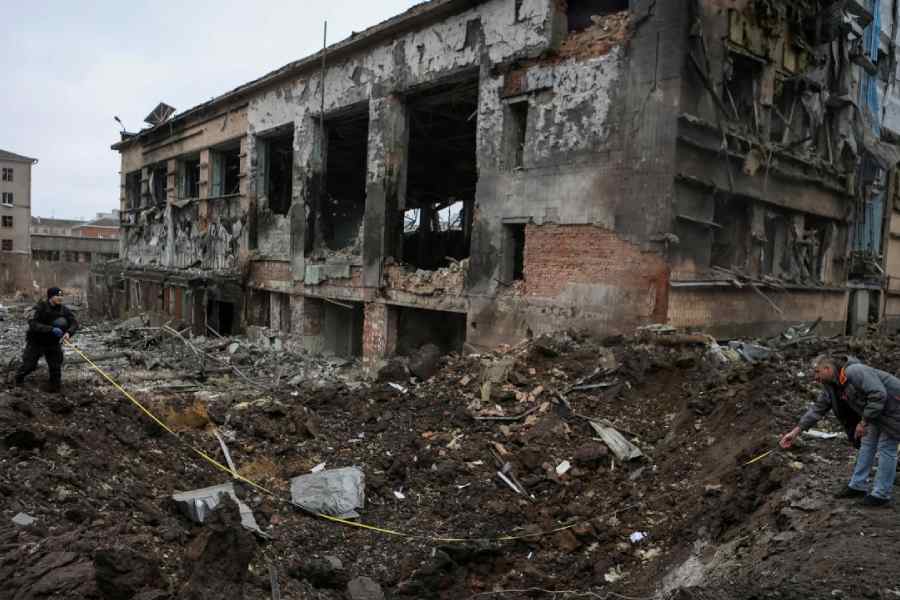
Karna Tehsil, or Tangdhar, in Kupwara district has 42 villages and a population of about 55,000. Some 70 per cent of the villages have hardly a single house intact. They are made of mud and stone. The only erect structures are concrete houses and wooden pillars and the tin sheds of the roofs.

Even if the army brigade and the BSF battalion work to distribute relief at full strength, there would be not more than 4,400 soldiers to give relief in the mountain fastnesses to a population that is over 10 times their number.

The civil administration is paralysed. The best excuse ? even if it were to be responsive ? is that its own staff is devastated by the quake.

Kande says: “We have reached relief to 90 per cent of the villages in two days”. But Abdul Hameed, a shepherd from Kona Gabra complains: “The relief that came ? tentages ? went into the police barracks. They are only taking care of their own. Why don’t they learn from the army? All relief should be given to the army for distribution.”

The army does not want to take the responsibility. It is already over-stretched.

Besides, Tangdhar has hardly been a priority area for successive governments in Srinagar even though militant violence has been on a low key here. But militants have often taken this route to infiltrate through the Line of Control.

Tangdhar’s history and topography ? it is demarcated from the Valley by the Shamshabari ridge to its south ? have increased the distance to Kashmir’s capital.

In 1947-48, raiders crossed over from here and provoked the first Kashmir war between India and Pakistan.

Top
Email This Page