|
| LOST WORLD: Cover
of the book, Climbing the Mango Trees by Madhur Jaffrey |
A trip down memory lane
Madhur Jaffrey, the 72-year-old
cookery writer and actress, hit big time in 1995 with her
BBC television series on Indian cuisine, Flavours of India.
Today, the New York-based Madhur is recognised as the queen
of curry. But in her just published memoirs of her idyllic
childhood days in pre-partition Delhi, Climbing the Mango
Trees (Ebury Press; ?18.99) she admits: When I left
India to study in England, I could not cook at all.
Her book reads in part like a
schoolgirls diary but is most moving when she recalls
how Partition destroyed the old Delhi and even the friendships
in Madhur Bahadurs classroom.
The reader is left with the impression
that she does not entirely approve of the overnight transformation
of Delhi, where previously one million Hindus and Muslims
had maintained a refined cultural balance, into a 13-million-strong
Punjabi dominated city.
Delhis Muslims began
disappearing, making their way to Pakistan, she writes.
All my Muslim classmates left without farewells. I
can only assume they had safe journeys. I have not seen
even one of them since.
How sad.
She also adds: Delhi, as
we knew it, ceased to exist. Its vibrant Hindu-Muslim culture,
its nuanced rules of etiquette, its unfailing politeness
and its unique sense of hospitality began to fade away.
Her upper middle-class family
had been all the richer for having absorbed many Muslim
customs, notably in matters of elegant dress and fine food.
As Madhur says, her family was Hindu by origin but
heavily veneered with Muslim culture and English education.
By the end of the book, when she
is about to leave for England to study at RADA, she tells
us that I was busy falling in love ? but not
that she had fallen for a Muslim boy.
We have to turn to Saeed Jaffreys
1998 autobiography, An Actors Journey, to read
of her fathers response when Jaffrey asked for his
daughters hand in marriage: Yes, you have rather
taken the whole affair into your hands. As a Muslim, when
you come back (from England) you may find getting a job
rather difficult. I will help you in the best way I can,
I assure you. But as far as allowing you to marry Madhur
is concerned, Im sorry the answer is a firm No!
Madhur should certainly bring
her fascinating life up to date in the second part of her
autobiography but she should be a lot more candid.
 |
| FRozen in time:
(Above) Tim Smiths picture of a Bollywood shoot
in the Lake District; The Shah Jehan Mosque (below)
in Woking was built in 1889 |
 |
Picture perfect
On a trip to Bradford some years
ago, I worked with a photographer called Tim Smith. What
I did not know at the time was that Tim was developing a
sideline, taking pictures of Asians in Britain. Now nearly
100 of those black and white images, depicting all aspects
of life over the past quarter of a century, including many
from the Muslim community, are on show at the National Theatre
in London in an exhibition, Asians in Britain.
One of my favourites is of the first purpose-built mosque
in Woking in Surrey. The Shah Jehan Mosque, built in 1889
and mostly financed by Begum Shah Jehan from the Bhopal
ruling family, proves that Britains link with Muslims
go back a long time.
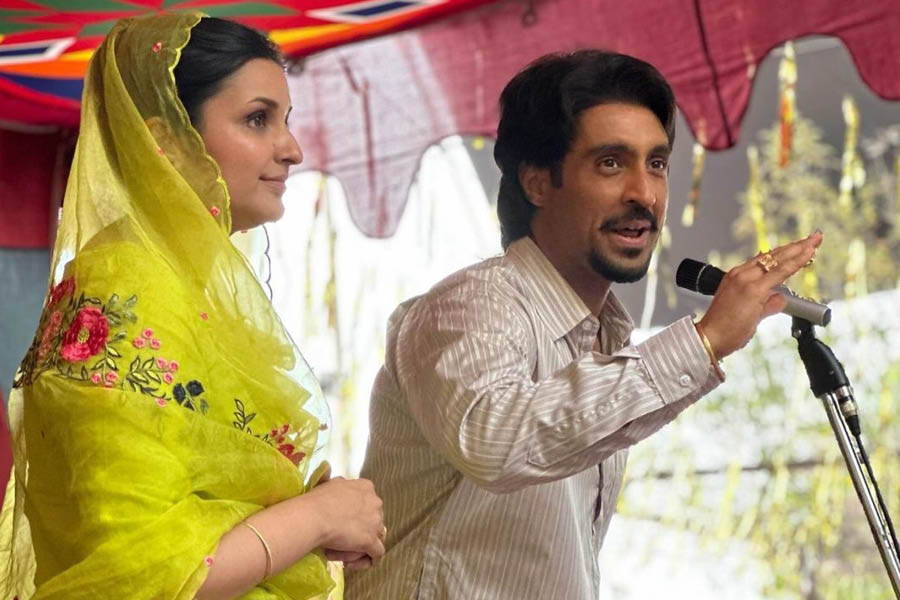
On another occasion, Tim took
pictures of a Bollywood shoot in the picturesque Lake District
in Cumbria. One of the actors with a quiff gave his name
as Hrithik Roshan, while two pretty girls said they were
called Rani Mukherjee and Kareena Kapoor.
Tim sounds almost Hindu about
his plans to spend more time taking pictures in India. I
could spend several lifetimes there, he sighs.
Praiseworthy
Journalists seeking more information
on talks in India between Dr John Reid, the visiting secretary
of state for defence from London, and his opposite number
Pranab Mukherjee, were referred to a press officer called
Sagar Sharma.
Was he newly appointed to the
Indian High Commission in London, I wondered, for the name
was not known to me.
Then I looked more closely and
realised that the said Mr Sharma is press officer for the
British ministry of defence.
Would Pranabbabu ever appoint
someone called, say Tristram Chomondley-Carruthers, to represent
Indias defence PR?
Credit to the Brits where it is
due.
His story
The Indian government will, I
hope, remember to send a big bouquet of fragrant marigolds
to the memorial service in London on November 15 of the
7th Lord Brabourne, who died at his home in Kent last month
aged 80. As John Brabourne, he produced a number of films,
including David Leans A Passage to India.
Brabourne Stadium in Mumbai was
named after his family as was Brabourne College in Calcutta.
I once complained to Lord Brabourne of the very strict security
checks I endured at Brabourne College when I used to go
there during holidays to collect my cousins, who were over-protected
students at the college.
Lord Brabourne, who was married
to Lord Mountbattens daughter, was born in Bombay
on November 9, 1924. His father, the 5th Baron Brabourne,
spent four months as Indias youngest Viceroy in 1938.
The latter is buried in Calcutta.
A few years ago when Lady Shreela
Flather took several descendants of Viceroys on a trip to
India, Lord Brabourne broke away briefly to visit his fathers
grave at the St Johns Church (which I myself happened
to visit in April this year to see the Job Charnock memorial
but missed Lord Brabournes grave). It is a remarkably
evocative place but needs a bit of tlc (tender loving care).
Food fave
Westminster Council in London
has erected a plaque at 102, George Street, Portman Square
(just behind Selfridges) in memory of Sake Dean Mahomed,
who established the first Indian restaurant in the UK, the
Hindoostane Coffee House, on the site in 1810.
Mahomed, who served in the East
India Company army before coming to the UK in 1784, was
born in ? yes, youve got it ? Patna in 1759. He died
in Brighton in 1851.
What about a plaque in Patna?
Tittle tattle
The man given the important job
of ensuring Britain secures a record medal haul at the 2012
Olympics in London is Lord Moynihan, a former Tory politician
and a rowing silver medallist from the 1980 Olympics in
Moscow. He has been appointed chairman of the British Olympics
Association.
Once described as small
but perfectly formed, Colin Moynihan was sports minister
under Margaret Thatcher in 1988 when an exotic
Indian woman disrupted his life.
It was as his escort to the Tory
Winter Ball that the desi lady in question first
caught the eye of the inquisitive photographers. She turned
out to be an escort, all right, used to charging ?500 a
night. It emerged that the woman had started life as Pamela
Singh, won the Miss India contest organised by Vimla Patil
of Femina, married a Frenchman, Henri Bordes, added
an extra to her name and reinvented herself
as Pamella Bordes. She was working in the House of Commons
as a researcher when she was rumbled.
There was no suggestion that Moynihan
himself had been indiscreet in any way. But, then, we all
have regrets.
|