TT Epaper LHS
The Telegraph
TT Mobile
 
 
IN TODAY'S PAPER
WEEKLY FEATURES
CITY NEWSLINES
FEEDS
  RSS
  My Yahoo!
SEARCH
 
Archives Web
 
ARCHIVES
Since 1st March, 1999
 
THE TELEGRAPH
 
CIMA Gallary
 
Email This Page
TOUCHED BY THE DIVINE

Three Bhakti Voices: Mirabai, Surdas and Kabir in Their Times and Ours By John Stratton Hawley, Oxford, Rs 695

Religion in India was radically redefined by the Bhakti poets in the 15th and 16th centuries. Three Bhakti Voices focuses on Mira, Kabir and Surdas, three of the best-known north-Indian Bhakti poets. It incorporates Hawley?s research, conducted over several decades, on some of the oldest manuscripts in various collections all over north India.

Hawley tells the history of the transmission of Bhakti poetry and stresses on the need to remember that the existing corpus of texts, now attributed to Mira, Kabir and Sur, emerges out of a complex historical process involving accretion and appropriation. Hawley dedicates several chapters to discussing how Mira, Kabir and Sur appear in their oldest manuscript traditions and, in the process, presents translations of several unpublished poems from the earliest manuscripts.

The book starts off with ?Author and Authority?, a chapter that discusses a characteristic feature of Bhakti poetry ? the oral signature, or the mention of the poet?s name near the end of the poem. Hawley carries out a textual analysis of several poems and shows a complex relationship between signature line and poem. He reminds readers that these signatures were often used by later poets to lay claim to a respectable pedigree for their poetry. Thus, while poems in the Sursagar bear a single ?signature?, the Sursagar as we have it today includes poems composed by several authors.

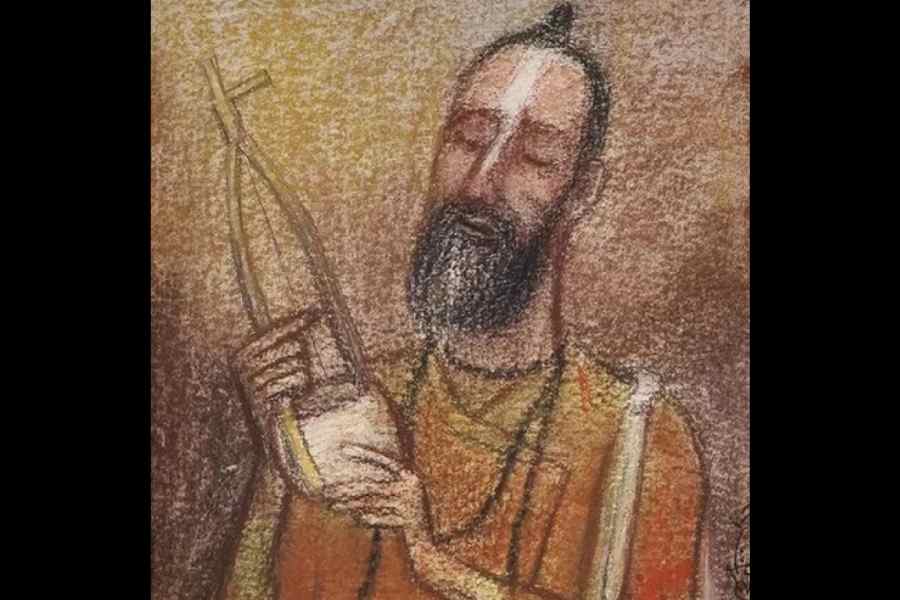
The ?blind? Surdas we all know of was probably not blind, till very late in his life, argues Hawley, backing his claim with painstaking analyses of early editions of the Sursagar. He also claims that Surdas was probably never a pupil of Vallabhacharya as the Vallabha sect claims. Hawley gives a history of the sect?s appropriation of Surdas and says that it led to a suppression of his vinaya poems, where he speaks without the dramatic interface of a member of Krishna?s world of lila.

Hawley?s thesis is that the oldest extant collections of Sur?s poems were much smaller than those found in books today and that many poems added later were commentaries on earlier compositions, in which the commentators often aimed to interpret the text so as to support positions espoused by their community. The author also finds that the core poems of the Sursagar were short, lively and sometimes irreverent compositions that were neither determined by sectarian allegiance, nor by the Bhagavata Purana, as is sometimes assumed. Poems added later tended to be longer and to enhance the role of Radha. Hawley argues in favour of reclaiming Surdas from the liturgy of the Vallabhite pustimarg and for relocating him in a less rigidly sectarian realm.

The Vallabha sect tried to divide the life and poetry of Surdas in such a way that his sagun and nirgun sides would stand in opposition to each other, the sagun overshadowing the nirgun. Yet, the Surdas we encounter in the old and presumably more authentic manuscripts is more of a mix. The sagun-nirgun division itself, Hawley argues in another chapter, was far less evident in the ?original? poems. The idea of a difference between the two was probably the result of sectarian definitions that grew stronger over time, he writes.

Hawley?s arguments are well substantiated by references to both poetry and hagiography. His comparative study of Kabir and Surdas and his readings of the Fatehpur collection are incisive and engrossing. Hawley also ventures into contemporary times and studies how the popular Amar Chitra Katha comicbook series reconstructs the lives of the Bhakti poets. The early hagiography of Mira highlights her disdain for family ties ? this is true of the Bhaktamal as well as of Priyadas?s later work, the Bhaktirasabodhini. Amar Chitra Katha transforms Mira?s rebellion into an acceptance of wifely decorum. It emphasizes her fidelity to the Rana and turns her into a model for young middle-class Indian women. Hawley explores how this version of Mira?s life differs from that of Priyadas and tries to understand these variations in the context of the stated objectives of the series.

Three Bhakti Voices is a fine work of scholarship and an important addition to the corpus of literature on Bhakti.

Top
Email This Page