Anandautsav 031008
The Telegraph
 
 
IN TODAY'S PAPER
WEEKLY FEATURES
CITY NEWSLINES
FEEDS
  RSS
  My Yahoo!
SEARCH
 
Archives Web
 
ARCHIVES
Since 1st March, 1999
 
THE TELEGRAPH
 
TT Mobile
 
Email This Page
Three-show weekend

Last weekend saw a new production each evening for three consecutive evenings. Friday offered the appetiser, as Theatrecian served up the witches? broth of Wyrd Sisters. Stephen Briggs?s inferior dramatisation of Terry Pratchett?s novel converts the original into an unmanageable Christmas pantomime. Unfortunately, it was a bit early for that time of year, while Dhruv Mookerji?s direction (and sound effects) did nothing to divest the costume drama of its regressive teenage air.

After the big yawn of the first half, the second sprang to life along with the Mousetrap within Macbeth ? nothing like a play within a play if you really want a travesty. Thus, Tathagata Singha, Sumeet Thakur and Tanaji Dasgupta in their brief appearances as the witches in drag with green wigs completely upstaged the regular weird sisters (Nilanjana Bose, Ipsita Chakrabarty and Anisha Sharma) who laboured earnestly in their parts, British accents and all, for two-and-a-half hours.

Other cameos that caught the eye included Simon Jennings as the harried author of the Mousetrap, Soumyak Kanti De Biswas as the heir not-so-apparent, and Deborshi Barat as his self-conscious princess. In the main plot, Bikram Ghosh desperately tried to inject malice into Felmet but his transparent smirk at the goings-on destroyed the illusion.

Then came the main course, the annual Odeon festival. On Saturday its curtain rose on Ji Jaisi Aapki Marzi by Ekjute (Mumbai), a quartet of monologues by women at different ages and from different stations. As a vehicle for gender issues it turned too schematic; it almost seemed as if director Nadira Babbar had picked one illustrative incident for every kind of trauma a woman can face ? discrimination in favour of brothers, child abuse, harassment on the streets, adultery, bigamy, rape, suicide.

On the other hand, it scores didactically by fulfilling the social purpose of bringing these topics to audience attention, therefore perhaps we should not criticise too much.

Artistically it was weak on other counts too. Like Babbar?s other productions, it contained gratuitous references to Bollywood and tellywood, as if life in Mumbai must revolve round these beacons. It also had unnecessarily cheap cracks at human physiques, again recurrent in Ekjute. One portrait, that of Divya Sharda as the Muslim mother, did not convince by way of age or naturalistic mannerisms. The others were in character right through ? Natasha Sehgal as the schoolgirl and Shivani Tanksale as the working woman ? but Juhi Babbar surprised most pleasantly as the Sikh bride whose husband cheats on her.

Dark Horse, by Just Us (Chennai), unexpectedly riveted audiences on Sunday. Unexpectedly, because it was a new group, because it was the production?s first full-scale show (in Chennai, it had so far only had shorter and less structured performances) and because of the untheatrical subject. Gowri Ramnarayan not only stitched a seamless fabric of the late Arun Kolatkar?s poetry, she also dramatised them effectively.

Against a constant soundscape scored by Ramnarayan of classical vocals by Savita Narasimhan, the scene unfolded as a young journalist, who as a girl felt inspired by reading Kolatkar, goes to interview the introverted poet, eventually winning his trust.

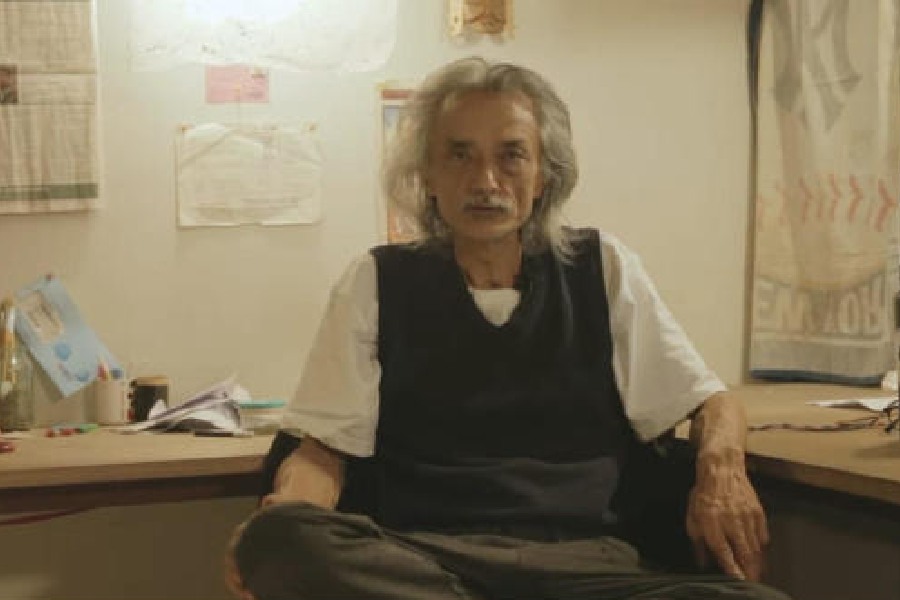
Dhritiman Chaterji?s characterisation of Kolatkar was another strong point. At first just his stern look, with brusque and guarded replies, then softly ironic and finally opening up, he portrayed the poet as intensely private and the poetry as perched between modernist scepticism and ancient faith ? if not devotional, certainly spiritual. For he captured those essential qualities in a poet: to see the spirit of life in people, in animals, in nature, in everything, and to make us see into the heart of things via a bare minimum of words.

Top
Email This Page