|
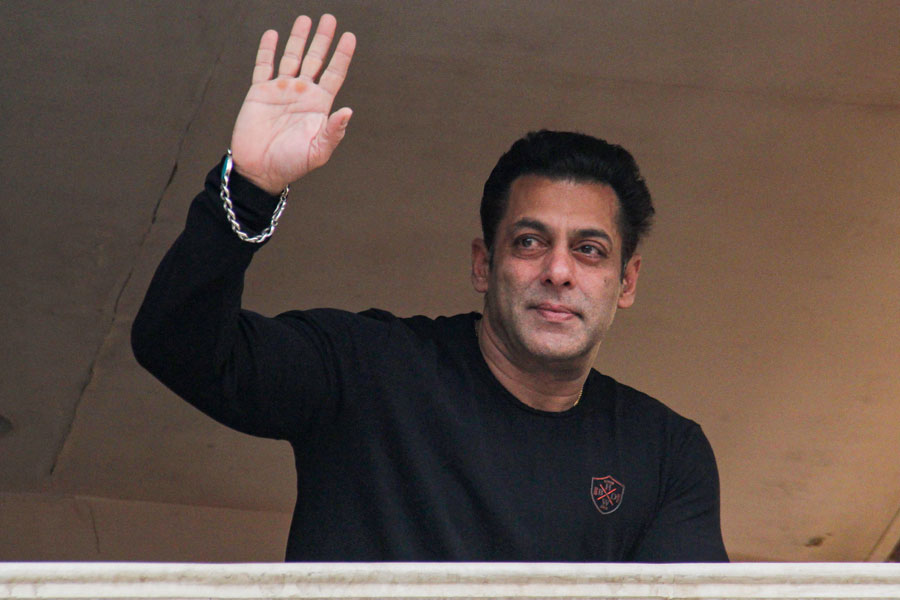
| Twinkle Toes: The man might have been in Amsterdam for the IIFA awards, but his students in Calcutta were busy showcasing their dancing talents at Science City auditorium on Monday evening. Around 250 youngsters learnt the steps at the Summer Funk workshop conducted by Shiamak Davar Institute for Performing Arts over 12 days of training in various dance forms. Picture by Amit Datta |
On June 10, at the Elgin Road outlet of Caffeine, Elaan presented the second instalment of Speakeasy, its series of coffee table addas, keeping in mind the legal perspective of the campaign against child sexual abuse. Besides a very enthusiastic young audience, especially invited to participate were potential volunteers of the group and a few members of AIESEC, the world?s largest youth-run organisation.
The two-hour interactive session was started by Pranaadhika Sinha, who answered the queries of the audience on awareness about child sexual abuse and incest. Next, Harsh Aditya Poddar of Elaan explained the legal stance of the group. He discussed the possibilities of a separate law under the Indian Penal Code for dealing with issues of child sexual abuse and incest ? why it is required, how it could be petitioned and achieved, and once in place, how could an abuse victim benefit from it.
The audience response to the discussion was overwhelming. Some of the participants came up with interesting questions on very obscure issues ? would this law be of any help to adults who had been abuse victims once? How would the court, which does not place much importance on a child?s testimony, proceed with such cases? All of these were explained patiently by Harsh. We sincerely apologise to everyone whose queries remained unanswered due to the time constraint, and hope we will be able to bring you many more such interactive sessions in the near future.
On behalf of Elaan, we would all like to offer a big thank you to Rajdeep Ghoshal and Talat Masud of Caffeine for their exceptional concern and support for our campaign. Caffeine is further credited for being the first venue at which Elaan?s legal petition is put up for public viewing and signature collection.
Note: The Elaan board is now functioning without Wei Ming Yu. He has been replaced by Joie Chatterjee.
Mandy M.,
Member, Elaan
Tradition & technology
Indian classical music is basically a form of chamber music. It used to be performed in closed chambers. But as time rolled by, its sponsorship and patronage was taken over from kings and emperors by the corporate sector, and classical music broke the barriers of its four walls and started reaching out to a vast cross-section of audiences. Closed chambers were replaced by huge auditoriums. It was popularised in the West through exponents like Pt Ravi Shankar. There has been an increasing effort on the part of both Western and Indian classical musicians to experiment with this form of music within its own boundaries and with other genres.
In the past decade, the technological boom has penetrated this form. The exposure to different types of Western music has also triggered the use of equipment such as processors and wawa pedals. With the availability of elect ronic gadgets like midi samplers, synthesisers, loop machines, drum machines et al, Indian classical music has reached a new level of development, where experimentation and innovation go hand-in-hand.
However, purity of sound is considered the bedrock of Indian classical music. So, the ?electronification? is being questioned nowadays. In an interview, popular classical musician Shubha Mudgal , whose experiments in Indipop are well known, shares her views on the advantages and disadvantages of using electronic gadgets in Indian classical music.
|
|
Youngsters from the NGO Diksha, from the Kalighat red-light area, perform a play, one in a series on child rights, HIV/AIDS, child abuse and trafficking, near Kalighat market last week, as part of a community awareness project. Picture by Pabitra Das |
Do you think the use of an electronic tanpura hampers the quality of classical music? What is the difference in tonal quality?
The use of an electronic tanpura is convenient for a variety of reasons, but I feel it can never completely replace the acoustic tanpura. It is very convenient for practise or riyaaz, and sometimes even for performances. Often performers are unable to get good tanpuras and in such circumstances the use of an electronic tanpura can save the day.
Do you use an electronic tanpura?
Yes I do, but usually in conjunction with an acoustic tanpura.
At what age did you start learning?
My formal training, or taleem, started unconventionally late, when I was about 16 or 17 years old. But I had grown up listening to a lot of music and with parents who loved and respected Indian music deeply.
Is voice training now done keeping electronic amplification in mind?
Not really. I would like to put it a little differently. I think people no longer feel the need to develop a full-throated voice projection because they are certain that amplification will now be used in all situations.
What is your opinion about musicians who have incorporated electronic equipment like processors in instruments which are originally acoustic in order to produce effects?
It would not be correct for me to generalise. Broadly speaking, I am not opposed to the idea of people experimenting with electronic equipment. But it would be pointless to do something like using a wawa pedal with a sarod for instance, and take credit for being an inventor. I feel each instrument has its own timbre and texture, and its own technique, and while it would be perfectly valid to experiment with techniques used by other instruments, experimentation must be regarded as a process that may or may not culminate fruitfully, and musicians would have to analyse their experiments critically.
Being a part of the recording industry for a long time, what do you think are the advantages and disadvantages of recorded music?
Recorded music can be a vital document for a student of music. For instance, I never had the chance to listen to Kesarbai Kerkar live. The fact that her music was recorded makes it possible for me to not only hear her first ever recorded 78 rpms made approximately 70 years ago, but technology even permits me to try and clean out old recordings and hear a restored version. Recording technology has also made processes such as editing of music much easier, but like everything else, it has its pros and cons. Today, multi-track recording and electronic instruments make it possible for one musician to create an entire soundtrack almost single-handedly. What happens then to the musicians who once earned their living through playing in studio sessions? We all know the answer to that, don?t we?
Sanghita Chatterjee,
Mass com & journalism, CU
Busybodies
Mass communication and journalism students of Calcutta University have been busy in the past couple of months with a slew of activities. The most recent event was on June 11, the 104th birth anniversary of the late literateur and professor Pramathanath Bishi. The Viswakosh Parishad had organised the Pramathanath Bishi Memorial Lecture. Among those present was Bishi?s son Kanishka Bishi.
In his presidential address, Pratap Chandra Chunder shared with the audience interesting anecdotes from his interactions with Prof Bishi. Chief guest Sabitendra Nath Ray, dwelling on the topic for the session, Pramathanath Bishi: Literateur and Personality, shed light on the chequered life of the man, with keen insights into his noteworthy role as a votary of communal harmony during India?s freedom struggle and his inspirational service to the student community in the capacity of the Rabindranath Tagore Professor of Bengali at CU.
On May 24, the additional director-general of Doordarshan News, Indian Information Service officer Amitava Chakraborty, was invited to the department of journalism and mass communication to share his experiences as a foreign correspondent. He gave a thrilling and humorous narration with an overview of his journalistic adventures during September 11, 2001, World Trade Center attacks, followed by inside stories of Operation Black Thunder, Operation Cactus, 1992 Ram Janmabhoomi-Babri Masjid crisis and the 1987 Colombo assassination attempt on Rajiv Gandhi.The interactive session with teachers and students covered topics like embedded journalism, media lobbies, news sources and media management.
Arjun Chaudhuri,
1st year, MA mass com & journalism, CU
|
|
What defines our existence is a mere absurd nothingness — a theme in Samuel Beckett’s Waiting for Godot, to be staged by Theatrecian at Gyan Manch on June 19, 6.30 pm. Directed by Tathagata Singha, the cast comprises Ronaan Roy, Sumeet Thakur, Deborshi Barat and Tanaji Dasgupta. Tickets are available at Gyan Manch and Coffee Pai. |
Small talk
World Environment Day is celebrated on June 5 every year. It was a pleasure for the Nature Club Council to organise a seminar along with the Agri-Horticultural Society. Schools Like Ashok Hall, Lakshmipath Singhania, Birla High School (girls), La Martiniere (boys and girls), St Xavier?s, Don Bosco, Mahadevi Birla, Modern High and GD Birla took the initiative for the common cause.
The day started off by the planting of a few saplings in front of Agri-Horticultural Society by the students. Then there were dance performances organised by the society. This was followed by a presentation by the Nature Club Council . Then came the seminar. The topic of discussion was Nature vs Infrastructure. The youngsters discussed the problems, remedies, prevention, environmental laws and awareness schemes. LMB bagged the first prize.
Neha Dokania,
Ashok Hall School
Eastern Zonal Cultural Centre (EZCC) in Salt Lake had organised a series of activities, which took the kids by storm. From May 1 to 5 was Bangla Epar-Opar in collaboration with NAIOR. The following day was Ei Nidaghe ? Baisakhe by Mousumi Karmakar and Tristi Bhattacharya (Rabindrasangeet). On May 8 was a cultural programme in collaboration with Tara Cultural Movement. Then was a talent search by Chinmoy Adak, Debmalya Chatterjee and Souraja Tagore.
On May 12 was Rakhi Bandhan by Banga Bhanga Birodhi Andolaner Saatabarsiki, and Rabindra gaan by Saptak and directed by Alpana Roy. May 13 to 23 was Dishari Drama Festival. May 10 to 25 was an Oddisi workshop by Guru Giridhari Nayak. May 27 was the Odissi recital by the guru and his students. May 23 to 27 was International Children?s Theatre Festival. The May Cultural Festival culminated on May 31with Manta Theatre Show Play Yaadon Ke Bujhe Huye Savere by Little Thespian. There are yet more cultural events happening at EZCC in June.
Sourendra Das, & Soumorshi Som
Sri Aurobindo Institute Of Education
|