|
|
|
Dead weight
|
In the bygone days, Indian intellectuals were quick to protest against gross violations of human decency. However, the Nepal royal family massacre under highly suspicious circumstances passed without public protest. The report that Uzbek troops fired point-blank at unarmed demonstrators, killing or wounding a thousand of them, got almost the same latitude. When General Dyer ordered the Gurkha riflemen to shoot into the packed Jallianwala Bagh, or a sole protestor standing in the path of the Chinese tanks clearing Tiananmen Square was mowed down by the first one, the images shocked the world conscience. The massacre of women and children calling for the release of relatives from the prison in Andizhan did not evoke any official or non-governmental protest in India. All that we know is from the internet.
Andizhan is not too far from Amritsar, Srinagar or Leh. The craggy Karakoram route runs across the upper Indus into Xinjiang, originally inhabited by Muslim Uighurs, descendants of the medieval Mughals who in those days roamed Kashgar, Urumchi, Osh (now in Kyrgyzstan) and also what was then spelt as Andijan, Nomonghan and Marghilan in the vale of Ferghana. Babur was born in the town (though by no means buried there, as Uzbek tourist guides now claim). Thrown out by his uncles, he wrote later in his memoirs about Mughal and Uzbek squabbles for the land. Till the early years of the 20th century, Multani and Shikarpuri traders regularly traversed this route, carrying money and Punjabi handicrafts and sending back dried fruits, other delicacies and Karakul caps to places as far as Calcutta.
Stalin?s nationality law in 1924 partitioned the vale, hemmed in by the Tian Shan mountains in the north and the Alai range in the south, into three parts. The bulk went to Uzbekistan; a strip along the south (Batkent) upto the north (Osh) went to Kyrgyzstan, a finger in the west (Khojent) went to Tajikistan, protruding towards Tashkent, the Uzbek capital. The jigsaw of majorities or minorities created the potential for Soviet ?divide and rule?.
Ferghana had a certain market unity. It produced cotton and silk. Factories were concentrated in the west around Khokand. By 2000, these had become uncompetitive in the new world market. East of the vale, agriculture was practised along the upper banks of the Syr Darya, which flows from the Kyrgyz rivers, Naryn and Kara Su. The Ferghana canal was built in the Twenties by Uzbek labour. Along the Alai slopes are vineyards; a certain amount of cheap wine is available in Uzbek and Kyrgyz markets.
The Uighurs migrated in fairly large numbers to the vale. The Uzbeks moved east in search of land at the expense of the more nomadic Kyrgyz. Large and sullen colonies of Crim Tartars and Meskhetian Turks were deported here from the Black Sea lands. Stalin accused them of collaboration with Germany in World War II.
Inter-ethnic tensions about arable land, pasture rights and water use came to the forefront in the perestroika days. Murderous riots exploded in the early Nineties in Marghilan and Osh. Uzbeks attacked new settlers from the west. They themselves were turned into refugees by the newly independent Kyrgyz. The Soviet defeat in Afghanistan brought a wave of religious propaganda by the mujahedin and their converts among captured Uzbek troops from the southern Uzbek-Tajik border. This created a situation like the Nineties? Kashmir.
Central Asia, like much of the old Soviet Union, lapsed into a state of economic recession. Corruption was rampant among the governing class. Once communist, it effortlessly changed sides into crony capitalism, forming clan or mafia connections that controlled vested interests in each republic, not to speak of the federation itself.
These socio-economic complications at a time of transition from late socialism to post-communism led to the present crisis, spilling over from Kyrgyzstan. Religious fundamentalists led by the late Juma Khojaev of Nomonghan and his preceptor, Tohir Yuldashev (whom the Americans and the Pakistanis have, strangely, not yet been able to capture), hooted the new president (previously first secretary), Islam Karimov, out of Nomonghan in the early Nineties, demanding national observance of the rituals of namaz and an Islamic constitution. As guerrillas in the Tajik and Kyrgyz southern borders of Ferghana, they were a prelude to America?s war on terror, bringing Uzbek and Kyrgyz airfields in Faizabad and Manas near Bishkek into the destruction of the taliban. Hizb-ut-Tahrir, the puritanical religious base of the guerrillas who include Uighurs as well as Batkent Kyrgyz and Uzbeks from eastern Ferghana, had led the Uzbek state to attempt to crush religious dissension. In the same way that its Russian big brother under Vladimir Putin had attacked the Chechens, and its Georgian cousin had treated the smaller ethnic groups on the Black Sea littoral. The police are notorious bribe-takers and mechanically brutal. This is a common dichotomy in all Eurasian states ? venal authorities and warm, friendly masses.
Globalization had increased poverty in the resource-scarce central Asian economies which had previously been subsidized by the Soviet Union. In the villages to the south and west of Andizhan, actually on the border of Kyrgyzstan, deprivation and capitalist market inroads among peasants unprepared for its temptations, mingled with a religious propaganda that retrogressively called for the veiling of women and a moralistic stand against the mafia. Tashkent?s secularist rulers, to keep at bay the creeping Islamist morality, locked up youth from the villages, subjecting them to thought control or perhaps even torture.
Even before 9/11, women from these villages and Andizhan itself had gathered in non-violent groups in the summer of 2001 to protest against sons and brothers being taken away by the police. Had the US-Uzbek alliance not supervened, this may have captured world attention. Instead, Ferghana, like Kashmir, became a pawn in the manipulation of Asian international relations. The issues are serious. India deals in military spares and other equipment of defence strategy with an Uzbek armaments economy that is now fighting obsolescence.
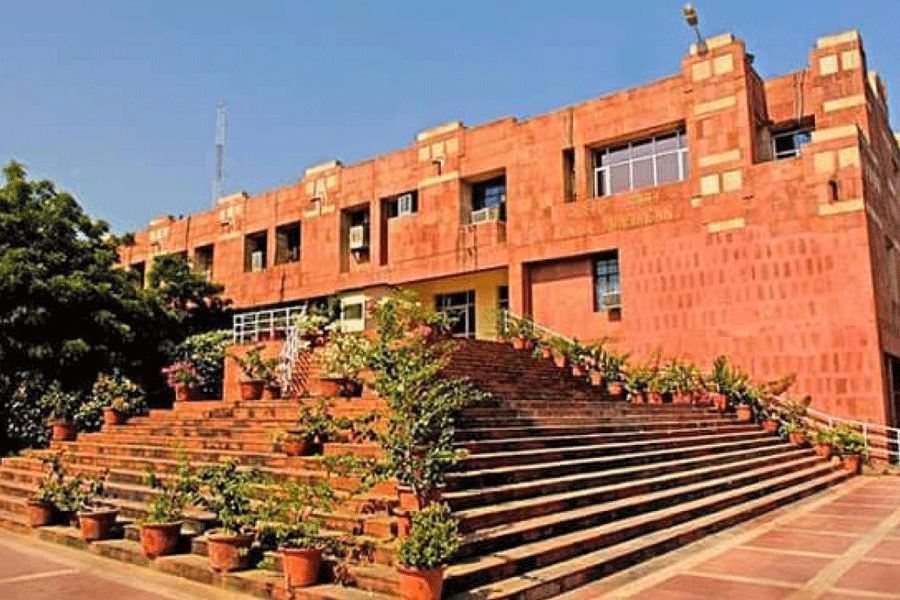
This cannot justify complicity with the Uzbek national security personnel with whom the Delhi Institute of Defense Studies and Analysis has been jointly publishing books ? one of which was even called Our Common Future. It has to be made clear to our government?s Uzbek contacts that we dissociate ourselves from old, authoritarian methods of training police, obsolete judicial procedures to repress freedom of opinion and an oligarchy that is intent on stifling public dissent.
Democratic secularism, dignity of labour, reliance on mass literacy and rationality among the poor, a spirit of Uzbek-Hindi bhai-bhai are still active among the warm and earthy Uzbek people. But unless police brutality and bureaucratic greed is done away with, not only will the rule of Karimov and his daughters crumble, but also that of the network that takes shelter behind his name. Look at the way Askar Akayev and his clan suddenly crumbled in Kyrgyzstan in a chain of events that obviously foreshadowed Andizhan?s horrors.
After all, the sick president has outlived his use to the American oil interests behind Condoleezza Rice and her central Asian contacts. They may have decided that the time is ripe for another ?democratic? revolution, all the way from Georgia to China?s border. This will also hem in the Russians and isolate them from the warm waters of west and south Asia while challenging the Chinese across the Gobi and Lop Nor. Where does India stand in this fluid central Asian scene?
|