merlin
The Telegraph
 
 
IN TODAY'S PAPER
WEEKLY FEATURES
CITY NEWSLINES
FEEDS
  RSS
  My Yahoo!
SEARCH
 
Archives Web
 
ARCHIVES
Since 1st March, 1999
 
THE TELEGRAPH
 
 
Email This Page
Fighting for custody across continents

When two parties are embroiled in a spat, it’s the law that decides. But who decides when two legal systems are at loggerheads? And that too, belonging to legal establishments of two different countries?

A case in point was the recent refusal of a New York family court to allow two children ? the right to whose custody is the bone of contention between their father and their grandparents ? to appear in the Supreme Court last month. Now aged 10 and seven, the brothers lost their mother, who committed suicide by consuming poison, in 2000. The children’s father, an Indian citizen, is a resident in the US and runs a textile business in New York.

Soon after the mother’s death, the Supreme Court of India had ruled that the father, being the natural guardian of the children, should be given custody of the children. But following several interim custody petitions filed by their Hyderabad-based maternal grandparents in different subordinate courts of the country, the apex court had come to the conclusion that custodial rights to the children should be decided keeping the interests and welfare of the siblings in mind. The case was to be heard by the Supreme Court on April 25, and the jury demanded that the brothers be present in the court during the hearing.

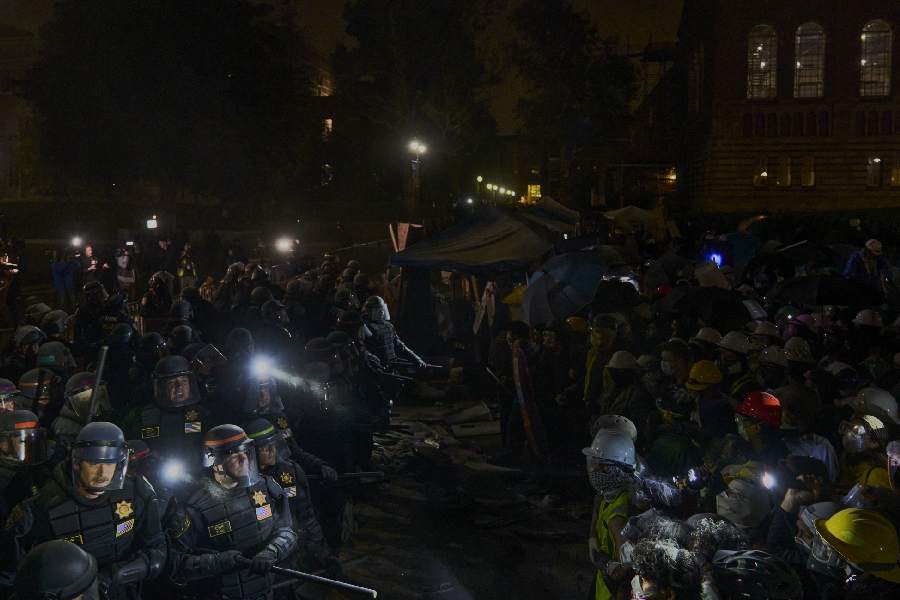
However, much had happened in faraway New York where the children have been residing with their father since 2002. Being American citizens by birth, the children had been pronounced wards of the family court by an American jury, reveals lawyer A. Raghunath, who is representing the father at the Supreme Court. An appeal to the American jury to allow the children to travel to India to appear before the Supreme Court was turned down. No reasons were cited to the Indian authorities for the denial.

Needless to say, the blunt refusal has irked the Indian legal system considerably. Taking strong offence to the New York court’s defiance, the Supreme Court has requested solicitor-general Goolam E. Vahanvati to look into the matter and decide whether a foreign court has the power to pass an order that negates the directive of the Supreme Court.

For the past few weeks, Indian legal circles have been buzzing with discussions regarding the possible fallout of this international spat. Vahanvati, being involved in the proceedings, has refused to comment. But there are others who are sceptical about the repercussions that this face-off could have.

In the event of legal systems of different countries differing in opinions, there could possibly be an element of national arrogance at work, feels Supreme Court lawyer Rajeev Dhawan. “In general, the legal authorities of the US and UK view their courts as superior to those of other countries, and they often feel that they must have total right to international cases,” he says.

But even while maintaining so, the American family court should ideally yield when it is requested to do so by the apex legal body of another country, feels Dhawan. “The reluctance cannot be merely based on a generalised picture of semi-failed states in the world, whose legal systems may not be reliable.”

The best way to solve the dispute, opines Dhawan, would be to go by the principles of private international law, and decide what particular law should be applied to a case such as the one in question. “It may also help if a forum convenience is arrived at,” says Dhawan, hinting at a situation where the case is referred to a neutral third body for arbitration.

While that may offer some insight into the situation, there are others who read more into this. Supreme Court lawyer Lalit Bhasin refers to the New York Convention to illustrate his point. “The convention requires its signatories to honour its clause of reciprocity, by upholding decisions taken by the legal system of another country,” he says. Both India and the US are signatories to the convention.

But the very fact that a subordinate American court can defy the apex Indian court is a retrogade step towards the administration of international justice,” says Bhasin. “There has been recent talk of opening up the Indian legal system for foreign practitioners. But this incident only shows the contempt with which visiting foreign lawyers might view the Indian legal structure. That does not make the future look any brighter,” he says.

Bhasin says there is no action that India can take at the governmental level to set the records straight. “There are no judicial remedies for such a case involving a foreign court,” he says. “The only option is to present the case before the International Court of Justice, and hope that redressal is doled out.”

The next hearing for the case regarding the children’s custody is slated for July 12. By then, one hopes that the solicitor-general’s report would also be tabled. Law, ideally, should take its own course. It remains to be seen, though, if the two courses, in this case, would match.

Top
Email This Page