TT Epaper LHS
The Telegraph
TT Mobile
 
 
IN TODAY'S PAPER
WEEKLY FEATURES
CITY NEWSLINES
FEEDS
  RSS
  My Yahoo!
SEARCH
 
Archives Web
 
ARCHIVES
Since 1st March, 1999
 
THE TELEGRAPH
 
CIMA Gallary
 
Email This Page
Tribute to the tambourine man
I don?t believe in anything. I don?t see anything to believe in.

? Bob Dylan to journalists in London, 1965

On May 24, the living legend turns 64. Although he rarely talks anymore, the singer-songwriter speaks through his music. Dylan performs more live shows now than he did 40 years ago. Fans still wait in long queues for up to 12 hours to get tickets to his sell-out concerts ? be it in huge arenas like London?s Wembley stadium or minor league baseball parks in small towns in the US. And protestors still march to the words he wrote way back in the 1960s.

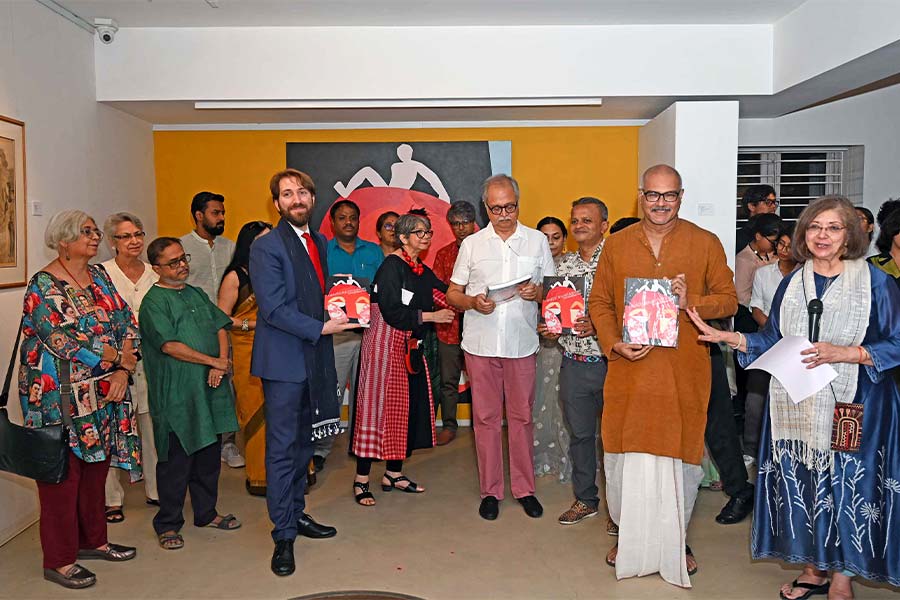
For three days last week, Calcutta celebrated the life, the music and the words of Robert Allen Zimmerman. More proof of how the Jewish boy from Minnesota, known to the world as Bob Dylan, continues to inspire generations. To coincide with the launch of Mike Marqusee?s book Chimes of Freedom: Bob Dylan and the Sixties, there was a three-day event, organised by Seagull Arts and Media Resource Centre.

April 21 saw the launch of the book by the author, an extended version of the original released earlier, and a discussion between Marqusee, musician Nondon Bagchi, Prof Ananda Lal who teaches Dylan?s lyrics at Jadavpur University, and the audience. The next day was a screening of D.A. Pennebaker?s documentary Don?t Look Back. The final event on Saturday was reserved for an evening of Dylan?s music by Anjan Dutt and son Neel, as well as songs inspired by Dylan.

Turbulent times

And I hope that you die/ And your death?ll come soon/ I will follow your casket/ In the pale afternoon/ And I?ll watch while you?re lowered/ Down to your deathbed/ And I?ll stand ?er your grave/ ?Til I?m sure that you?re dead...

? Masters of war

It doesn?t matter what Dylan?s real name is, where he lives, how many wives or children he had. What matters is the artiste, the one who freed us to hate. Pure, unforgiving, unadulterated, unambiguous, unmitigated hatred at a time when popular musicians were singing of love and peace.

Those were turbulent times, and here was a 20-something who made it okay to feel anger born of confusion and frustration. These were some of the strains that emerged from the discussions.

Impossible, enigmatic, perverse, mischievous, an imp, stimulating, inspiring? There are adjectives aplenty to describe Dylan. As Marqusee, a historian of popular culture who has been studying Dylan for the past four decades, says: ?He?s very restless. He asks the right questions, but rarely sticks around for the answers.? However, his inner restlessness is the very source of his inspiration, always questioning, never satisfied.

Dylan spawned a genre of protest music with songs like Blowin? in the wind, The times they are a-changing, All along the watchtower, Highway 61 and Masters of war. Yet, he became a renegade against the protest movement, turning away from it. Sometimes revolutionary, sometimes reactionary, penning words that are universal but with personal appeal and making music that is timeless.

Carry a light bulb

How many years must a mountain exist/ Before it?s washed to the sea?/ Yes, ?? how many years can some people exist/ Before they?re allowed to be free?/ Yes ?? how many times can a man turn his head/ Pretending he just doesn?t see?/ The answer, my friend, is blowin? in the wind/ The answer is blowing? in the wind...

? Blowin? in the wind

In the documentary, when reporters ask him if he has a message for the youth, the then 23-year-old replies with a crooked smile and a cryptic comment: ?Keep a good head and always carry a light bulb.? There were moments when the man of few words said it all with a few questions ? attacking, not defending.

Like when he turns the tables on a journalist, damning the media, which he was always suspicious of ? ?You have too much to lose by printing the truth.?

Another time, he chats with a science student on friendship and relationships. ?When you meet someone, what?s your attitude towards them?? asks the student, who later became the chief of Island Records. ?I don?t like them,? replies Dylan, strumming his guitar.

Shamelessly, gloriously irreverent, that?s Dylan. For instance, amidst the Dylan mania at the Seagull discussion, there was also much griping among fans against a recent Victoria?s Secret lingerie advertisement in which one of the singer?s songs was used.

Dylan drew from American folk tradition, from Muddy Waters and Woody Guthrie, Hank Williams and Gospel music. He, in turn, inspired a new breed of musicians, from Marvin Gaye to Curtis Mayfield, the Beatles to Jimi Hendrix. It was an age of musical revolution, moving with the tide of political upheaval that crossed borders.

?The albums weren?t released here, so we could only copy them from people who were lucky enough to have got it from abroad,? recalls Nondon Bagchi. While the issue of civil rights raged in the US through the 60s and 70s, India and Bengal were being torn apart by post-Independence strife. And Dylan struck a chord in many hearts. ?I went to MusicWorld, where I was told that they sell Dylan everyday, even now,? says Marqusee.

While preachers preach of evil fates/ Teachers teach that knowledge waits/ Can lead to hundred-dollar plates/ Goodness hides behind its gates/ But even the president of the United States/ Must sometimes have/ To stand naked...

? It?s alright ma (I?m only bleeding)

Top
Email This Page