|
| Sohini Sengupta rehearses for Bappaditya |
The dark auditorium of Girish Mancha is empty, barring
a few Nandikar members scattered all over. With the feeble light that filters
in from the stage, one can figure out Tapas Sen hurling instructions about lights
from the front row.
Rehearsals are on in full steam for two new Nandikar
productions to be directed by Goutam Halder ? Abanindranath Tagore?s Bappaditya
and Tarashankar Bandopadhyay?s Chokh Galo.
Featuring the mother-daughter duo, Swatilekha and
Sohini Sengupta, in solo acts, Chokh Galo premieres on April 9 at Girish
Mancha and Bappaditya at the same venue the following day.
?The two roles are completely different; they have
different philosophies. The narrative styles are different, too. Besides, Sohini
and Swatidi have distinct styles,? says Halder, who himself has riveted
viewers with solo performances in Meghnadbodh Kabya and Barda.
The prince?
Halder has assigned the tough job of performing all
the characters in Bappaditya, stretching almost an hour and a half, to
wife Sohini. As she flits in and out of the five personas ? Bappaditya, the three
women he is enamoured of, and the narrator ? Halder sprints from one end of the
auditorium to the front row to correct a step.
?Bappaditya is a very popular text for most
kids and I have always wondered why it has been particularly popular with girls.
Much later, I realised that the character of Bappaditya had certain traits which
women are very fond of,? says Halder, supervising every conceivable aspect of
this production, as also Chokh Galo.
?Here are three different women ? king Salim?s daughter,
the princess of Solanki and Deb Bandar?s daughter ? and all of them are fascinated
by him. Because Bappaditya embodies a combination of femininity and masculine
strength.?
Hence, Halder decided to have only one actor performing
all four characters, plus the narrator. ?For this I needed an actress who could
sing, dance and have the depth to depict the transition of a village boy to a
king. And I don?t think it would have been possible without Sohini,? adds Halder,
as his wife delivers a long dialogue, falters and picks up the cue again.
In between her kathak and martial movements, Sohini
breaks into a folk song, with some support from a chorus. A band of musicians
on stage renders some classical compositions.
?The Rajasthani ambience, the palace, the folklore
and the Muslim background? all this makes you think of classical music,? explains
Halder, grabbing a quick bite before the second rehearsal.
|
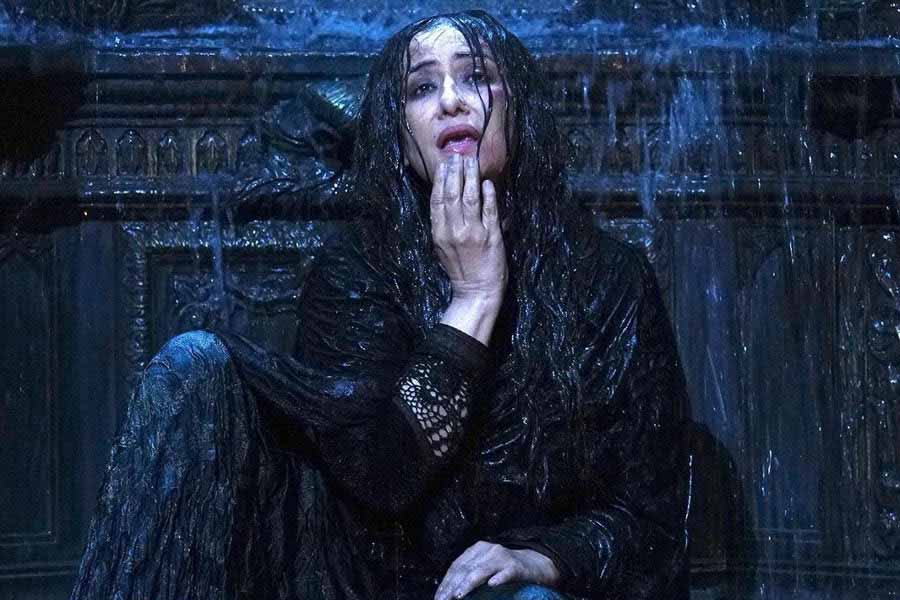
| Swatilekha Sengupta in Chokh Galo.
Pictures by Aranya Sen |
? and the pauper
As the curtains go up on the barren stage landscape,
a beam of light falls on a wrinkly old woman raving and ranting with a begging
bowl in her trembling hands. Yet, it?s not entirely a mad woman?s muttering ?
her words make sense. She is, what society has made her to believe, a witch, and
hence a social outcast.
By the look of it, Swatilekha Sengupta seems poised
to surpass her solo act in Shanu Roy Chowdhury, where Halder had assisted
in directing the production.
?This play is about witch hunting, a social evil prevalent
in our times too. We have a lot of superstitions about eyes, which takes on different
connotations and meanings in different contexts. In Chokh Galo, we see
the woman through the eyes of men and strangely enough, this woman actually believes
that she is a witch. It?s a social commentary on the patriarchal set-up,? says
Halder, who has adapted the play from the original Tarashankar Bandopadhyay story
called Daini.
?For a stage production, I look for a text which is
striking enough as a story. I am not worried about how far it will be adaptable
on stage,? says Halder.
Apart from enacting the witch, Swatilekha will, like
her daughter, don the garb of the narrator as well. ?Kathakata, where a
narrator comments on the play and its characters, is ingrained in our theatrical
tradition and the actor performing this role has to have a very strong philosophy.
Because it turns out to be a process where the performer assesses his worldview
with that of the narrator?s,? adds Halder, who has digitally scored the music
for Chokh Galo.
|