The Telegraph
 
 
ARCHIVES
Since 1st March, 1999
 
THE TELEGRAPH
 
 
Email This Page
THE FREEDOM SONG

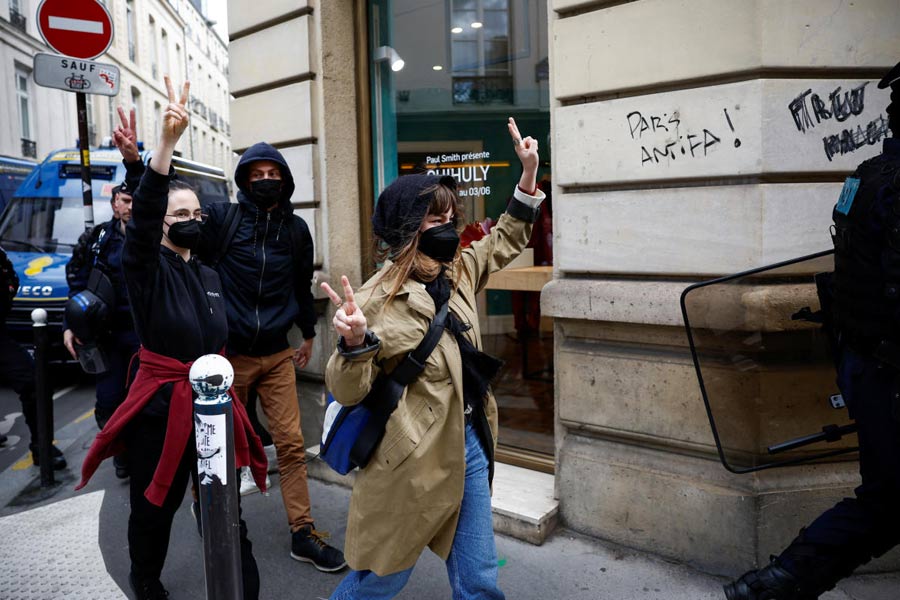
Does the American invasion of Iraq have a silver lining' Is demo-cracy about to spread through west Asia, toppling one odious regime after another' And will they be replaced by moderate, America-loving governments' Paula Dobriansky thinks so. She claims that the non-violent demonstrations in Beirut and the resignation of the pro- Syrian Lebanese government prove her case.

Dobriansky is under-secretary of state for global affairs in the Bush administration. She greeted the demon-strations in Beirut with the following claim: 'As the president noted in Bratislava, there was a rose revolution in Georgia, an orange revolution in Ukraine, and most recently, a purple revolution in Iraq. In Lebanon, we see growing momentum for a 'cedar revolution' that is unifying the citizens to the cause of true democracy and freedom from foreign influence.'

The 'purple revolution' is a phrase invented by Bush ad-ministration to link the Iraqi elections with the spontaneous, non-violent uprisings that have brought democracy to several other countries in the past. Whatever else it may be, Iraq is not a case of spontaneous, non-violent revolution against tyranny. On the other hand, the Lebanese protesters who are demanding the withdrawal of Syrian troops do fit that general pattern.

Long shadow

Lebanon has long had the institutional forms of a democracy, although its deep sectarian divisions ' Maronite Christian, Orthodox Christian, Sunni Muslim, Shia Muslim and Druse ' distorted everything, even the constitution. For the past 15 years, the Syrian intelligence services, backed by a large military force, have had the last word on everything that happened in Lebanon.

The Syrian army first entered Lebanon in 1976 after the outbreak of the Lebanese civil war. Thirteen years later, its continued presence was legitimized by the Taif treaty that brought the war to an end. The Syrians insist that their presence is vital even now to 'stabilize' Lebanon. Unless they pull out, we will never know whether that is true.

Syria's president, Bashir al-Assad, is under severe pressure to withdraw from many quarters but he is under equally strong pressure at home to stay. The revenues that Syria creams off Lebanon help to sustain the moribund economy, and a humiliating defeat in Lebanon could pave the way for a challenge to the Baathist regime in Syria. And some governments in the region fear that a full Syrian withdrawal might turn Lebanon into a playground of Palestinian and Islamist militias.

Divided house

Are the Lebanese responding as one to an example of democratization that has been set by the US in Iraq' The Shia community, which is closely allied to Syria and accounts for almost half of Lebanon's population, has been virtually absent from the Beirut demos and from the talks that have produced a 'united' opposition. As for the example that the US is setting in Iraq, the Lebanese opinion was probably well represented by Walid Jumblatt, the Druse leader. When the Iraqi resistance fired rockets at the Baghdad hotel where Paul Wolfowitz was staying last year, he expressed the wish that the rocket had hit Wolfowitz personally.

Lebanon could come out of this free, prosperous and democratic, or it could slide back into some kind of civil war. The Syrian regime could also fall, though what might replace it is unclear. Even the identities of the people who triggered the current crisis by murdering the former Lebanese prime minister, Rafik Hariri, are not clear.

Long-congealed positions are starting to melt in west Asia, and a wave of something is about to sweep through the area, but it isn't necessarily democracy.

Top
Email This Page