|
|
| In anticipation |
The finance minister, P. Chidambaram, has now an opportunity
to present a full budget for a year, after adequate consideration of all options.
He had been faced by a shortage of time when he presented the budget for 2004-05
in July 2004. This had led to his making an ad hoc additional provision
of Rs 10,000 crore for plan budget support, which meant consequential delays in
allocations and implementation. These are handicaps, owing to shortage of time,
which he will not suffer from in his forthcoming budget effort.
Fortunately, he has already produced a curtain-raiser
with his reports on the Fiscal Responsibility and Budget Management Act as well
as the promised report on subsidies. The former report lays out a view from the
finance minister?s perspective on the Centre?s fiscal outlook so far. While it
had data only for the first six months, it indicated how the revenues and expenditure
were proceeding, tax revenues being less buoyant than expected and capital expenditure
being slack. The explanation was advanced that the allocations were communicated
rather late, with the Appropriation Act being delayed and the planners taking
time to finalize the allotments. The fiscal out-turn was more or less satisfactory,
taking the pluses and minuses together. Regrettably, subsidies were rising overall.
So was non-plan expenditure. The coming budget should target restrictions in both.
What the finance minister offers on budget day has
a mystique, which his earlier pronouncements on the financial situations lack.
Budget day has a sanctity, born out of years of experience of tax-payers in the
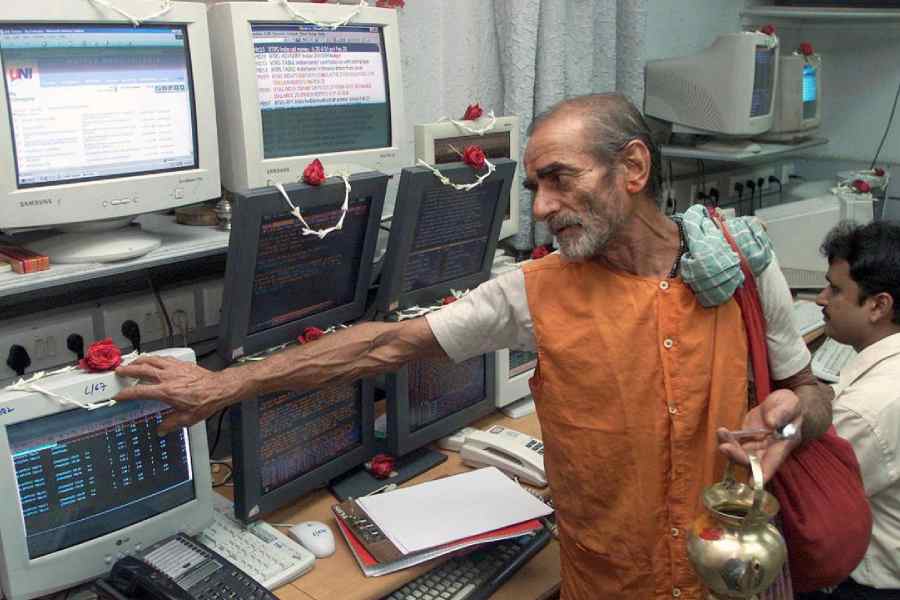
general public. As in all countries, in India, the markets look forward to it
with bated breath. The tax-payers expect the finance minister to be generous with
both tax-cuts and giveaways ? which is illogical but human. The finance minister
has to meet the conflicting demands of many constituencies ? chief among which
are the tax-payer, the corporate, the foreign institutional investor and the foreign
direct investor. I should not leave out the foreign rating agencies. The FIIs
are looking for indications which the budget discloses about growth and stability.
The retail investor, in particular, is hoping that the finance minister will not
rock the boat with market-unfriendly mis-steps, such as the Security Transactions
Tax, which he introduced and modified after the shock effect it caused in July
2004. The markets have, over time, learnt to expect surprises from the finance
minister, but they will be happy not to receive shocks. The finance minister has
been sensitive to what the markets are likely to expect of fear ? witness his
double-quick, albeit prudent, repudiation of Y.V. Reddy?s hint about some possible
restrictive measures on FII flows.
The finance minister has a difficult task at hand
to meet the divergent demands of his coalition partners, who disagree on many
things but agree on only one aspect ? to please the populist palate. The finance
minister has fortunately made a bold attempt to get the privatization window open,
although whether he will be able to carry it out finally depends on the mood of
the coalition partners. He has put forward the carrot of using the proceeds for
social schemes. Money is after all fungible and any additional receipts through
privatization will be of help. In addition to all his existing demands, the finance
minister has to meet the demands of various state governments for relief, arising
particularly from the tsunami-affected states. These are bound to be a serious
challenge for the finance minister.
Yet another task before the finance minister is to
accommodate the recommendations of the Twelfth Finance Commission. The commission
has had the wise leadership of C. Rangarajan, who would, no doubt, have kept in
mind the fiscal travails of the Centre. But, his ?dharma? being to minister to
the needs of states, he is bound to have unveiled a package of measures of assistance
and devolution, which are friendly to states, but without hurting the Centre overmuch.
How will Chidambaram weave in these recommendations into his budget, dovetailing
them with the commitment in the national common minimum programme to proffer large
devolutions to backward states? Surely, the Centre cannot afford too hefty a package
for backward states on the basis of NCMP promises, in addition to the Finance
Commission?s generous allocations for the same states! I do hope the Centre does
not forget the principle that the backwardness of many states is partly because
of the failure of governance, which should not be rewarded unduly, leading to
penalizing the more prudently managed states for their success.
In addition to the above demands, the finance minister
faces the challenge of accommodating the ever-rising demands of defence, given
the continuing slackening in India-Pakistan peace talks and confidence-building
measures. The fact that the spending on defence has increased substantially in
the last two years is evident from the budget numbers. Appetite grows with what
is on the table. There is bound to be demand for more. Defence expenditure is
often considered sacrosanct, but even in defence outlay one has to consider how
much the country can afford. I am reminded in this context of a debate at the
secretary?s level between a redoubtable defence secretary and the finance ministry
in the Eighties. He had pressed for an unconscionably high level of defence capital
outlay citing security threats. It was my privilege to point out on behalf of
the ministry of finance that his threat that he would not be responsible for the
defence of India was not tenable. Because, if his demands were considered, there
may not be any India to defend, given the fiscal chaos, which would destabilize
the country?s economy. This called for intervention by the then prime minister,
Rajiv Gandhi, in favour of a more moderate defence outlay.
I am sure that the present situation would also call
for the healing hand of the prime minister, who is a veteran of many such battles
with the defence ministries. The temptation of stocking up on defence hardware
is all the greater, given the competition of first-world armaments manufacturers,
who display various items of equipment before the top defence echelons of countries
in potential conflict. The answer to such tempting offers lies in the domain of
diplomacy. While it is true that success in diplomacy itself can arise only on
the back of a relative strength in armed forces, it is difficult not to discount
the dangers of a continuing arms race. What matters, however, is that the battle
of the budget will be decided not by the demands of the defence ministry but by
the success of the confidence-building measures in which the two countries ? India
and Pakistan ? are at present engaged.
The finance minister has to deal with the proposal
mooted by the deputy chairman, Montek Singh Ahluwalia, about utilizing the country?s
forex reserves for infrastructure investment. The proposal has triggered a number
of debates with some prominent economists discounting the idea as a disguised
form of monetization. The influential voice of Raghuram Rajan, chief economist
of the International Monetary Fund, has been raised against the idea as he has
debunked the proposal. The prime minister has endorsed the idea. The finance minister
has suggested that it should be limited to financing of imports. The finance minister?s
suggestion does not, however, address the problem of shortage of rupee resources,
which is the deputy chairman?s, and should also be the finance minister?s, concern.
One of the problems posed by critics is that if the
Reserve Bank of India is to lend the forex to the government of India for investment,
it will violate the FRBM provision of not borrowing from the RBI. Again, a doubt
has been raised about the advisability of using what are basically short-term
capital flows for long-term investment in infrastructure. But there are ways out
of both these dilemmas. For one thing, the RBI can invest in equity in the government-sponsored
ventures, like the Industrial Development and Finance Corporation. This route
does not amount to borrowing from the RBI. So, we are out of the FRBM loop. A
special purpose vehicle can be set up in which the RBI can invest part of its
forex reserves. The SPV can, in turn, invest in equities of public sector units
or public-private partnerships, which can then leverage the equity to borrow from
the banking sector. The equity corpus can be the $20 billion and odd, which is
of the order of the stable element in forex reserves, being the total current
account surplus over the last two years, which is evidently continuing to grow.
This itself would be around Rs 80,000 crore or so, which can provide a substantial
equity base to the SPV and catalyse the infrastructure investments in India. Surely,
the above route is far better than going on canvassing abroad for FDI flows into
infrastructure projects ? which anyway seem to find few takers, given our hesitations
and the miserable performance of Dabhol.
All said, budget-making is a work of art. Chidambaram
is an expert at it. Here is to hoping that he will be able to unveil on February
28, 2005, an attractive budget, which will demonstrate to the world that the government
is keen on continuing the reforms and growth impulses. Chidambaram has done it
before and let us hope that this time the budget will prove to be a trendsetter,
pleasing the markets and the masses alike.
|