|
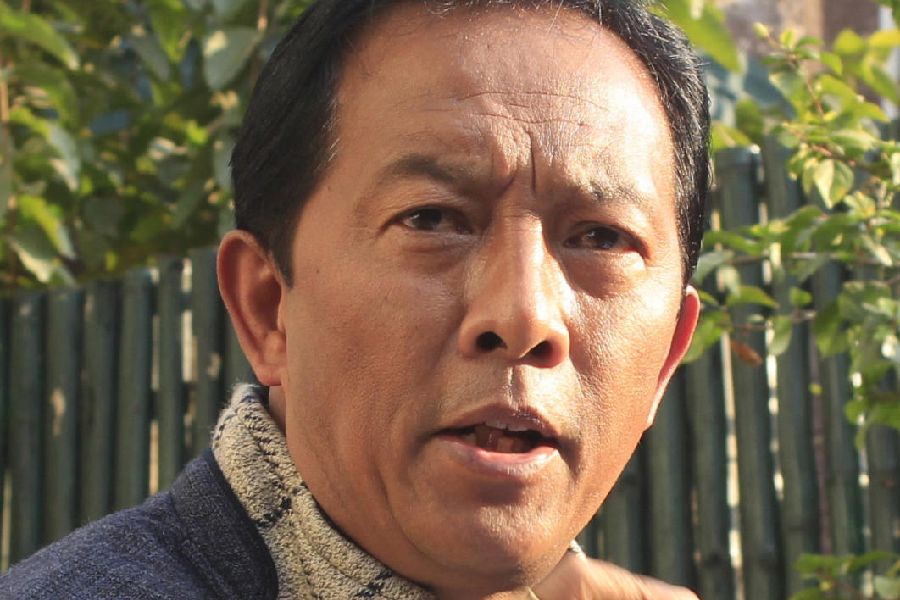
| Redemption song: Bob Marley |
Marley's message of one love People in Brixton, the heart of Britain's Caribbean community ' and indeed millions of his fans across the world ' will be marking Bob Marley's birthday today. Had he lived he would have been 60 but the king of reggae music, who was born in Jamaica in 1945, died of cancer in 1981, aged only 36. An Indian writer friend of mine recalled how he blew away his blues on a night long ago: 'It was 2 am, I was depressed, a girlfriend had left me and I walked into a club in Brixton. Marley had turned up unannounced. He said he was going to sing something new, and began, 'Exodus: movement of Jah people!' I forgot everything.' Though my notebooks are in a mess, I have dug up the one for October, 1998, when, on arriving in Jamaica, I made for the Marley Museum. The tale of his music, his numerous girlfriends and his worship of the 'holy weed' had grown in the telling. I returned to London laden with Marley T-shirts, a copy of his biography, Catch a Fire (which I am reading again), and a pile of CDs. His was the music of black rebellion but he also preached unity, One Love. Personally, I can listen to Exodus, or No, Woman, No Cry again and again (and occasionally do). He was touched by the divine, though he, in turn, helped popularise the idea of Emperor Haile Selassie of Ethiopia as having descended from the God of the Jah people, the displaced people of Africa. Many years earlier, I had sought interviews in a Rastafarian commune in Birmingham which had been raided by the police who, out of sheer spite, had smashed up their treasured framed photographs of Haile Selassie. This was how I learnt that to the Rastas, the Ethiopian ruler had divine powers. They took their name from Ras Tafari, Haile Selassie's name as a young prince before his coronation in 1930. 'Marley's message is as strong as ever,' I caught a first-generation West Indian remark on radio last week. 'It's how to integrate, how to come together, it's one love. Long after I am gone, my children's children and their children, generation after generation will listen to Bob Marley.'
|
| IDENTITY CRISIS: Lisa Ray |
Ray of light The actor Lisa Ray, who is Polish on her mother's side, immediately thought of her maternal grandmother when she heard that the 84-year-old Pope had been taken ill. 'More than my mother, it was my grandmother who brought me up when I was a little girl,' says Lisa, whose father, Salil Ray, is Bengali, and mother Barbara (Basia in her native tongue) Polish. John Paul II, who was the unknown Cardinal Karol Wojtyla from Krakow in 1978 when he was chosen as the first non-Italian Pope in 455 years, 'has been a source of great pride for most Poles', explains Lisa. 'That is the impression my grandmother, who is very traditional and very Polish, gave me,' she adds. Her grandmother, Halina Gallus, who is about the same age as the Pontiff, 'couldn't stay away from Poland', says her granddaughter. 'She now lives in Warsaw and I am just about to go and see her.' The star of the film Hollywood Bollywood admits that even though she has not visited Poland for many years, 'I speak fluent Polish. It's much better than my Hindi. This is because my grandmother spoke no English.' Every time I bump into Lisa, as I did last week, we end up chatting about Poland, which was once part of my beat and where I indeed pursued the Pope when he returned to Krakow and Warsaw. It is a country of extraordinarily civilised people, with an abiding love for music, literature and very political jokes (eg. 'With this Cold War on, the Americans and Russians are willing to fight each other ' right down to the last Pole'). The last time I glimpsed the Pope was in October, 2003, in St Peter's Square, Rome, when he presided over the beatification of Mother Teresa. I saw His Holiness looking baffled when a group of Indian women in orange, white and green saris appeared before him and did what seemed remarkably like a Bollywood dance number with a bit of aarti thrown in. Lisa reminds me that 'the Pope has been a strong influence on my grandmother. She talked about him to me all the time.' Although Lisa was raised as a Catholic in London and in Toronto, she says that she now feels very Indian. 'But there is something very passionate and tragic about being Polish, and I want to go to Poland to reclaim part of my Polish heritage.' Mind games What motivates Raj Persaud, Britain's best known media psychiatrist' We might pick up clues in his next book. 'It's called The Motivated Mind,' discloses Raj, who was born in London of Indian parents from Guyana and Trinidad. According to Raj, whose previous books are Staying Sane and From the Edge, 'motivation explains why some people manage to achieve the impossible. It lies at the heart of the billionaire's success, the Olympic athlete's record and the Oscar-winner's award. But how exactly do we motivate ourselves to achieve that elusive dream' No doubt he wants to sell his book but the crucial factor, Raj argues, is 'understanding the key to success ' the key to fulfilling your dreams and realising all that you desire'. Another question is, 'What motivates Indians' Raj has gained valuable insights from a recent trip to Delhi where he visited call centres to investigate the high levels of stress experienced by their staff. The young men and women who work there are handsomely paid but they have to function in a frenzied performance-related environment. 'We need to become more aware of what we really, really want ' rather than what we say we want ' in order to properly harness our drives and direct them in a way that helps us achieve fulfilment,' says Raj. He adds: 'In truth, the missing ingredient in all our attempts to achieve change is not a chemical or a specific exercise regime but a frame of mind: motivation is the key.'
|
| DANCE DANCE: Actress Mahima Chowdhury at a Nava-ratri festival |
Slim line Watching the Tamasha Theatre Company's revival of Strictly Dandia, it occurred to me that at one level Indians and Pakistanis, Hindus and Muslims, get on very well indeed in Britain. The comedy tells of a Navaratri dance competition when the Lohanas, Patels and Shahs in north London fight it out for the coveted 'Diwali King & Queen' titles. An interloper wins but all hell has broken loose because the victor, 'Raj', is uncovered as Raza ' a 'Slim' (youth slang for Muslim). He loves Preethi, a 'Gujju' girl. The caste and communal jokes could misfire but don't. Everyone laughs. It's all very good-natured. The British Asian arts community, Tamasha especially, has contributed significantly to communal harmony. Tittle tattle A new form of insult has hit the London scene. A Gujarati newspaper editor, extremely annoyed with an Indian friend for continuing to criticise Narendra Modi as the unacceptable face of Hinduism, finally lost patience with him. 'You are a secular fundamentalist,' he spluttered. |